
There are four main female voice types: soprano, mezzo-soprano, alto, and contralto. They differ in where the voice sits most comfortably, how the tone sounds, and how the voice functions through the range — not just in the highest note each can reach.
This page covers all four clearly and directly, with note ranges, tone descriptions, famous examples, and the key distinctions that matter for classification.
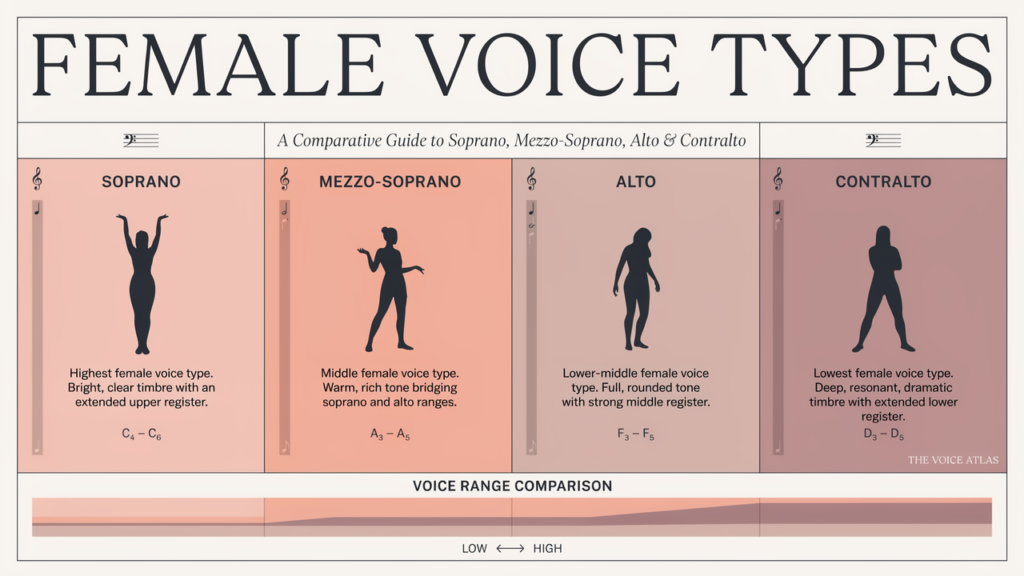
Quick Comparison
| Voice Type | Typical Range | Tessitura | Tone Quality | Rarity |
|---|---|---|---|---|
| Soprano | C4 – C6 | Upper half of range | Bright, clear, powerful high notes | Most common female voice type |
| Mezzo-Soprano | A3 – A5 | Middle register | Warm, rich, versatile | Most common overall in pop/R&B |
| Alto (Choral) | F3 – F5 | Lower-middle register | Dark, warm, rounded | Common in choirs |
| Contralto | E3 – E5 | Low register | Deep, dark, rich | Rarest female voice type (~1% of singers) |
Note: Alto and contralto are sometimes used interchangeably, but in precise usage, the contralto sits slightly lower and darker than the choral alto. In most choir settings, the lowest female voice part is called “alto” regardless of whether individual singers are technically mezzos with strong lower extensions or true contraltos.
Soprano — The Highest Female Voice
Range: C4 (middle C) to C6 (1,046 Hz) and above Tessitura: E4 – A5 — the voice resonates most naturally in the upper half of the range Tone: Bright, clear, forward, powerful in the upper register
The soprano is the highest standard female voice type and the most commonly occurring in formal classification. In choral music, sopranos carry the top melodic line. In opera, the soprano is almost invariably the female lead — the dramatic soprano, lyric soprano, and coloratura soprano are the three main subtypes, distinguished by vocal weight and agility rather than range.
What makes a soprano: The tessitura sits high. Notes above A4 feel natural and resonant; notes below D4 may feel flat or unsupported. The voice projects most powerfully in the upper register. High notes are not effortful — they are where the voice sounds best.
Soprano subtypes:
- Lyric soprano — warm, full tone with a moderate range. The most common soprano subtype in contemporary music.
- Dramatic soprano — heavier, more powerful tone capable of sustained projection at volume. Less agile at the top but more powerful through the middle.
- Coloratura soprano — exceptional agility in the upper register, with a range extending well above C6. The most technically demanding soprano classification.
Famous sopranos: Mariah Carey, Whitney Houston, Beyoncé, Ariana Grande, Celine Dion.
Mezzo-Soprano — The Middle Female Voice
Range: A3 – A5 (220 Hz – 880 Hz) Tessitura: D4 – E5 — the voice sits most comfortably in the mid-register Tone: Warm, rich, darker than soprano but brighter than alto — versatile across a wide range of styles
The mezzo-soprano — “mezzo” means “half” in Italian, making this literally the “half soprano” — sits between the soprano and the contralto. It is the most common female voice type in contemporary pop, R&B, and singer-songwriter music, even when artists are never formally classified.
The distinguishing feature of the mezzo-soprano versus the soprano is not always range — both can often access similar notes — but tessitura. A mezzo’s voice sounds most natural, resonant, and powerful in the mid-register. High soprano notes may be reachable but feel like work; lower notes feel warm and easy. A soprano in the same mid-register range sounds smaller, thinner, or less resonant than they do above A4.
What makes a mezzo-soprano: Mid-range notes feel effortless and full. Notes above B5 feel effortful or require a significant technique adjustment. The voice sounds warmer and heavier than a soprano at the same pitch.
Mezzo-soprano subtypes:
- Lyric mezzo-soprano — the most common subtype. Warm, flexible voice used across opera, musical theatre, and contemporary music.
- Dramatic mezzo-soprano — heavier, more powerful, better suited to sustained forte singing. Rarer than the lyric mezzo.
- Coloratura mezzo-soprano — agile upper register with ornamentation capability. Less common than lyric or dramatic.
Famous mezzo-sopranos: Taylor Swift, Adele, Billie Eilish, Lady Gaga, Alicia Keys, Aaliyah, Barbra Streisand.
Alto — The Lower Female Voice (Choral)
Range (choral): F3 – F5 Tessitura: G3 – D5 — the voice sits comfortably in the lower-middle register Tone: Dark, warm, rounded, with strong lower-register resonance
In choral music, “alto” refers to the lowest female voice part — the second line from the bottom in a standard SATB arrangement. In practice, most singers classified as “altos” in choirs are technically mezzo-sopranos with a strong lower extension rather than true classical contraltos. The label describes the choir part they sing, not necessarily a precise voice type classification.
The choral alto range overlaps substantially with both the mezzo-soprano above and the contralto below. What distinguishes a singer placed in the alto section from one placed in the soprano section is not always the total range but the quality and weight of tone in the lower register — and where the tessitura sits.
What makes a choral alto: Notes in the lower-middle register (G3 to D4) feel resonant and powerful. High soprano notes above G5 feel thin or forced. The voice has a naturally darker quality than a mezzo-soprano even at the same pitch.
Contralto — The Lowest Female Voice
Range: E3 – E5 (165 Hz – 659 Hz) Tessitura: F3 – C5 — the voice sits comfortably in the lowest part of the female range Tone: Deep, dark, rich — unusually heavy and dark in the lower register
The true contralto is the rarest female voice type, estimated at fewer than 1% of female singers. The defining quality is not simply having low notes — many mezzo-sopranos have access to notes below E3 — but having a naturally dark, heavy, rich quality in the lower register that projects without effort and cannot be manufactured through technique alone.
True contraltos are so rare in classical music that many contralto roles in opera are now performed by mezzo-sopranos with darker voices. The opera world sometimes draws no practical distinction between a very low mezzo and a contralto.
What makes a contralto: Notes below E3 feel resonant and natural — not pushed or forced. The voice has a distinctive depth and darkness in the lower register that is immediately recognisable. High soprano notes are often not easily accessible, and the tessitura is firmly in the lower portion of the female range.
Famous contraltos and deep altos: Amy Winehouse, Aretha Franklin (who had significant contralto qualities in the lower register despite an impressive upper extension).
Soprano vs Mezzo-Soprano — The Most Common Confusion
The soprano/mezzo distinction is the most frequently misidentified boundary in female voice classification. Both voice types overlap substantially in range — many mezzos can access soprano territory and vice versa. The classification rests on tessitura, not on the highest note either can touch.
Key differences in practice:
| Soprano | Mezzo-Soprano | |
|---|---|---|
| Comfortable top note | C5–C6 and above | A4–B5 |
| Natural tessitura | Upper half of range | Middle of range |
| Notes below D4 | Feel unsupported or thin | Feel resonant and full |
| High notes above A5 | Feel natural | Require significant effort |
| Tone in mid-register | Lighter, brighter | Warmer, heavier |
A singer who can touch B5 but sounds best between D4 and G5 is a mezzo-soprano whose upper extension reaches soprano notes — not a soprano. A soprano sounds characteristically bright and clear in the upper register; a mezzo in the same notes sounds warmer and heavier.
Mezzo-Soprano vs Contralto — Less Common but Frequently Muddled
Most singers who identify as contraltos are actually mezzo-sopranos with strong lower extension. True contraltos are genuinely rare.
Key differences:
| Mezzo-Soprano | Contralto | |
|---|---|---|
| Comfortable low note | A3 | E3 |
| Natural lower tessitura | Around D4 | Around G3 |
| Tone in lower register | Warm, resonant | Unusually dark and heavy |
| Upper range | A5 accessible | Upper range may be limited |
| Rarity | Common | Under 1% of female singers |
The clearest test: sing notes in the G3–B3 range. A mezzo-soprano can access these notes but they may feel like the outer edge of the comfortable range — they work, but higher notes feel more natural. A contralto in this range feels completely at home — the voice projects naturally and the tone is full and dark.
How to Identify Your Female Voice Type
Voice type is determined by where your voice feels most comfortable and sounds best — not by the highest or lowest note you can reach on a good day.
Step 1 — Find your full range. Use the vocal range test to identify your lowest and highest stable notes.
Step 2 — Find your tessitura. Sing through your range and notice where the voice feels most effortless, resonant, and full. That zone is your tessitura — the most reliable indicator of voice type.
Step 3 — Test your tone in the lower register. Sing notes around D4–A3 and notice whether they feel resonant and natural (mezzo or lower) or thin and unsupported (soprano tendency).
Step 4 — Test your tone in the upper register. Sing notes around A4–C5. Do they feel easy and resonant (soprano tendency) or like a reach (mezzo tendency)?
Step 5 — Compare against the voice type profiles above. Use the voice type test for a guided classification that asks specifically about tessitura and tone rather than range alone.
Using Your Voice Type to Choose Song Keys
Once you know your voice type, you can use it to select or transpose songs into keys that suit your tessitura — not just your total range.
A soprano choosing keys for a song should look for versions where the melody’s highest notes land around A4–C5 as a comfortable ceiling, with the melody spending most of its time in the E4–G5 range.
A mezzo-soprano choosing keys should look for the melody to sit primarily between D4 and E5, with occasional peaks up to A5 rather than consistently high notes.
An alto or contralto choosing keys should look for the melody to spend most of its time below D4, with the low notes feeling resonant and full rather than pushed.
Use the online key changer to shift any song’s key up or down by semitones to find the version where the melody sits in your tessitura. The key for your vocal range guide walks through the matching process in detail.
Frequently Asked Questions
Is mezzo-soprano higher or lower than soprano?
Lower. The soprano has the highest tessitura of the four female voice types. The mezzo-soprano sits below it, with a tessitura that feels most natural in the mid-register rather than the upper register. The contralto and alto sit below the mezzo.
Can a soprano sing mezzo-soprano roles?
Yes, and vice versa, with some limitations. Sopranos can often sing mezzo-soprano repertoire that doesn’t venture too far into the low register. Mezzo-sopranos frequently cover soprano roles if their upper range is sufficient. The deciding factor is usually tessitura — a mezzo singing soprano repertoire will often sound thin at the top, and a soprano singing contralto repertoire will sound unsupported at the bottom.
How rare is a true contralto?
Very rare. True contraltos — those with a naturally dark, heavy quality in the lower register that projects without effort — are estimated at fewer than 1% of female singers. Many singers labelled “contralto” in popular contexts are mezzo-sopranos with strong lower extensions. In opera, genuine contraltos are rare enough that many contralto roles are now routinely performed by low mezzo-sopranos.
Does voice type change with training?
The fundamental voice type — determined by the size and mass of the vocal folds, the shape of the resonating cavities, and the basic anatomy of the instrument — is stable in adult singers. Training develops range, control, and tonal quality but does not change the underlying voice type. A mezzo-soprano with extensive training has a developed mezzo-soprano voice, not a soprano voice. A soprano training for lyric soprano roles does not become a dramatic soprano.
I can sing both high and low — does that mean I’m a mezzo-soprano?
Not necessarily. Being able to access notes from both the soprano and contralto range is common, particularly in trained singers. Voice type is determined by where the voice sounds best and sits most naturally — the tessitura — not by the extreme limits of the range. A singer who can reach C6 but sounds best around D4–G4 is most likely a mezzo-soprano or alto, not a soprano, despite the high upper range.
Related Tools and Guides
Vocal Range Test — measure your exact lowest and highest notes. Voice Type Test — classify your voice type through guided questions. Vocal Ranges — Complete Guide to Every Voice Type — all six voice types explained with Hz data and artist examples. Male Voice Types Compared — tenor, baritone, and bass explained. Online Key Changer — transpose any song to a key that suits your voice type. Key for Your Vocal Range — find the right key for your tessitura. What Is Tessitura — why comfortable range matters more than total range. Choir Vocal Ranges — how female voice types map to SATB choir parts.

Mayer runs Online Pitch Changer (OnlinePitchChanger.com) independently. Mayer maintains the site’s free browser tools for changing the pitch, key and tempo of audio, video and voice, and writes and checks its guides on keys, semitones, transposition and vocal ranges. Each rebuilt tool is tested before release with measured test tones, and app steps in the guides are checked against official manuals such as the Audacity manual and Apple’s GarageBand guide. Audio processed with the tools never leaves the reader’s browser. Mayer is not affiliated with YouTube, Google or any audio software company. For corrections or tool problems, see the Contact page.