
Celine Dion’s vocal range spans approximately B2 to C6 — about three and a half octaves. She is classified as a lyric soprano, and her voice combines the natural brightness and upper-register strength of the soprano type with extraordinary technical precision, breath control, and emotional expressiveness developed through decades of intensive performance.
She is one of the few singers in popular music whose technical foundation is genuinely comparable to classical soprano training — her breath management, intonation consistency, and dynamic control across a wide range of contexts and venues represent a level of technical development uncommon outside the classical world.
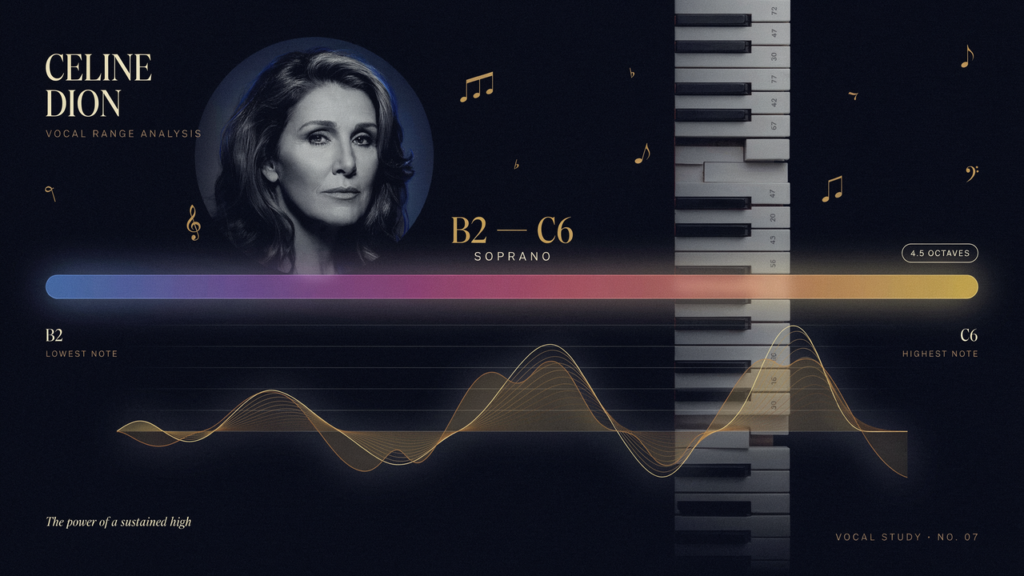
Vocal Range at a Glance
| Lowest documented note | B2 |
| Highest documented note | C6 (soprano C) |
| Approximate span | ~3.5 octaves |
| Voice type | Lyric soprano |
| Tessitura | D4 – A5 |
| Belt ceiling | ~B5 |
| Strongest register | Upper register; powerful sustained soprano C |
Voice Type — Lyric Soprano
Celine Dion is a lyric soprano. Her tessitura — the zone of most comfortable and natural resonance — sits in the D4–A5 range, which is firmly in the soprano upper register. Her voice above G4 has a bright, forward quality with carrying power that is characteristic of the soprano type. Below D4, her voice is present and accessible but thinner than in the upper register.
The lyric qualification reflects the primary character of her voice: warm, flexible, and melodic rather than heavy and dramatic. She is capable of dramatic intensity in her upper register, but the weight of her voice through the middle range is lighter than a dramatic soprano’s.
Technical Characteristics
Breath control. Celine Dion’s breath management is one of her most discussed technical attributes. Her ability to sustain long phrases, shape dynamic arcs across extended held notes, and maintain consistent tone under physical demands — including the marathon residency performances that characterised her Las Vegas shows — reflects exceptional respiratory management.
Intonation. Her pitch accuracy across a wide range of contexts — stadium performances, orchestral accompaniments, intimate ballad settings — is consistently exceptional. This is a trained technical achievement rather than an innate gift; precise intonation under performance conditions requires disciplined breath support.
Dynamic range. From whispered pianissimo to full dramatic forte, Celine Dion manages an unusually wide dynamic range with consistent tone quality throughout. The shape of her dynamic arc — how she builds from soft to loud across a phrase — is one of the most analysed features of her studio recordings.
Upper register power. Her soprano C (C6) is one of the most powerful notes in her arsenal — produced with full resonance and projection, not as a delicate high note but as a sustained, ringing tone that carries across large venues.
Notable Songs
“The Power of Love” (1993) — The full soprano range demonstrated across a classic ballad structure. The climactic high notes are among her most famous.
“My Heart Will Go On” (1997) — The most commercially successful showcase. The sustained phrase structure and the climactic upper notes demonstrate breath control and upper register power simultaneously.
“Because You Loved Me” (1996) — Mid-range focus. Shows the tessitura in its most natural and resonant zone.
“I’m Alive” (2002) — Upper register energy. The sustained B4–Bb5 passages show the belt quality at her peak period.
“Je ne sais pas” (French catalogue) — Her French-language recordings often push further into the soprano tessitura and demonstrate the classical foundation more clearly than her English pop catalogue.
Frequently Asked Questions
What is Celine Dion’s vocal range?
Approximately B2 to C6 — about three and a half octaves. Her working range in most recorded material sits between D4 and A5, with the C6 soprano C appearing in specific climactic passages.
What voice type is Celine Dion?
Lyric soprano. Her tessitura sits in the upper register, her voice carries characteristic soprano brightness above G4, and her technical foundation is comparable to classical soprano training in its precision and breath management.
How does Celine Dion compare to Whitney Houston?
Both are iconic voices of the same era with comparable commercial success. Celine Dion’s voice type is soprano; Whitney Houston’s is typically classified as mezzo-soprano or spinto soprano. Celine’s voice is more classical in foundation and brighter in the upper register; Whitney’s belt zone was arguably more powerful in the A4–D5 range. See Whitney Houston vocal range for the full comparison.
Related Pages
Whitney Houston Vocal Range — contemporary comparison. Mariah Carey Vocal Range — coloratura soprano comparison. Barbra Streisand Vocal Range — lyric soprano comparison. Female Voice Types Compared — soprano, mezzo-soprano, alto explained. Vocal Ranges — Complete Guide — all voice types. Online Key Changer — transpose Celine Dion songs to your key.

Mayer runs Online Pitch Changer (OnlinePitchChanger.com) independently. Mayer maintains the site’s free browser tools for changing the pitch, key and tempo of audio, video and voice, and writes and checks its guides on keys, semitones, transposition and vocal ranges. Each rebuilt tool is tested before release with measured test tones, and app steps in the guides are checked against official manuals such as the Audacity manual and Apple’s GarageBand guide. Audio processed with the tools never leaves the reader’s browser. Mayer is not affiliated with YouTube, Google or any audio software company. For corrections or tool problems, see the Contact page.