
Barbra Streisand’s vocal range spans approximately B2 to E6 — over three octaves. She is classified as a lyric soprano — the most common soprano subcategory — with a voice that has been a benchmark for musical theatre and pop vocal singing since her Broadway debut in the early 1960s.
At her peak, her voice combined extraordinary breath control with the ability to shape long, sustained phrases at very high dynamics — a combination that produces the specific impression of power without effort that her best recordings give. The breath support and the phrasing are the techniques that underpin every other feature of her voice.
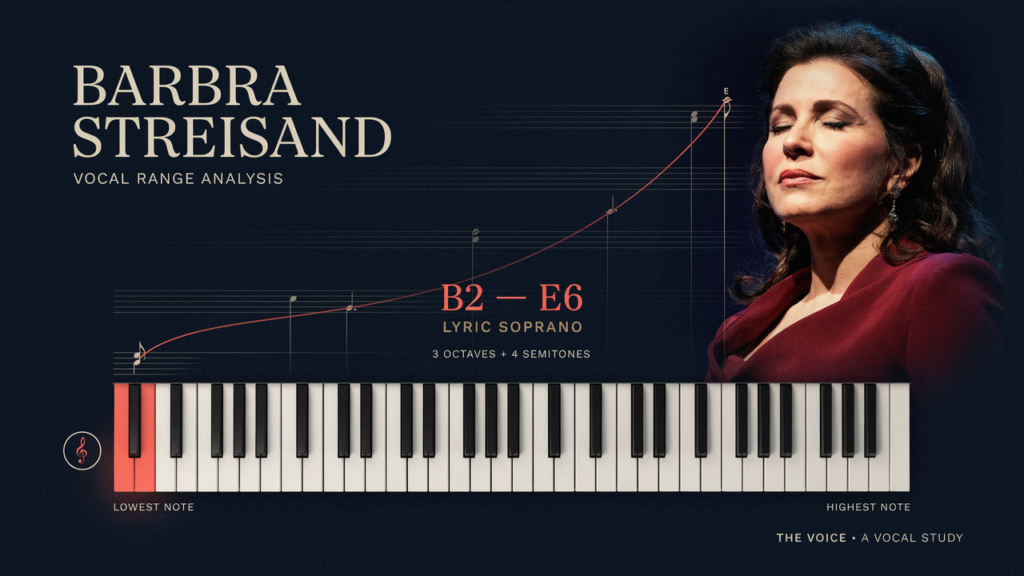
Vocal Range at a Glance
| Lowest documented note | B2 |
| Highest documented note | E6 |
| Approximate span | ~3+ octaves |
| Voice type | Lyric soprano |
| Tessitura | D4 – B5 |
| Belt ceiling | ~C6 |
| Strongest register | Upper mid-range and soprano belt; long sustained phrases |
Voice Type — Lyric Soprano
Barbra Streisand is a lyric soprano. Her tessitura sits in the D4–B5 zone — the upper part of the female range — where her voice is warmest and most resonant. Her lower register below C4 is present and functional but thinner than her upper-register character. Her voice above D4 has a brightness, warmth, and carrying power that is characteristic of the lyric soprano type.
The lyric soprano classification reflects the primary character of her voice: warm, melodic, and sustained rather than heavy, dramatic, or coloratura-agile. Her voice carries warmth through the middle register and brightness and power in the upper register.
Technical Characteristics
Breath control. Widely considered to be Barbra Streisand’s most discussed technical attribute. Her ability to sustain long phrases — across multiple words, through climactic high notes, with consistent tonal quality — is the product of exceptional respiratory management. This technique is what makes her singing sound effortless even at its most demanding.
Phrasing. The shaping of musical phrases — the rise and fall of dynamics within a single phrase, the rhythmic placement of individual words, the use of space — is her primary artistic language. Her phrasing often carries more information than the note itself.
Vibrato. Her vibrato is wide, warm, and controlled — one of the most characteristic features of her tonal identity. It appears reliably on sustained notes and contributes significantly to the warmth of her sound.
Notable Songs
“People” (1964) — The breakthrough showcase. Upper register power and phrase shaping at their most definitive.
“The Way We Were” (1973) — Lyric soprano quality in a pop ballad context. The sustained phrases and the emotional depth of the delivery.
“Evergreen” (1976) — The combination of mid-range warmth and upper register power in a film context.
“Memory” (from Cats, Broadway recording) — Musical theatre showcase. The full soprano range and the sustained climactic phrases.
Frequently Asked Questions
What is Barbra Streisand’s vocal range?
B2 to E6 — over three octaves. Her working range in most recordings sits between D4 and B5, with the most characteristic delivery in the G4–Bb5 zone.
What voice type is Barbra Streisand?
Lyric soprano. Her tessitura and tonal character are characteristic of the lyric soprano type — warm, melodic, and sustained in the upper register.
Related Pages
Celine Dion Vocal Range — lyric soprano comparison. Whitney Houston Vocal Range — contemporary soprano comparison. Soprano Vocal Range — her voice type explained. Female Voice Types Compared — all female voice types. Online Key Changer — transpose Barbra Streisand songs to your key.

Mayer is a music production and audio editing writer specializing in pitch shifting, vocal processing, sound manipulation, and online audio tools for musicians, producers, singers, and creators. He creates practical content focused on pitch changing, vocal editing workflows, audio enhancement, and music production techniques.