
Aretha Franklin’s vocal range spanned approximately G2 to E6 — over three and a half octaves. Her voice type is most accurately described as a powerful mezzo-soprano with dramatic soprano extension, though some analysts apply the classical “Falcon soprano” label — a rare fach describing a dramatic voice with a mezzo-soprano tessitura and soprano upper range and weight.
What no classification fully captures is the particular combination of technical mastery and raw emotional authority that made her voice singular in the history of American music. Her melismatic agility, her belting power, and the immediate emotional impact of every note were not features of the classification — they were features of the singer.
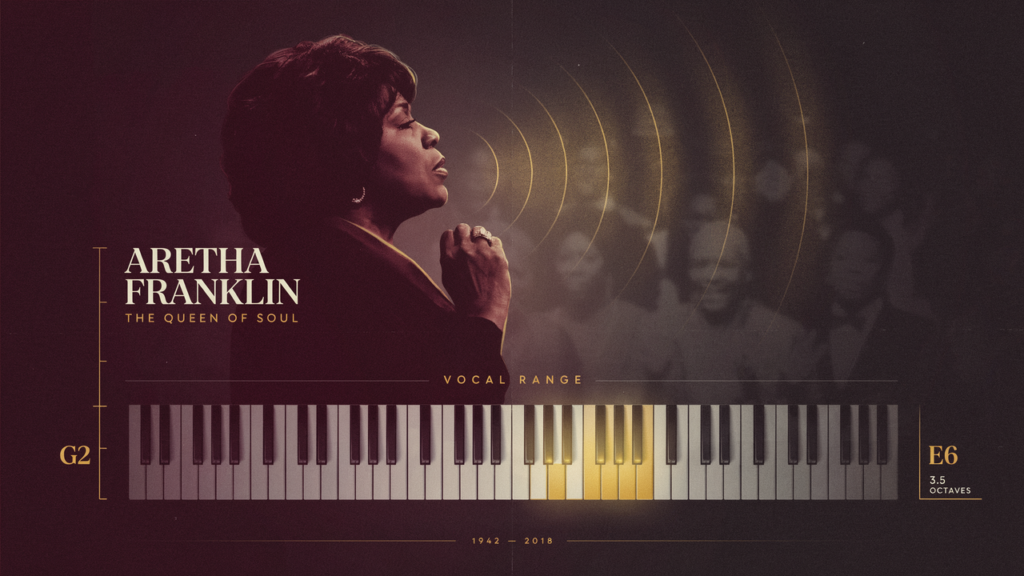
Vocal Range at a Glance
| Lowest documented note | G2 (resonant; some sources cite E2 in studio) |
| Highest documented note | E6 (head voice; D6 belt documented live) |
| Approximate span | ~3.5–4 octaves |
| Voice type | Mezzo-soprano with dramatic soprano extension |
| Tessitura | F3 – C6 (core strength zone) |
| Belt ceiling | ~D6 (mixed/head voice) |
| Strongest register | Upper mid-range belt; powerful gospel runs |
Voice Type — Mezzo-Soprano with Soprano Extension
Aretha Franklin’s classification is one of the most debated in vocal analysis. The facts that make it genuinely complex:
Her tessitura and tonal weight in the lower register are characteristic of a mezzo-soprano — the voice has warmth, darkness, and body in the F3–C4 zone. But her upper range — sustained belting to D6, documented head voice to E6, and melismatic runs that traversed the full range cleanly — exceeded what most mezzos achieve in the upper register.
The “Falcon soprano” label, applied by several serious analysts, describes a dramatic voice with a mezzo-soprano tonal character and lower tessitura, but with the upper range and sustained power of a soprano. Named after the 19th-century French soprano Cornélie Falcon, this rare fach fits Aretha better than either “mezzo” or “soprano” alone.
For practical purposes: her most resonant, natural, and powerful zone was the F3–C6 range — within that zone, every note sounded authoritative, full, and instantly recognisable.
Registers and Technical Characteristics
Lower register (G2–E3): The lowest part of her range is rich and dark. Notes in the G2–C3 zone have a distinctive weight and warmth — unusually resonant for a female voice. Classic FM described her lower register as projecting “with incredible ease and accuracy” down to G2 with a neutral larynx technique that avoided the forced pushing that characterises less skilled singers in this zone.
Middle register (E3–A4): The home territory of her voice — warm, authoritative, instantly recognisable. Her gospel-rooted delivery in this zone — the conversational phrasing, the rhythmic precision of melismatic runs, the vibrato — is the sound most people associate with Aretha Franklin.
Belt zone (A4–D6): Her most celebrated register. Her belting quality up to D6 is one of the most powerful in documented soul and gospel music. The sound retains its characteristic tone — the nasal edge that Classic FM’s vocal analysis noted actually boosts the amplitude of higher harmonics, a feature valued in gospel tradition — right to the ceiling of the belt range.
Melismatic ability: Aretha Franklin’s gospel-rooted runs — fast passages moving through multiple notes — are one of the defining technical features of her voice. They are not decorative: each run carries musical and emotional intention, with notes placed precisely and the movement between them controlled rather than approximate.
Notable Songs That Showcase Her Range
“Respect” (1967) — The mid-range as command. Not about high notes — about the complete authority of a voice operating in its most powerful zone. The assertive chest voice delivery and rhythmic precision define her style.
“(You Make Me Feel Like) A Natural Woman” (1967) — Controlled ascents through the registers. The song covers a wide dynamic range from intimate to powerful, demonstrating her ability to shape a phrase rather than simply project volume.
“Think” (1968) — Rapid register shifts and sustained upper notes. One of the clearest showcases of her combination of speed, precision, and power.
“Amazing Grace” (1972 live recording) — The most complete document of her gospel tradition. The live two-day recording at a Los Angeles church shows every register in a single extended performance — from the lower register harmonics to the full gospel belt.
“I Knew You Were Waiting (for Me)” (1987, with George Michael) — Later career showcase. The belt quality and the melismatic ability are both present, demonstrating the consistency of her technique across decades.
The Gospel Foundation
Aretha Franklin’s vocal technique is inseparable from the African American gospel tradition in which she was trained. She began singing professionally as a child at New Bethel Baptist Church in Detroit, where her father, Rev. C.L. Franklin, was the pastor. Every technical element of her voice — the melismatic runs, the placement, the approach to resonance, the vibrato — reflects gospel pedagogy rather than classical or contemporary pop technique.
This gospel foundation explains both the distinctive qualities of her voice and the reason classical classification systems feel inadequate to describe it. The gospel tradition optimises for emotional authority and congregation connection; classical fach classification optimises for sustained operatic projection. Aretha Franklin achieved both simultaneously.
Frequently Asked Questions
What was Aretha Franklin’s vocal range?
Her documented range ran from G2 to E6 — approximately three and a half to four octaves. Her working range across most performances sat between F3 and D6, where the voice was at its most consistent and powerful.
What voice type was Aretha Franklin?
Most accurately described as a powerful mezzo-soprano with dramatic soprano extension. Some analysts apply the classical “Falcon soprano” label — a rare fach for a dramatic voice with mezzo-soprano tessitura and soprano upper range. Either way, her voice defies clean categorisation in standard six-type frameworks.
How many octaves did Aretha Franklin have?
Approximately three and a half to four octaves, from G2 to E6. This is a genuinely exceptional range, particularly given that every register — from the dark lower notes to the gospel belt at D6 — was produced with full, characteristic tone rather than as a technical extreme.
How does Aretha Franklin compare to Whitney Houston?
Both are iconic voices of related traditions. Whitney Houston’s belt was arguably cleaner and more operatically precise in the A4–D5 zone; Aretha’s had more gospel rawness and was documented to a higher ceiling (D6 vs Whitney’s documented D5). Aretha’s lower register was richer; Whitney’s mid-range had more consistent support. See Whitney Houston vocal range for the full comparison.
Related Pages
Whitney Houston Vocal Range — the closest contemporary comparison. Beyoncé Vocal Range — coloratura mezzo-soprano comparison. Mezzo-Soprano Vocal Range — the standard voice type framework. Soprano Vocal Range — where Aretha’s upper extension reaches. Female Voice Types Compared — all female voice types explained. Vocal Ranges — Complete Guide — full artist and voice type directory. Online Key Changer — transpose Aretha Franklin songs to your key. Vocal Range Test — find out how your range compares.

Mayer is a music production and audio editing writer specializing in pitch shifting, vocal processing, sound manipulation, and online audio tools for musicians, producers, singers, and creators. He creates practical content focused on pitch changing, vocal editing workflows, audio enhancement, and music production techniques.