
Alicia Keys’s vocal range spans approximately A2 to G5 — about two and a half to three octaves. She is classified as a mezzo-soprano, with a warm, soulful mid-range and a powerful belt that has been a consistent feature of her commercial recordings and live performances since her 2001 debut. Her voice and her piano playing are deeply integrated — she is one of the few major artists whose instrument playing is as technically developed as her singing.
Her vocal influence spans multiple generations of R&B and soul singers, and her approach to piano-vocal integration — the voice and the instrument conceived as a single expressive unit — has a distinct lineage from Nina Simone through to her own work.
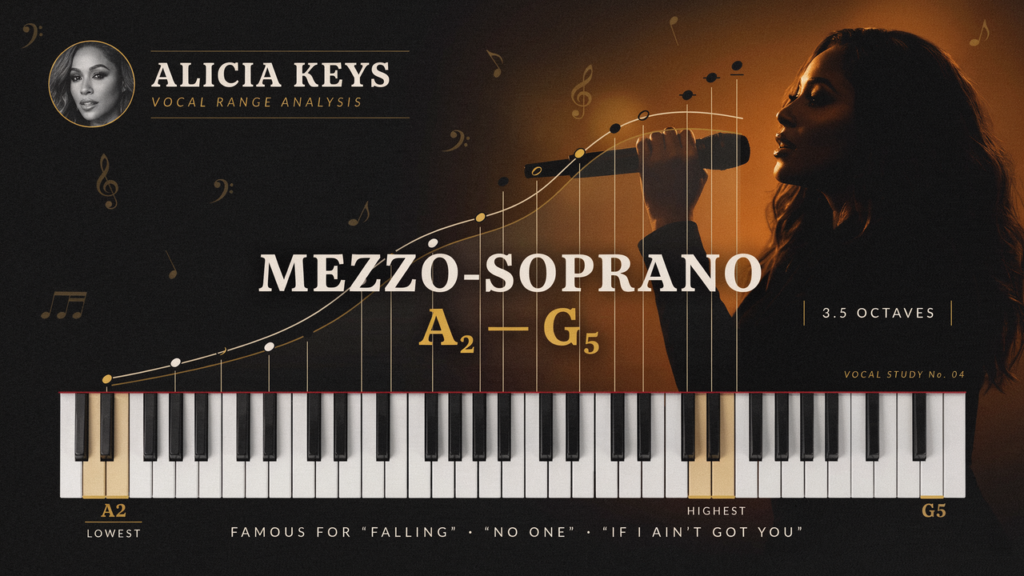
Vocal Range at a Glance
| Lowest documented note | A2 |
| Highest documented note | G5 (head voice) |
| Approximate span | ~2.5–3 octaves |
| Voice type | Mezzo-soprano |
| Tessitura | C4 – E5 |
| Belt ceiling | ~E5 |
| Strongest register | Mid-range soulful belt; warm lower register |
Voice Type — Mezzo-Soprano
Alicia Keys is a mezzo-soprano. Her tessitura sits around C4–E5, where the voice is warmest, most resonant, and most characteristically expressive. Her lower register below D3 is present and accessible; her upper register above E5 is thinner than her mid-range.
Her mezzo-soprano classification is reinforced by where her most powerful and characteristic delivery occurs — the C4–E5 zone, which is the mezzo-soprano tessitura — and by the warmth and body of her tone in that zone compared to higher voice types.
Technical Characteristics
Gospel-soul technique. Her vocal approach draws directly from the gospel-soul tradition — particularly the Baptist church music she grew up with. The phrasing, the melismatic runs, and the approach to emotional delivery all reflect this foundation.
Piano integration. The voice and piano lines are mutually supportive rather than the voice riding over the piano. In her most characteristic performances, the two instruments create a single integrated expression.
Belt quality. Her belt in the Bb4–Eb5 zone is warm and supported, with a gospel-influenced emotional charge. “If I Ain’t Got You” demonstrates this belt quality at its clearest and most sustained.
Vocal control. Her pitch accuracy in live performance — documented across decades of live recordings — is consistently high, which is less common than assumed among major pop artists.
Notable Songs
“Fallin'” (2001) — The debut breakthrough. Mid-range mezzo quality in a gospel-influenced R&B context. Demonstrates the full character of her voice from the first major commercial appearance.
“If I Ain’t Got You” (2003) — The most complete vocal showcase. The piano-vocal integration and the upper belt quality across the full song.
“No One” (2007) — Upper register in a pop-anthem context. Sustained passages in the Bb4–D5 zone.
“Empire State of Mind (Part II)” (2009) — Full range demonstration from lower verses to upper chorus belt.
Frequently Asked Questions
What is Alicia Keys’s vocal range?
A2 to G5 — approximately two and a half to three octaves. Her working range in most recorded material sits between C4 and E5, with the most characteristic delivery in the C4–D5 zone.
What voice type is Alicia Keys?
Mezzo-soprano. Her tessitura and tonal weight are characteristic of the mezzo-soprano voice type — warm and full in the mid-register, with a gospel-influenced delivery approach.
Related Pages
Adele Vocal Range — mezzo-soprano comparison. Beyoncé Vocal Range — coloratura mezzo-soprano comparison. Amy Winehouse Vocal Range — jazz-influenced mezzo comparison. Mezzo-Soprano Vocal Range — her voice type explained. Female Voice Types Compared — all female voice types. Online Key Changer — transpose Alicia Keys songs to your key.

Mayer is a music production and audio editing writer specializing in pitch shifting, vocal processing, sound manipulation, and online audio tools for musicians, producers, singers, and creators. He creates practical content focused on pitch changing, vocal editing workflows, audio enhancement, and music production techniques.