
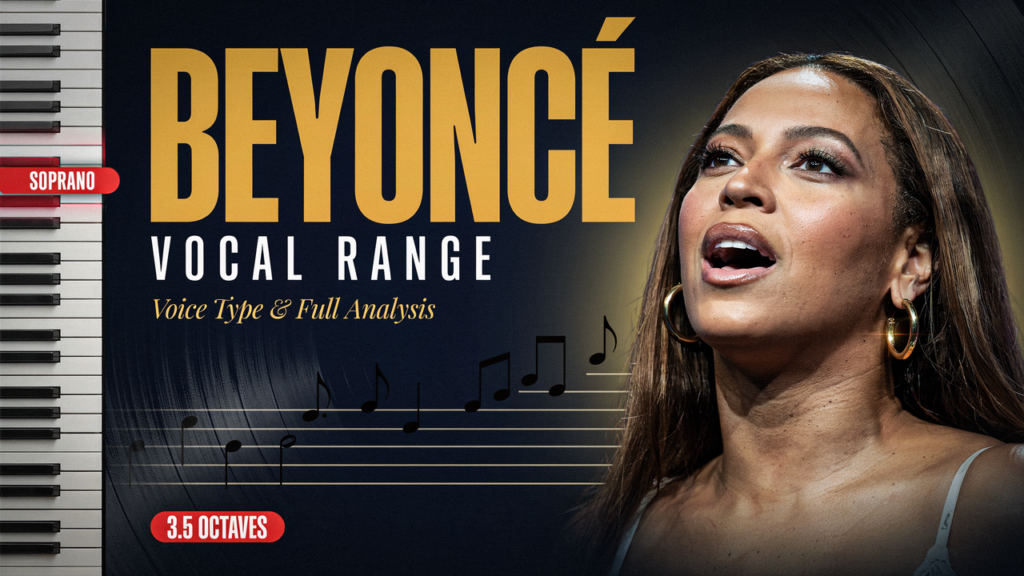
Beyoncé’s vocal range spans approximately G2 to G#5, with head voice and falsetto extensions documented as high as F6 — nearly four octaves total. Her voice type is most consistently classified as a coloratura mezzo-soprano: a mezzo-soprano with exceptional agility and a high register that extends well above the standard mezzo ceiling, while retaining the weight, darkness, and warmth in the lower register that defines the mezzo classification.
She is widely regarded as one of the most technically complete vocalists in contemporary popular music — not because of an extraordinary range ceiling, but because of the combination of technical control, dynamic power, vocal agility, and stamina that she has demonstrated across a career spanning more than three decades.
Vocal Range at a Glance
| Lowest documented note | G2 (studio), Bb2 (consistent live) |
| Highest documented note | G#5 (full belt), F6 (head voice) |
| Approximate span | ~4 octaves |
| Voice type | Coloratura mezzo-soprano |
| Tessitura | C3 – Eb5 |
| Strongest register | Upper mid-range belt; agile head voice |
Voice Type — Coloratura Mezzo-Soprano
The label coloratura mezzo-soprano describes a voice with two distinctive characteristics: the warmth, weight, and lower-register depth of a mezzo-soprano, combined with exceptional agility and an upper register that extends beyond the standard mezzo range.
Beyoncé fits this classification clearly. Her lower register — documented as low as G2 in studio recordings, with a consistent C3 appearing in live performances of “Halo” — has the weight and darkness of a mezzo-soprano rather than the lighter, more soprano-like quality of a higher voice type. But her upper register extends to G#5 in full belt and F6 in head voice, well above the standard mezzo ceiling of A5. The agility she demonstrates in melismatic runs — moving quickly and accurately through complex runs across multiple registers — is the defining characteristic of the coloratura designation.
Some analysts classify her as a dramatic soprano or lyric soprano based on the weight and power of her upper belt. The more accurate classification remains coloratura mezzo-soprano: the power comes from exceptional belt technique rather than from a soprano’s natural tessitura in the upper register.
Registers and Technical Characteristics
Lower register (G2–C3): The deepest part of Beyoncé’s range has a characteristically smoky, dark quality. Notes in this zone appear in background harmonies, spoken vocal moments, and occasional verses. The C3 in live “Halo” performances is one of the most cited examples — produced with full tone and resonance rather than the airy quality that characterises many soprano lower registers.
Middle register (C3–Ab4): Rich, warm, and powerful. The mid-register is where her voice carries its most characteristic soul and R&B weight. This zone is the foundation of most of her ballad work and the source of her distinctive tonal identity.
Upper mid-range and belt zone (Ab4–F5): Beyoncé’s most impressive technical territory. Her belted upper range maintains support, brightness, and ring up to approximately Eb5–F5 — a belt ceiling that is exceptionally high and well-supported. “Love on Top” cycles through multiple key changes that repeatedly push the melody into this zone, demonstrating stamina and consistency at the upper belt limit across multiple repetitions.
Head voice (F5–F6): Well-supported and resonant — notably thicker and more operatic in quality than many contemporary pop singers’ head voices. Beyoncé’s head voice is not a delicate, airy upper register but a full, connected sound that retains power through to its highest documented notes.
Vocal agility: Her melismatic capability — fast, accurate runs across multiple notes and registers — is one of her defining technical features. The runs are produced with clean pitch accuracy and even tone across the registers they cover.
Breath support: Extraordinary. Beyoncé is one of the few vocalists who can maintain full vocal quality while dancing through extended choreography. Her breath control and core support allow sustained phrases, held notes of up to 14 seconds documented, and consistent tone under physical exertion.
Notable Songs That Showcase Her Range
“Love on Top” (2011) — The most famous range demonstration in her catalogue. The song goes through multiple key changes across the final section, climbing higher with each repeat until the melody reaches the upper belt zone. A direct showcase of belt stamina and consistency.
“Halo” (2009) — The ballad that best demonstrates her lower register depth. Live versions routinely show C3 in the lowest sung passages, alongside powerful belted passages in the upper mid-range.
“Dangerously in Love 2” (2003) — Extended vocal runs and transitions across registers. Shows her melismatic technique at its most fluid.
“I Care” (2011) — One of the most technically demanding tracks in her catalogue. Combines chest voice power, head voice height, and sustained belting in a single performance.
“Drunk in Love” (2013) — Lower register focus with a raw, compressed tone. Demonstrates the lower part of her range and her ability to produce an aggressive, grounded quality in the lower-middle register.
Comparing Beyoncé to Artists with Similar Ranges
Beyoncé’s range and voice type put her in the company of powerful mezzo-soprano and soprano vocalists with wide upper ranges. Her belt strength and lower register depth distinguish her most clearly:
- Whitney Houston — soprano with a higher natural tessitura, cleaner upper register tone, less lower-register weight
- Mariah Carey — documented wider range including whistle register; different tonal quality and vocal approach
- Aretha Franklin — similar mezzo classification, similar belt power, different stylistic and gospel approach
For a singer wanting to perform Beyoncé songs, knowing the key relationship is essential. Her recordings sit in a range that suits mezzo-sopranos and heavier sopranos well. Lighter sopranos and altos may need to transpose. Use the online key changer to adjust any backing track to your range.
Frequently Asked Questions
What is Beyoncé’s vocal range?
Beyoncé’s documented vocal range spans approximately G2 to G#5 in full voice, with head voice extensions to F6. This gives her a total span of close to four octaves — a genuinely impressive range by any standard.
What voice type is Beyoncé?
Most vocal analysts classify Beyoncé as a coloratura mezzo-soprano — a mezzo-soprano with exceptional upper register agility and extension. Some analysts classify her as a soprano based on the power of her upper belt. The mezzo classification is more accurate given the weight, darkness, and depth of her lower and mid-range register.
Does Beyoncé use the whistle register?
No verified whistle register notes exist in Beyoncé’s documented performances. Her upper range is achieved through powerful head voice and belt technique rather than the whistle register mechanism. This distinguishes her approach from Mariah Carey and Ariana Grande, whose upper ranges depend significantly on whistle register access.
What key are most Beyoncé songs in?
Beyoncé’s songs span a wide range of keys depending on the album and era. For finding the key of any specific track, use the song key finder. For transposing a song to a different key for your own voice, use the online key changer.
Related Pages
Whitney Houston Vocal Range — soprano comparison. Mariah Carey Vocal Range — coloratura soprano with whistle register. Aretha Franklin Vocal Range — mezzo-soprano comparison. Taylor Swift Vocal Range — lighter mezzo-soprano comparison. Vocal Ranges — Complete Guide — all voice types explained. Online Key Changer — transpose Beyoncé songs to your key. Female Voice Types Compared — soprano, mezzo-soprano, alto comparison.

Mayer runs Online Pitch Changer (OnlinePitchChanger.com) independently. Mayer maintains the site’s free browser tools for changing the pitch, key and tempo of audio, video and voice, and writes and checks its guides on keys, semitones, transposition and vocal ranges. Each rebuilt tool is tested before release with measured test tones, and app steps in the guides are checked against official manuals such as the Audacity manual and Apple’s GarageBand guide. Audio processed with the tools never leaves the reader’s browser. Mayer is not affiliated with YouTube, Google or any audio software company. For corrections or tool problems, see the Contact page.