
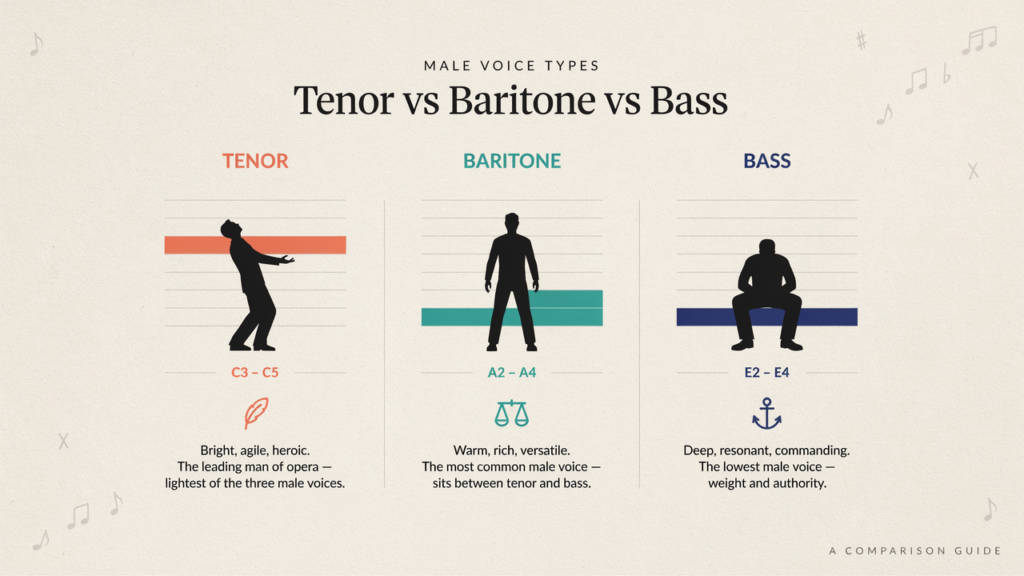
There are three standard male voice types: tenor (highest), baritone (middle), and bass (lowest). The most common point of confusion — the tenor/baritone distinction — is also the most frequently misidentified boundary in male vocal classification, because ranges overlap and many baritones can access tenor notes by pushing.
This page covers all three voice types clearly, with ranges, tessitura, passaggio locations, tone descriptions, and famous examples.
Quick Comparison
| Voice Type | Typical Range | Tessitura | Tone Quality | Rarity |
|---|---|---|---|---|
| Tenor | C3 – C5 | D3 – B4 | Bright, ringing, powerful upper register | Most common male lead voice type |
| Baritone | G2 – G4 | A2 – F4 | Warm, full, rich in the middle register | Most common male voice type overall |
| Bass | E2 – E4 | E2 – C4 | Deep, dark, resonant in the low register | ~8–10% of male singers |
Tenor — The Highest Standard Male Voice
Range: C3 – C5 (130 Hz – 523 Hz), with high tenors extending to E5 or above Tessitura: D3 – B4 — the voice sits most naturally in the upper portion of the male range Passaggio: D4 – E4 (first register break between chest and head voice) Tone: Bright, forward, ringing — with particular clarity and carrying power in the upper register
The tenor is the highest standard male voice and the dominant lead voice in pop, rock, R&B, and opera. In choral music, the tenor carries the top male melodic line. In opera, tenor roles are typically the male protagonists — the most dramatic, demanding, and prominent male parts are written for tenor.
What makes a tenor: Notes above E4 feel natural and resonant rather than strained. The voice sounds characteristically bright and clear in the upper register. The passaggio falls around D4–E4, meaning notes in that zone are where the register transition is most noticeable. Songs that spend consistent time above F4 feel comfortable rather than effortful.
Tenor subtypes:
- Lyric tenor — the most common subtype. Bright, flexible voice with a comfortable range into the upper register. Most pop and rock tenors fall here.
- Dramatic tenor (heldentenor) — heavier, more powerful, capable of sustained loud singing. Less agile at the top but more resonant through the middle.
- Countertenor — a male voice using head voice and reinforced falsetto to reach mezzo-soprano and soprano territory. A distinct classification from the standard tenor.
Famous tenors: Freddie Mercury, Bruno Mars, The Weeknd, Michael Jackson, Prince, Adam Levine, Axl Rose.
Baritone — The Middle Male Voice
Range: G2 – G4 (98 Hz – 392 Hz), with strong baritones extending into tenor and bass territory Tessitura: A2 – F4 — the voice sits most naturally in the mid-range Passaggio: A3 – Bb3 (first register break) Tone: Warm, full, rounded — rich and powerful through the middle register
The baritone is the most common male voice type overall. Most male voices are baritones — positioned between the brightness of the tenor above and the depth of the bass below. The baritone’s versatility across the middle range makes it the most adaptable voice type in contemporary music, even when individual baritone singers are never formally classified as such.
In choral music, the baritone fills the gap between tenor and bass, often doubling the bass line in the lower part of the range or the tenor in the upper part. In opera and musical theatre, baritone roles are often the dramatic authority figures, fathers, villains, or complex protagonists.
What makes a baritone: Notes between A2 and F4 feel resonant, full, and natural. The passaggio falls around A3–Bb3, lower than the tenor’s transition. Notes above G4 may be accessible but feel like they require a technique adjustment; notes below E2 feel pushed or unsupported. The tone through the middle register is warmer and heavier than a tenor at the same pitch.
Baritone subtypes:
- Lyric baritone — the most common subtype. Warm, flexible, melodic voice. Many pop baritones are lyric baritones.
- Dramatic baritone — heavier, more powerful, with greater carrying capacity at volume.
- Bass-baritone — sits between the baritone and bass classifications. Access to lower notes with a darker quality than a standard baritone, but brighter and more mobile than a true bass.
Famous baritones: Ed Sheeran, Harry Styles, Elton John, Bob Dylan, Billy Joel, Freddie Mercury (often classified as baritone-tenor).
Bass — The Lowest Male Voice
Range: E2 – E4 (82 Hz – 330 Hz), with basso profundo singers extending below C2 Tessitura: E2 – C4 — the voice sits comfortably in the lowest male register Passaggio: F3 – G3 (first register break) Tone: Deep, dark, resonant — with distinctive carrying power in the low register
The bass is the lowest standard male voice and one of the rarer voice types — making up roughly 8–10% of male singers. Bass voices provide the harmonic foundation in choral and ensemble music. In opera, bass roles tend to be authority figures, supernatural characters, and older patriarchs — partly because the dark, weighty quality of a bass voice carries a particular kind of gravitas.
What makes a bass: Notes below G2 feel accessible and resonant rather than pushed or forced. The tessitura sits firmly in the lower register. Notes above E4 may be reachable but feel thin or out of character with the natural quality of the voice. The tone is characteristically dark and deep, with a weight and density in the low register that is immediately recognisable.
A bass is not simply a baritone who can sing low notes. The defining quality is the tonal weight and natural centre of gravity of the voice — a true bass sounds distinctly different from a baritone even when both sing the same pitch.
Basso profundo is the deepest bass subtype — capable of sustaining notes below C2 (65 Hz), well below the standard bass range. These voices are genuinely rare.
Famous bass singers: Barry Gibb is often noted for his falsetto, but classic bass voices include Johnny Cash and Barry White in popular music.
Tenor vs Baritone — The Most Common Confusion
The tenor/baritone distinction is the most frequently misidentified boundary in male voice classification. Both voice types overlap substantially in range — many baritones can access notes in tenor territory, and many tenors sound comfortable in baritone range. The classification rests on tessitura and passaggio location, not on the highest note either can touch.
Key differences in practice:
| Tenor | Baritone | |
|---|---|---|
| Passaggio location | D4 – E4 | A3 – Bb3 |
| Notes above G4 | Natural, resonant | Require effort |
| Notes around A2–D3 | Thin or pushed | Resonant and full |
| Tone in mid-register | Bright, forward | Warm, rounded |
| Upper range tessitura | D4 – B4 | A2 – F4 |
The passaggio test is the most reliable indicator. Where a singer’s first register break falls — the point where the voice transitions between chest and head voice — is strongly correlated with voice type. A passaggio around D4–E4 indicates tenor. A passaggio around A3–Bb3 indicates baritone.
The most common misclassification: Many baritones are pushed to sing as tenors in choirs and ensembles because tenors are always in demand. Singing tenor repertoire does not make a singer a tenor — it makes a baritone a singer performing outside their natural tessitura. A baritone whose voice sounds and feels better on notes between A2 and F4 than on notes above G4 is a baritone, regardless of whether they can reach tenor notes by pushing.
Baritone vs Bass — Less Confused but Worth Clarifying
The baritone/bass distinction is less frequently confused than tenor/baritone, but the boundaries still overlap.
Key differences:
| Baritone | Bass | |
|---|---|---|
| Passaggio location | A3 – Bb3 | F3 – G3 |
| Tessitura centre | Around D3 – D4 | Around B2 – B3 |
| Notes below E2 | Pushed or inaccessible | Resonant and natural |
| Tone weight | Warm, medium | Heavy, dark |
| Rarity | Most common male voice | ~8–10% of male singers |
The clearest test: sing notes around E2–G2. A baritone in this zone feels like the outer edge of the lower range — accessible but not resonant or natural. A bass in this zone feels comfortable — the voice has its characteristic depth and fullness here without effort.
Tenor vs Bass — The Widest Range Pair
Tenor and bass represent the two extremes of the standard male voice classification. Their tessituras do not overlap — a tenor’s comfortable zone (D3–B4) sits entirely above a bass’s comfortable zone (E2–C4). They are the clearest and most distinct of the three male voice type pairings.
In choral music, tenors and basses are the “outer voices” of the SATB system — soprano and tenor carry the top lines; bass and soprano carry the structural outer parts. Tenors and basses rarely sing the same notes in harmony; baritones serve as the bridge between them.
How to Identify Your Male Voice Type
Voice type is determined by where your voice sounds best and functions most comfortably — the tessitura — alongside where your passaggio falls, how the tone sounds at a given pitch, and the weight and colour of the voice.
Step 1 — Find your full range. Use the vocal range test to identify your lowest and highest stable notes.
Step 2 — Find your passaggio. Sing scales through your middle range and notice where the voice shifts register — where it naturally wants to move from chest voice to head voice. If that break falls around D4–E4, tenor is the likely classification. Around A3–Bb3 suggests baritone. Around F3–G3 suggests bass.
Step 3 — Find your tessitura. Sing through your range and notice where the voice sounds most natural, resonant, and powerful without effort. That zone is your tessitura — the most reliable indicator of voice type.
Step 4 — Assess your tone at key pitches. Sing a note around D3. Does it feel full and resonant (baritone tendency) or slightly thin and pushed (tenor tendency)? Sing a note around A4. Does it feel natural and bright (tenor) or effortful and stretched (baritone)?
Step 5 — Use the voice type test. The voice type test asks specifically about passaggio location, tessitura feel, and tone quality — a classification approach that goes beyond range alone.
Using Your Voice Type to Choose Song Keys
Tenors typically look for songs where the melody’s highest notes land around A4–C5 as a comfortable ceiling, with the melody spending most of its time in the D3–G4 range.
Baritones should look for the melody to sit primarily between A2 and F4, with the highest notes around G4–Bb4 rather than C5 and above.
Basses need songs with melody lines that spend significant time below D3, with the characteristic depth of the voice featured rather than masked by constantly reaching upward.
Use the online key changer to shift any song’s key to find the version that sits most naturally in your tessitura. The key for your vocal range guide walks through matching song keys to vocal range in detail.
Frequently Asked Questions
Is baritone higher or lower than tenor?
Lower. The tenor has the highest tessitura of the three standard male voice types. The baritone sits below the tenor, and the bass sits below the baritone.
Am I a tenor or baritone if I can reach both?
You are the voice type where your voice sounds best and feels most natural — not the highest type you can access by pushing. If high tenor notes (above G4) require consistent effort and the voice sounds better in the baritone register, the classification is baritone. If the upper register feels natural and resonant without strain, and the passaggio falls around D4–E4, the classification is tenor.
Why are so many baritones called tenors in choirs?
Choirs always need tenors and often have more low voices than high voices. Choir directors sometimes assign baritones to the tenor section for balance. Singing tenor in a choir does not make a singer a tenor voice type — it makes them a baritone performing outside their natural tessitura. Sustained singing significantly above the natural tessitura leads to vocal fatigue and, over time, can strain the voice.
Is bass the rarest male voice type?
Yes, among the three standard types. True basses make up roughly 8–10% of male singers. Baritones are the most common male voice type overall, and tenors are common in popular music lead vocal roles. The rarest male voice classification is the countertenor — a male voice using head voice and reinforced falsetto to operate in the alto to soprano range.
Does voice type change over time?
The fundamental voice type — determined by vocal fold size, mass, and anatomy — is stable in adult singers. Many male voices continue to darken and settle lower through their 20s and into the 30s as the larynx continues to mature after puberty. A young singer classified as a tenor at 18 may settle into a baritone classification by 25. This is normal, and responsible vocal teachers avoid locking in a permanent label too early for young male singers whose voices are still developing.
Related Tools and Guides
Vocal Range Test — measure your full range using your microphone. Voice Type Test — classify your voice type through guided questions. Vocal Ranges — Complete Guide to Every Voice Type — all six voice types with ranges and Hz data. Female Voice Types Compared — soprano, mezzo-soprano, alto, and contralto explained. Online Key Changer — transpose any song to a key that suits your voice type. Key for Your Vocal Range — find the right key for your tessitura. What Is Tessitura — the comfortable range that defines voice type. Choir Vocal Ranges — how male voice types map to SATB tenor and bass parts. Head Voice vs Chest Voice — understanding register transitions and passaggio.

Mayer runs Online Pitch Changer (OnlinePitchChanger.com) independently. Mayer maintains the site’s free browser tools for changing the pitch, key and tempo of audio, video and voice, and writes and checks its guides on keys, semitones, transposition and vocal ranges. Each rebuilt tool is tested before release with measured test tones, and app steps in the guides are checked against official manuals such as the Audacity manual and Apple’s GarageBand guide. Audio processed with the tools never leaves the reader’s browser. Mayer is not affiliated with YouTube, Google or any audio software company. For corrections or tool problems, see the Contact page.