
Axl Rose’s documented vocal range spans approximately F1 to B6 — nearly six octaves — making it one of the widest ranges ever measured in a major rock artist. A 2012 study by concert ticket comparison site Musicnotes analyzed thousands of popular songs and found that Axl Rose had the widest vocal range of any artist in their dataset, with a span that traverses multiple octaves and multiple distinct registers.
He does not have a single voice type — he has multiple. Within a single performance, he moves between a deep baritone-bass in the lowest register, a gritty mid-range rock tenor, a powerful upper belt, and a piercing high falsetto or head voice. This multi-register capability, combined with his specific tonal character and stage presence, produced one of the most distinctive voices in the history of rock music.
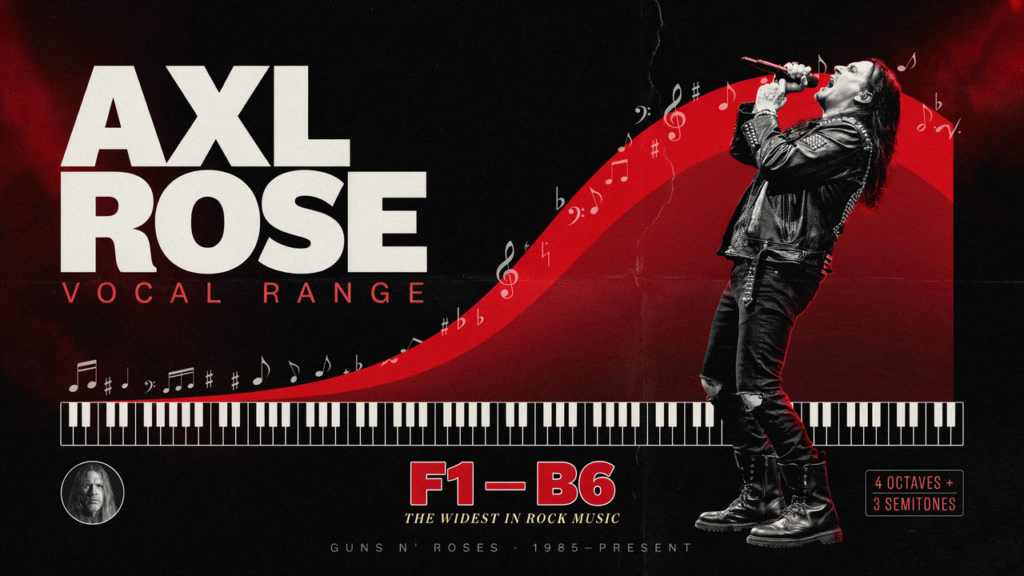
Vocal Range at a Glance
| Lowest documented note | F1 (sub-bass register) |
| Highest documented note | B6 (falsetto/head voice) |
| Approximate span | ~6 octaves |
| Voice type | Multi-register (baritone core with tenor performance range) |
| Primary belt zone | G3 – C5 |
| Strongest register | Mid-range rock belt; upper falsetto |
Multiple Registers — One Voice
Axl Rose’s voice is genuinely unusual because it doesn’t sit cleanly in a single vocal fach. The operational registers:
Sub-bass (F1–B1): The lowest notes documented in his range — a deep, resonant quality that extends into frequencies more associated with bass voices. These appear in specific spoken-singing passages and low vocal lines.
Baritone chest voice (B1–E3): His natural speaking voice and lower singing register. Warm, grounded, darker than his mid-range character.
Mid-range rock belt (E3–C5): His primary performance zone. The gritty, compressed, forward-placed quality that is most associated with his voice in classic Guns N’ Roses recordings. This zone carries the most characteristic tonal quality — the slight roughness, the specific placement, the emotional charge.
Upper head voice/falsetto (C5–B6): His extended upper register, which reaches into soprano territory. Notes in the upper part of this range appear in specific passages across the catalogue.
Technical Characteristics
Tonal variety across registers. The most remarkable technical feature is not the range span alone but how differently the voice sounds in each register — and how he moves between them with apparent ease. Each register has a distinct character that contributes to the overall expressiveness of his performances.
Rock belt technique. His primary belt uses a compressed, gritty, forward-placed quality that is specific to the rock tradition. This is not classical technique — it would not be considered healthy in a classical training context — but it produces the specific tonal character associated with his voice.
Durability questions. The high-intensity rock belt technique Axl Rose employed across decades of stadium performance carries known vocal health risks. His voice has been documented to have changed significantly over the decades, with the upper belt range less consistently accessible in later periods than in his prime.
Notable Songs
“Welcome to the Jungle” (1987) — The definitive showcase. Multiple registers within a single song — from the low, menacing opening notes to the upper register screams.
“November Rain” (1991) — The full ballad range. Shows the mid-range quality and the emotional control available outside the full-throttle rock context.
“Paradise City” (1987) — Upper register focus. The sustained high notes in the chorus are among his most famous.
“Sweet Child O’ Mine” (1987) — Mid-range lyrical delivery. Shows the warmth of his belt zone in a more melodic context.
Frequently Asked Questions
What is Axl Rose’s vocal range?
F1 to B6 — approximately six octaves. This is one of the widest ranges ever documented for a major rock artist. However, not all notes across this span were produced with the same quality or consistency — the primary performance range sits between B1 and C5, with extension registers above and below.
What voice type is Axl Rose?
His natural voice is baritone, but he performs primarily in tenor range and above. His multi-register capability means standard voice type classification is limited in describing his full range — he is best described as a multi-register rock vocalist with a baritone foundation.
Related Pages
Freddie Mercury Vocal Range — rock era baritone-tenor comparison. Adam Lambert Vocal Range — wide-range rock tenor comparison. Brendon Urie Vocal Range — wide-range contemporary rock tenor. Tenor Vocal Range — his primary performance range explained. Male Voice Types Compared — full male voice type guide. Online Key Changer — transpose Guns N’ Roses songs to your key.

Mayer is a music production and audio editing writer specializing in pitch shifting, vocal processing, sound manipulation, and online audio tools for musicians, producers, singers, and creators. He creates practical content focused on pitch changing, vocal editing workflows, audio enhancement, and music production techniques.