
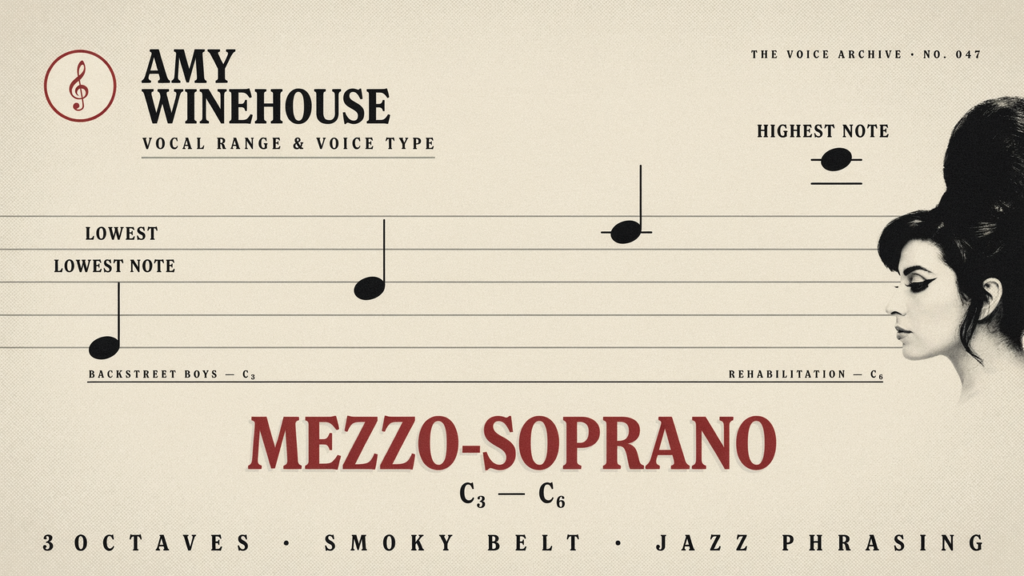
Amy Winehouse’s vocal range spanned approximately G2 to E5 — about two and a half to three octaves. She is classified as a contralto or deep mezzo-soprano — one of the most frequently cited contemporary contralto voices in popular music, with a naturally dark, husky lower register that gave her voice its instantly recognisable character.
Her voice was not defined by its range but by its quality: a rich, slightly rough-edged darkness in the lower and mid-register that was immediately unlike any other voice in contemporary pop when she emerged. The jazz, soul, and blues influences she absorbed shaped a vocal delivery — phrasing, ornament, and emotional directness — that was technically sophisticated without ever sounding studied.
Vocal Range at a Glance
| Lowest documented note | G2 |
| Highest documented note | E5 |
| Approximate span | ~2.5–3 octaves |
| Voice type | Contralto / deep mezzo-soprano |
| Tessitura | A3 – B4 |
| Strongest register | Lower and mid-range; characteristic dark chest voice |
Voice Type — Contralto
Amy Winehouse is one of the most commonly cited contemporary contralto voices. Her tessitura — sitting around A3–B4 — is at the lower end of the standard female range, and the tonal quality of her lower register has the dark, warm weight that characterises the contralto voice type rather than the lighter, brighter quality of a mezzo-soprano.
The classification is not merely about range — many mezzo-sopranos can access notes in the same zone. It is about tonal character: the darkness, the slight roughness, the weight in the G3–C4 zone that immediately identifies the voice as belonging in the lower female register.
Technical Characteristics
Tonal darkness. The most immediate feature of her voice — a dark, slightly rough quality that persists through the mid-range and is not the result of technique but of physiology. This quality is the source of the immediate recognition her voice produces.
Jazz phrasing. Amy Winehouse’s rhythmic placement of notes — the slight delay, the early arrival, the speech-rhythm phrasing that characterises jazz tradition — was her primary musical language. It is not a technique applied over a standard pop delivery; it is the foundation of how she approached melody.
Blues ornamentation. Bent notes, slides, and blue notes — the ornamental vocabulary of the blues tradition — appear throughout her material. These are not decorative; they are semantic. Each bent note carries emotional information.
Restraint as technique. Amy Winehouse did not over-sing. The economy of her note choices — her willingness to deliver a phrase with less rather than more — gave each note more weight than a more maximalist approach would have achieved.
Notable Songs
“Back to Black” (2006) — The most complete showcase of her tonal character. The lower-mid register is where the song lives, and the voice is at its most characteristic.
“Rehab” (2006) — Mid-range and rhythmic phrasing. The jazz-influenced delivery at its most direct.
“Valerie” (live) — Shows the full range in a more upbeat context. The lower register and the brighter head voice notes are both audible.
“Love Is a Losing Game” (2006) — Ballad. Emotional directness through restraint rather than power.
“Tears Dry on Their Own” (2006) — Motown-influenced. Shows the stylistic breadth her voice supported.
Frequently Asked Questions
What was Amy Winehouse’s vocal range?
G2 to E5 — approximately two and a half to three octaves. Her working range in most recorded material sat between A3 and C5, with the most characteristic vocal quality in the G3–B4 zone.
What voice type was Amy Winehouse?
Contralto or deep mezzo-soprano. The classification is genuinely debated — some analysts say contralto based on her tonal weight in the lower register; others say deep mezzo-soprano based on the tessitura. Either classification is defensible; she sits at the boundary between the two.
Related Pages
Brandy Vocal Range — mezzo comparison. Adele Vocal Range — mezzo-soprano comparison. Contralto Vocal Range — the rarest female voice type explained. Mezzo-Soprano Vocal Range — the adjacent classification. Female Voice Types Compared — all female voice types. Online Key Changer — transpose Amy Winehouse songs to your key.

Mayer is a music production and audio editing writer specializing in pitch shifting, vocal processing, sound manipulation, and online audio tools for musicians, producers, singers, and creators. He creates practical content focused on pitch changing, vocal editing workflows, audio enhancement, and music production techniques.