
The Weeknd’s vocal range spans approximately F2 to G#5 in chest and mix voice, with head voice extensions documented to C6 — about three to three and a half octaves total. His voice type is a light lyric tenor, confirmed by both Wikipedia’s article on him and multiple vocal analysts. He is known for his extraordinary falsetto control, his Michael Jackson and Prince influence, and a production aesthetic that places the voice within a specific sonic environment — dark, atmospheric, synthetic — that is as much a part of his vocal identity as the voice itself.
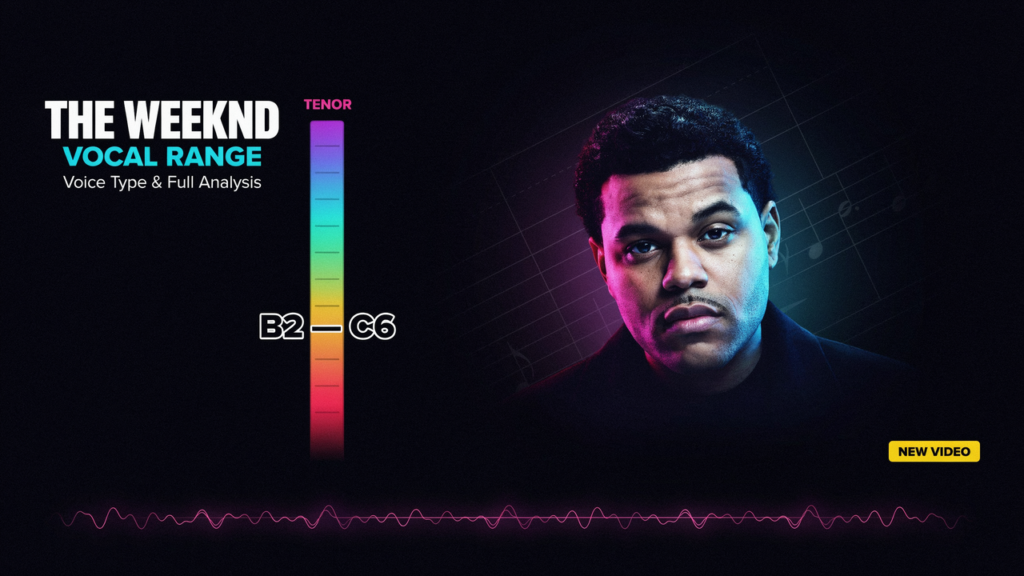
Vocal Range at a Glance
| Lowest documented note | F2 |
| Highest documented note | C6 (head voice) |
| Approximate span | ~3–3.5 octaves |
| Voice type | Light lyric tenor |
| Tessitura | D3 – B4 |
| Belt ceiling | ~G#5 (in chest/mix) |
| Strongest register | Falsetto; upper mid-range mix |
Voice Type — Light Lyric Tenor
The Weeknd is a light lyric tenor. His voice carries the characteristic brightness and forward quality of the tenor type in the D3–B4 zone, with a natural tessitura that sits comfortably in that range. The “light” qualifier reflects the relatively low weight of his voice — he is not a heavy dramatic tenor but a lighter, more agile voice with a youthful, bright quality that his production style amplifies.
His voice type aligns with his cited influences: Michael Jackson and Prince are both tenors with extraordinary falsettos and light, agile voices in the mid-to-upper range. The Weeknd’s vocal approach is a direct continuation of this lineage — the same brightness, the same falsetto-centred upper register, the same integration of vocal quirks and stylistic ornaments.
Technical Characteristics
Falsetto — the signature instrument. The Weeknd’s falsetto is his most analysed and discussed vocal attribute. It is not a thin, disconnected falsetto but a full, supported, resonant upper register that sustains with power and emotional weight. His falsetto in “The Hills,” “Earned It,” and “Sacrifice” demonstrates a quality that most male singers spend years trying to develop.
The key technical element is breath support. Falsetto requires more precise airflow management than chest voice — too much air breaks the mechanism, too little loses the tone. The Weeknd’s falsetto is supported almost like a normal singing tone, just lighter — the product of developed technique rather than natural gift alone.
Melisma and ornamentation. Classic FM’s analysis notes his use of “Arabic-influenced melismas” — rapid passages through multiple notes on a single syllable that add rhythmic and emotional complexity. These appear throughout his catalogue and reflect the R&B and soul tradition he works in, alongside a specific Middle Eastern musical influence connected to his Ethiopian heritage.
Mix voice. His ability to blend chest and head voice in the G4–C5 zone gives him access to a wide dynamic and tonal range in that register — from a lighter, head-voice-influenced mix to a more powerful, chest-dominant sound. This flexibility allows him to move quickly between registers without audible breaks.
Vocal control at soft dynamics. Like SZA and Billie Eilish in female vocal terms, The Weeknd demonstrates that soft singing is often harder than loud singing. His quieter passages in ballads like “Call Out My Name” and “Prisoner” show precise pitch control and tonal consistency at low volumes.
Michael Jackson and Prince Influence
The Weeknd has explicitly cited Michael Jackson and Prince as his primary vocal influences, and both influences are audible throughout his catalogue:
From Michael Jackson: the light, bright tenor quality in the modal voice; the precise rhythmic placement of vocal ornaments; the integration of grunts, shrieks, and vocal punctuation with the melodic material; the smooth falsetto-to-chest transitions.
From Prince: the use of register switching as a primary expressive technique; the willingness to let the falsetto dominate extended passages; the incorporation of vocal theatrics into a production identity.
See Michael Jackson vocal range and Prince vocal range for the full analyses of his two primary influences.
Notable Songs That Showcase His Voice
“The Hills” (2015) — Falsetto showcase. The entire song demonstrates the power, control, and emotional weight of his upper register. The darker, atmospheric production frames the falsetto in its most characteristic context.
“Earned It” (2015) — Smooth transitions between mix and falsetto. Shows the lyrical, sustained quality of his upper register in a more traditional ballad framework.
“Can’t Feel My Face” (2015) — Chest voice and mix. Demonstrates the E3–B4 zone in a more propulsive, upbeat context.
“Blinding Lights” (2019) — The most commercially successful showcase. D3–A4 melody range, sitting squarely in his comfortable tessitura. The clarity and precision of delivery across repeated listens shows the consistency of his technique.
“Save Your Tears” (2020) — Full range demonstration. The song moves from lower chest voice in the verses through to falsetto passages, covering most of his working range across a single track.
“Sacrifice” (2022) — F#4–B5 range. Upper register focus with falsetto as the primary voice throughout.
“Call Out My Name” (2018) — Emotional ballad delivery. Demonstrates the power of his approach at lower dynamics — the emotional intensity at soft volumes.
Singing The Weeknd Songs — Key Considerations
The Weeknd’s songs are frequently described as “surprisingly hard to sing” — a pattern he shares with SZA. The challenges are not primarily range but register management:
The falsetto-heavy passages require genuinely developed head voice technique. Attempting them with pushed chest voice produces a strained, uncharacteristic sound. The transitions between mix and falsetto need to be smooth — abrupt breaks are immediately audible in a style built on seamlessness.
For singers with a strong falsetto and a light to moderate tenor or high baritone voice, his songs sit in a comfortable range. For lower baritones and basses, transposing down by 2–4 semitones often places the melody in a more manageable zone without losing the character of the songs. Use the online key changer to apply the shift to any backing track.
Frequently Asked Questions
What is The Weeknd’s vocal range?
Approximately F2 to G#5 in chest and mix voice, with head voice extensions to C6 — about three to three and a half octaves total. His working range in most recorded material sits between D3 and G#5, with falsetto appearing regularly above B4.
What voice type is The Weeknd?
Light lyric tenor. His Wikipedia article explicitly identifies him as having a “light-lyric tenor vocal range and falsetto.” The classification reflects the bright, forward, agile character of his voice and the natural placement of his tessitura in the D3–B4 zone.
Why is The Weeknd so hard to sing?
The primary challenge is the falsetto technique. His falsetto is supported and full — it requires developed head voice mechanics rather than the thin, disconnected falsetto most singers can produce without training. The transitions between registers also need to be smooth, and his conversational, ornament-heavy phrasing requires attention to rhythmic detail that most singers underestimate.
How does The Weeknd’s voice compare to Michael Jackson?
Both are light lyric tenors with extraordinary falsettos and a soul/funk-influenced ornament approach. The differences: Jackson’s voice carried slightly more weight in the mid-range and his register transitions were smoother (the connection between registers is arguably Jackson’s most outstanding technical feature). The Weeknd’s falsetto is arguably stronger in terms of sustained power in the upper register. Both share the integration of vocal theatrics — grunts, shrieks, stylistic ornaments — with melodic material.
Related Pages
Michael Jackson Vocal Range — primary vocal influence; light lyric tenor comparison. Prince Vocal Range — primary vocal influence; falsetto comparison. Bruno Mars Vocal Range — lyric tenor comparison. Sam Smith Vocal Range — countertenor falsetto comparison. Male Voice Types Compared — tenor, baritone, bass explained. Vocal Ranges — Complete Guide — all voice types with ranges. Online Key Changer — transpose The Weeknd songs to your key. Vocal Range Test — find out how your range compares.

Mayer runs Online Pitch Changer (OnlinePitchChanger.com) independently. Mayer maintains the site’s free browser tools for changing the pitch, key and tempo of audio, video and voice, and writes and checks its guides on keys, semitones, transposition and vocal ranges. Each rebuilt tool is tested before release with measured test tones, and app steps in the guides are checked against official manuals such as the Audacity manual and Apple’s GarageBand guide. Audio processed with the tools never leaves the reader’s browser. Mayer is not affiliated with YouTube, Google or any audio software company. For corrections or tool problems, see the Contact page.