
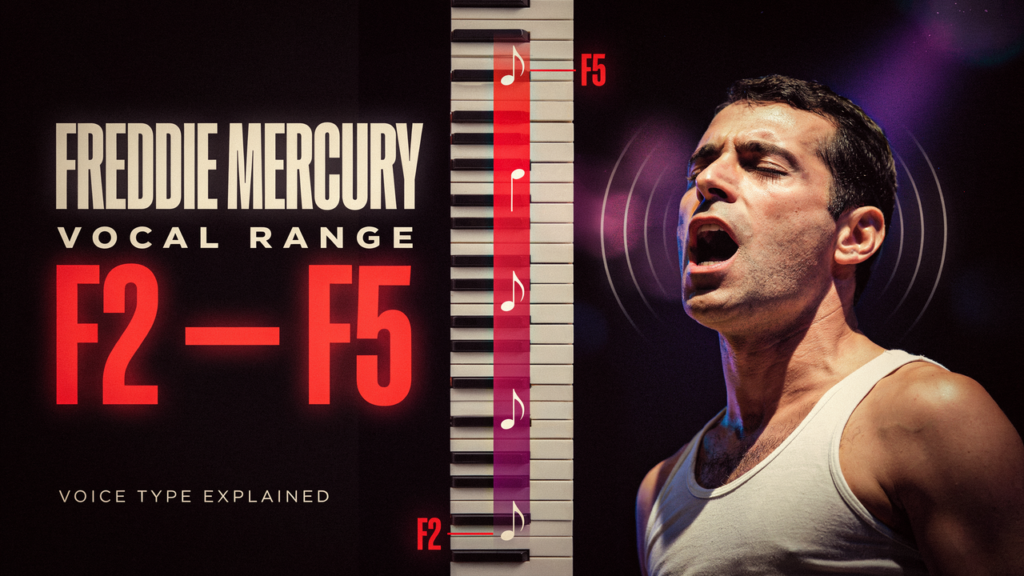
Freddie Mercury’s vocal range spans approximately F2 to F5 — just over three octaves. His voice type sits at the intersection of baritone and tenor: he had the natural weight and lower resonance of a baritone but sang in the tenor register with power and consistency that few baritones can achieve. He is often classified as a dramatic baritone-tenor — a baritone who sang as a tenor — or sometimes simply as a tenor given his consistent performance in that register.
A 2016 scientific study published in the journal Logopedics Phoniatrics Vocology analysed recordings of Mercury’s voice and identified his mean speaking fundamental frequency as approximately 117.3 Hz — lower than most professional baritones — but documented his extraordinary vibrato rate, subharmonics production, and a growl technique that created phonation at multiple frequencies simultaneously.
Vocal Range at a Glance
| Lowest documented note | F2 |
| Highest documented note | F5 (live); higher in studio |
| Approximate span | ~3+ octaves |
| Voice type | Baritone-tenor (sang as dramatic tenor) |
| Tessitura | G3 – F4 (natural); performed consistently to B4 |
| Strongest register | Upper mid-range; exceptional stage projection |
Voice Type — Baritone-Tenor
The baritone-tenor classification reflects the reality of Freddie Mercury’s voice: a natural baritone who trained himself to sing consistently in tenor territory. His speaking voice fundamental frequency of ~117 Hz sits firmly in baritone range. His performance range, however — the notes he consistently produced with full tone and power in live settings — extended to Bb4 and beyond, which is tenor territory.
This combination — natural baritone weight with consistent tenor performance — is unusual and technically demanding. It requires exceptional breath support, a well-managed passaggio, and the specific muscle coordination that allows a heavier voice to sustain high notes without losing tone quality. Mercury demonstrated all of these across decades of live performance, often under physically demanding stage conditions.
The Vibrato Study
The 2016 Logopedics Phoniatrics Vocology study found that Mercury’s vibrato oscillated at approximately 5.4–7.8 Hz — within the normal range for classical singers — but with an unusually wide modulation of pitch that gives his vibrato its distinctive trembling, emotionally charged quality. The study also noted his use of subharmonics — a phonation technique that adds tones an octave below the fundamental, creating the distinctively rich, complex texture of his voice at full volume.
Technical Characteristics
Stage projection. Queen performed extensively in large venues without in-ear monitors and with minimal vocal amplification by contemporary standards. Mercury’s projection — the ability to fill large spaces with consistent tone — was exceptional. This was the product of trained technique rather than simply a powerful voice.
Vibrato. His vibrato is one of the most distinctive in rock — wide, oscillating, and emotionally immediate. It is a trained vibrato that became a core part of his expressive identity rather than a natural vibrato that emerged without training.
Tonal versatility. Mercury could move from delicate, piano falsetto passages to full-throated operatic belts across the same song. The dynamic and tonal range of his voice — not just the pitch range — is what most analysts cite as its defining quality.
Showmanship integration. Mercury is one of the rare singers whose physical performance enhanced rather than compromised his vocal delivery. His stage movement, microphone technique, and audience interaction were integrated with his vocal approach rather than existing separately from it.
Notable Songs
“Bohemian Rhapsody” (1975) — The most complete showcase of his vocal capabilities. The opera section demonstrates his ability to switch rapidly between bass, baritone, and tenor registers with consistent tone. The final ballad section shows his sustained mid-range quality.
“We Are the Champions” (1977) — Stadium anthemic delivery. The B4 notes in the chorus demonstrate the tenor reach at full resonance.
“Somebody to Love” (1976) — Gospel-influenced. Shows the gospel call-and-response approach and the belt quality across the full mid-range.
“Don’t Stop Me Now” (1978) — Agility and energy. Demonstrates the upper range at pace rather than in sustained phrases.
“The Show Must Go On” (1991) — Recorded at the end of his life when his voice was significantly compromised by illness. Its emotional impact given the context makes it one of the most discussed vocal performances in rock history.
Frequently Asked Questions
What was Freddie Mercury’s vocal range?
Approximately F2 to F5 — just over three octaves. His working range in most Queen recordings sits between G2 and Bb4, with the characteristic tenor reach of B4–C5 appearing in specific songs.
Was Freddie Mercury a tenor or baritone?
A baritone-tenor — a natural baritone who sang consistently in the tenor register. His speaking voice fundamental frequency (~117 Hz) places him in baritone range, but his performance consistency at tenor pitches is well-documented. He is most accurately described as a dramatic baritone who sang as a tenor.
How many octaves did Freddie Mercury have?
Approximately three octaves, from F2 to F5. Claims of larger ranges circulate online but are not consistently supported by documented performance evidence. Three octaves is genuinely impressive for a male voice operating at the intensity and volume that Queen’s performances demanded.
Related Pages
Axl Rose Vocal Range — multi-octave rock vocalist comparison. Adam Lambert Vocal Range — Queen’s current vocalist comparison. Elton John Vocal Range — contemporary peer baritone comparison. Male Voice Types Compared — tenor, baritone, bass explained. Vocal Ranges — Complete Guide — all voice types. Online Key Changer — transpose Queen songs to your key.

Mayer runs Online Pitch Changer (OnlinePitchChanger.com) independently. Mayer maintains the site’s free browser tools for changing the pitch, key and tempo of audio, video and voice, and writes and checks its guides on keys, semitones, transposition and vocal ranges. Each rebuilt tool is tested before release with measured test tones, and app steps in the guides are checked against official manuals such as the Audacity manual and Apple’s GarageBand guide. Audio processed with the tools never leaves the reader’s browser. Mayer is not affiliated with YouTube, Google or any audio software company. For corrections or tool problems, see the Contact page.