
Barry Gibb’s vocal range spans approximately E2 to G5 — about three octaves. He is classified as a baritone with an exceptionally developed falsetto — a speaking and modal voice that sits in the lower-middle male range, combined with an upper falsetto extension that defines the sonic identity of the Bee Gees at the height of their commercial success.
His is one of the most immediately recognisable voices in the history of popular music — not because of range extremes, but because of the specific quality of his falsetto and the way it was deployed in the disco and pop context of the late 1970s.
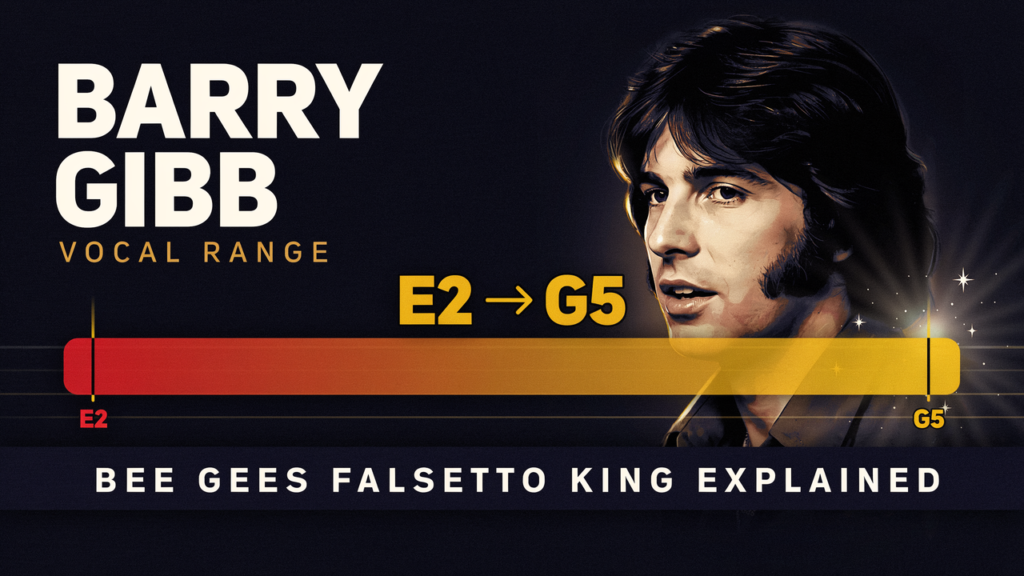
Vocal Range at a Glance
| Lowest documented note | E2 |
| Highest documented note | G5 (falsetto) |
| Approximate span | ~3 octaves |
| Voice type | Baritone with exceptional falsetto development |
| Tessitura | A2 – E4 (chest); D4 – G5 (falsetto) |
| Strongest register | Falsetto; emotional mid-range belt |
Voice Type — Baritone with Extraordinary Falsetto
Barry Gibb is a baritone. His speaking voice and natural modal voice sit in the lower-middle male range — warm, full, with the characteristic weight of the baritone type. His songs in the lower register demonstrate this quality clearly.
What makes him exceptional is the development of his falsetto. His falsetto is not thin or disconnected — it has a warm, urgent, forward quality that carries emotional weight comparable to his chest voice. The signature sound of the Bee Gees in their “Stayin’ Alive” and “Night Fever” era is built almost entirely on this falsetto — a specific tonal quality that no other singer has replicated with the same commercial success.
The Falsetto — What Makes It Distinctive
Barry Gibb’s falsetto has several characteristics that distinguish it from the typical male falsetto:
Urgency. His falsetto carries a forward, urgent quality — it does not float or drift but pushes forward with rhythmic intention. This is a product of his specific approach to breath support and the stylistic demands of the material.
Warmth. Most male falsettos thin out and lose tonal body in the upper register. Gibb’s retains warmth through the D4–G5 zone — a relatively unusual quality.
Emotional directness. The falsetto functions as his primary emotional register — the high notes carry the peak of the song’s emotional content rather than serving as a technical display.
Notable Songs
“Stayin’ Alive” (1977) — The definitive showcase. The falsetto carries the entire lead vocal line, with the specific tonal quality most associated with his voice.
“Night Fever” (1977) — Sustained falsetto quality across a full song. Shows the stamina and consistency of the upper register.
“How Deep Is Your Love” (1977) — The chest voice quality in a ballad context. Shows the baritone register at its warmest and most intimate.
“More Than a Woman” (1977) — Full range. The movement between chest and falsetto registers across the song demonstrates the span of his working range.
Frequently Asked Questions
What is Barry Gibb’s vocal range?
E2 to G5 — approximately three octaves including his extensive falsetto. His working range in most recorded material sits between the lower chest voice (E2–D4) and the extended falsetto (D4–G5).
What voice type is Barry Gibb?
Baritone with exceptional falsetto development. His natural modal voice is baritone; the falsetto that defines the Bee Gees sound is a developed upper register built on that baritonal foundation.
Related Pages
Elton John Vocal Range — baritone contemporary comparison. Billy Joel Vocal Range — baritone comparison. Sam Smith Vocal Range — countertenor falsetto comparison. Baritone Vocal Range — his voice type explained. Male Voice Types Compared — full male voice type guide. Online Key Changer — transpose Bee Gees songs to your range.

Mayer is a music production and audio editing writer specializing in pitch shifting, vocal processing, sound manipulation, and online audio tools for musicians, producers, singers, and creators. He creates practical content focused on pitch changing, vocal editing workflows, audio enhancement, and music production techniques.