
Whitney Houston’s vocal range spans approximately C#3 to D#6 — about three octaves and a major second. Her voice type is most accurately described as a spinto soprano or a powerful mezzo-soprano, depending on which analytical framework is applied. Her vocal coach confirmed the mezzo-soprano classification; many analysts argue for spinto soprano based on the power, size, and weight of her voice in the upper mid-range.
What is beyond debate is the quality and consistency of her voice at its peak — particularly the sustained, powerful belt in the A4–D5 zone that produced notes like the B4 in “I Will Always Love You,” widely regarded as one of the most powerful single notes in the history of recorded popular music.
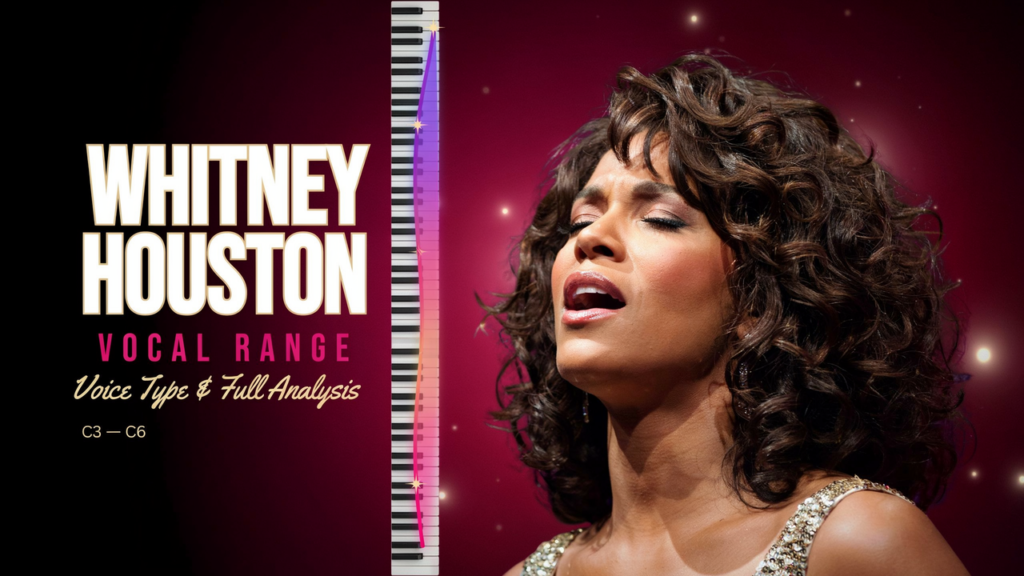
Vocal Range at a Glance
| Lowest documented note | C#3 |
| Highest documented note | D#6 (head voice) |
| Approximate span | ~3 octaves + major second |
| Voice type | Spinto soprano / powerful mezzo-soprano |
| Tessitura | A4 – D5 (primary strength zone) |
| Belt ceiling | ~D5 (with full power and resonance) |
| Strongest register | Upper mid-range belt |
Voice Type — Spinto Soprano or Mezzo-Soprano?
The debate exists because Whitney Houston’s voice does not fit cleanly into either category. The facts:
For mezzo-soprano: Her vocal coach classified her as a mezzo-soprano. Her tessitura does not sit as high as a typical soprano — she is not most comfortable above D5. Her lower register has the warmth and body of a mezzo. Her voice below G4 has more weight than a typical soprano.
For spinto soprano: A spinto soprano is characterised by a balance of lyrical sweetness and dramatic power, with a voice capable of sustaining full resonance at high volume in the upper register. This describes Whitney Houston’s voice in the A4–D5 zone precisely. The size and carrying power of her voice at A4–D5 exceeds what most mezzo-sopranos can produce.
The most honest answer: her voice defies clean classification in the standard six-type system. She is most accurately described as a powerful mezzo-soprano with spinto soprano characteristics — particularly in her belt zone.
Technical Characteristics
The belt. Whitney Houston’s belt in the A4–D5 zone is the defining technical feature of her voice. The B4 in “I Will Always Love You” — produced at full resonance, with consistent tone, sustained for several seconds, without vibrato initially and then released into controlled vibrato — is one of the most technically demanding and emotionally powerful moments in recorded pop. The consistency with which she reproduced this quality across live performances is what separates her from artists who can occasionally hit comparable notes.
Tone quality. The timbre of her voice at peak quality — warm, clear, and overwhelmingly present — is her most discussed attribute. Notes in the A4–D5 zone carry a quality that is instantly recognisable and immediately emotionally impactful.
Melisma and runs. Her gospel-influenced vocal runs are fast, accurate, and emotionally charged. Unlike many of her contemporaries who deploy runs as ornamentation, her runs carry emotional weight — each run tells a story rather than demonstrating technique for its own sake.
Breath support and stamina. Her ability to sustain powerful notes for extended durations — a 16-second sustained note has been documented — while maintaining consistent tone reflects exceptional breath support and core engagement.
Notable Songs
“I Will Always Love You” (1992) — The definitive Whitney Houston vocal. The sustained B4 belt, the gospel-inflected melisma through the bridge, and the sustained resonance across the full song constitute a complete demonstration of every technical element discussed above.
“I Have Nothing” (1992) — Climactic high note near C6, delivered with flawless power after sustained mid-range belting throughout.
“Greatest Love of All” (1986) — The 16-second sustained note. Mid-range consistency and emotional control across the full song.
“The Star-Spangled Banner” (1991 Super Bowl) — Widely regarded as the definitive performance of the national anthem. Demonstrates the full weight and presence of her voice in a single extended solo.
Frequently Asked Questions
What was Whitney Houston’s vocal range?
Approximately C#3 to D#6 — about three octaves and a major second. Her working range sat between C#3 and G#5, with the primary strength zone between A4 and D5.
What voice type was Whitney Houston?
Most accurately described as a spinto soprano or a powerful mezzo-soprano. Her vocal coach confirmed mezzo-soprano. Analytical frameworks based on power and upper-register weight suggest spinto soprano. She represents one of the clearest cases of a voice that defies standard classification.
How does Whitney Houston compare to Mariah Carey?
Both are iconic voices of their era with comparable cultural impact. Mariah Carey’s documented range is wider — approximately F2 to G7, over five octaves, including whistle register. Whitney Houston’s documented range is smaller but her belt zone power is arguably stronger than Carey’s at equivalent pitches. The two voices are different instruments: Carey’s is lighter and more agile with extreme upper extensions; Whitney’s is heavier and more powerful with a shorter but more concentrated belt range. See Mariah Carey vocal range for the full comparison.
Related Pages
Mariah Carey Vocal Range — contemporary comparison. Beyoncé Vocal Range — coloratura mezzo comparison. Aretha Franklin Vocal Range — gospel tradition comparison. Celine Dion Vocal Range — soprano comparison. Vocal Ranges — Complete Guide — all voice types with ranges. Online Key Changer — transpose Whitney Houston songs to your key.

Mayer runs Online Pitch Changer (OnlinePitchChanger.com) independently. Mayer maintains the site’s free browser tools for changing the pitch, key and tempo of audio, video and voice, and writes and checks its guides on keys, semitones, transposition and vocal ranges. Each rebuilt tool is tested before release with measured test tones, and app steps in the guides are checked against official manuals such as the Audacity manual and Apple’s GarageBand guide. Audio processed with the tools never leaves the reader’s browser. Mayer is not affiliated with YouTube, Google or any audio software company. For corrections or tool problems, see the Contact page.