
Adam Lambert’s vocal range spans approximately A2 to C6 — over three and a half octaves. He is classified as a countertenor — a male voice that operates primarily in head voice and reinforced falsetto to reach the mezzo-soprano to soprano register — combined with a powerful chest voice that extends the lower range well into baritone territory. This combination gives him one of the widest and most versatile ranges of any male vocalist in contemporary rock and pop.
His technical facility across the full range — the control, the power, the precision of his runs, and the seamless connection between registers — makes him one of the most complete vocalists in contemporary popular music by any technical standard.
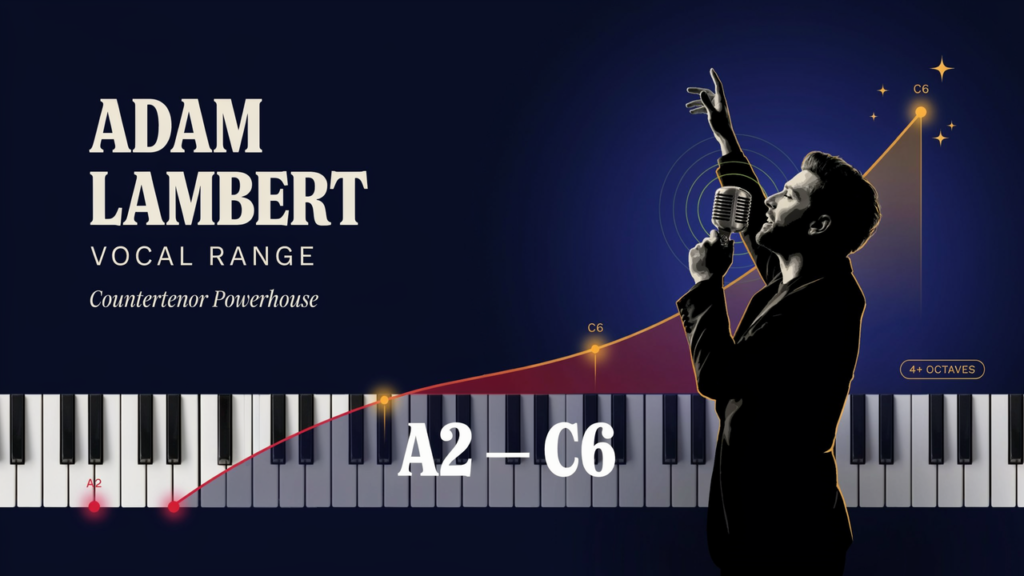
Vocal Range at a Glance
| Lowest documented note | A2 |
| Highest documented note | C6 |
| Approximate span | ~3.5+ octaves |
| Voice type | Countertenor (with powerful chest voice) |
| Tessitura | E3 – B4 (chest); C4 – A5 (head voice) |
| Strongest register | Full-range power; belt to C5; head voice to C6 |
Voice Type — Countertenor
Adam Lambert is most accurately classified as a countertenor — a male voice that uses head voice and reinforced falsetto as a primary register to access the mezzo-soprano to soprano range. His upper register reaches C6 — soprano C — with genuine resonance and control.
What distinguishes him from other male countertenors in popular music is the additional capability of a powerful chest voice. His lower register, from A2 to approximately Bb4, is produced in modal (chest) voice with full, resonant tone. He can belt Bb4 and C5 in a way that most countertenors — who favour head voice throughout — cannot. This gives him simultaneous access to both the power of a heavy rock tenor and the upper extension of a soprano.
Technical Characteristics
Belt power. His belt in the Bb4–C5 zone is one of the most powerful in contemporary rock. It is produced with full chest or mixed voice resonance and carries the emotional charge associated with the climax of a rock performance.
Head voice quality. His head voice and reinforced falsetto in the C5–C6 zone are resonant and well-supported — not the thin, breathy quality of an underdeveloped falsetto but a full, connected sound.
Melismatic precision. His runs — demonstrated extensively in his American Idol performances and across his solo catalogue — are executed with precision comparable to the best contemporary R&B vocalists.
Range transitions. The movement between his lower chest voice and upper head voice is managed smoothly. The two registers sound connected rather than like separate instruments.
Notable Songs
“Mad World” (American Idol, 2009) — The performance that introduced his full range to a mainstream audience. Upper register quality and emotional control simultaneously demonstrated.
“Whole Lotta Love” (with Queen) — Belt power showcase. His performances with Queen demonstrate the full intensity and range of his rock belt in live performance.
“Ghost Town” (2015) — Studio showcase of the full range across a pop production.
“Aftermath” (2009) — Head voice quality in a ballad context.
Frequently Asked Questions
What is Adam Lambert’s vocal range?
A2 to C6 — over three and a half octaves. His working range covers both powerful low-register chest voice and extended upper register head voice, giving him one of the widest practical ranges in contemporary rock.
What voice type is Adam Lambert?
Countertenor. He operates primarily in head voice and reinforced falsetto for his upper register while maintaining a powerful chest voice in the lower-to-mid range — a combination that is relatively rare and gives him exceptional versatility.
Related Pages
Brendon Urie Vocal Range — wide-range rock vocalist comparison. Axl Rose Vocal Range — multi-octave rock voice comparison. Sam Smith Vocal Range — countertenor comparison. Tenor Vocal Range — related male voice type. Male Voice Types Compared — full male voice type guide. Online Key Changer — transpose Adam Lambert songs to your key.

Mayer is a music production and audio editing writer specializing in pitch shifting, vocal processing, sound manipulation, and online audio tools for musicians, producers, singers, and creators. He creates practical content focused on pitch changing, vocal editing workflows, audio enhancement, and music production techniques.