
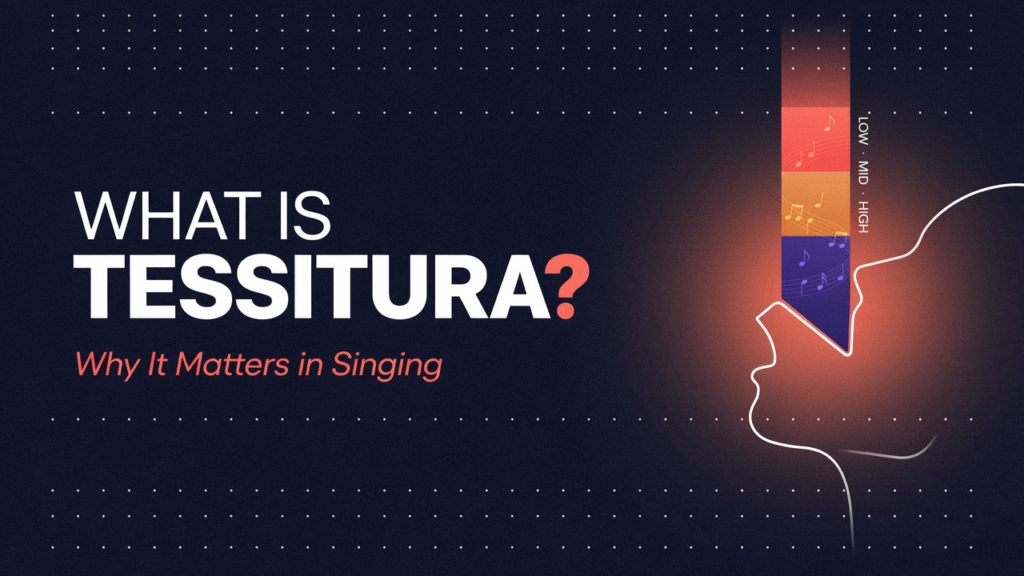
Tessitura is the range of notes where a voice or instrument sits most comfortably and consistently—not the highest or lowest notes possible.
In singing, tessitura describes where the voice sounds best, feels easiest, and can sustain music over time without strain. It is one of the most important concepts in voice classification, repertoire choice, and vocal health.
Tessitura is the range where your voice sounds best and feels easiest to sing. It matters because voice type, vocal health, and song choice are based on comfortable notes, not extreme highs or lows. Singing outside your tessitura causes strain.
Why Tessitura Is So Often Misunderstood
Many people encounter the word tessitura in music class or choir without a clear explanation. It is frequently confused with range, reduced to a dictionary definition, or ignored entirely in favor of extreme high or low notes.
This misunderstanding leads to common problems:
- Singers misidentify their voice type
- Music is chosen that causes fatigue
- Voices are pushed outside their natural comfort zone
Understanding tessitura solves many of these issues.
Tessitura vs Range: The Critical Difference
This distinction is essential.
Range refers to the total span of notes a singer or instrument can produce—from the lowest possible note to the highest possible note.
Tessitura refers to where most of the music actually sits and where the voice is comfortable for long periods.
A singer might technically reach very high or very low notes, but if most of the music feels tiring, strained, or unstable, that area is not their tessitura.
In practical terms:
- Range answers “What notes can I hit?”
- Tessitura answers “Where does my voice work best?”
Our site functions as a song pitch editing tool for beginners.
What Tessitura Means in Singing
In singing, tessitura describes:
- Where the voice feels easiest
- Where tone quality is most consistent
- Where stamina is highest
- Where long phrases can be sustained comfortably
A role, song, or choral part may not include extreme notes at all, yet still feel exhausting if it sits too high or too low for the singer’s tessitura.
This is why two singers with the same range may experience the same piece very differently.
Why Tessitura Matters More Than High or Low Notes
Many singers focus on “top notes” or “low notes” as proof of ability. This is misleading.
A singer is not defined by:
- One impressive high note
- One unusually low note
They are defined by where the voice functions consistently and healthily.
Tessitura determines:
- Voice type classification
- Appropriate repertoire
- Choir placement comfort
- Long-term vocal health
Ignoring tessitura often leads to chronic fatigue and stalled progress.
Tessitura and Voice Types
Tessitura is one of the primary factors used to classify voices.
For example:
- A singer who can sing low notes but feels best in the middle range likely has a middle tessitura
- A singer who can sustain high passages easily has a higher tessitura
- A singer whose voice consistently settles low without effort has a low tessitura
This is why voice types cannot be determined by range alone. Tessitura explains why many singers are misclassified when only pitch extremes are considered.
Tessitura in Choir vs Tessitura in Solo Singing
Choir settings often hide tessitura issues.
In choirs:
- Singers are assigned parts for balance
- Music is shared among many voices
- Individuals can rest or blend when uncomfortable
As a result, a singer may survive in a part that does not match their tessitura.
In solo singing:
- There is no place to hide
- Tessitura mismatches become obvious
- Fatigue appears quickly
This is why singers often discover their true tessitura only when they begin solo work.
Tessitura in Music Beyond Singing
Tessitura applies to instruments as well.
For instruments:
- The full range may be large
- The tessitura is where tone, control, and agility are best
Composers consider tessitura when writing music that is playable, expressive, and sustainable. Writing too high or too low for too long—even if technically possible—creates strain.
The same principle applies to voices.
Does Tessitura Change Over Time?
Yes—but not in the way many people expect.
Tessitura can shift gradually due to:
- Physical maturation
- Vocal training
- Changes in technique
- Aging
However, tessitura cannot be safely changed by force. Trying to push the voice higher or lower than its natural comfort zone does not alter tessitura—it creates tension.
Young singers, especially teenagers, often experience tessitura changes as the voice matures. This is one reason early voice classification is unreliable.
Common Myths About Tessitura
Myth: Tessitura is just another word for range
Reality: Tessitura is about comfort and consistency, not extremes
Myth: Tessitura only matters in opera
Reality: Tessitura matters in choir, musical theatre, pop, and speech
Myth: You can change tessitura by practicing extremes
Reality: Tessitura reflects vocal structure and function, not effort
Myth: Tessitura never changes
Reality: It can shift naturally over time, but slowly and safely
How to Identify Your Tessitura (Safely)
Instead of testing extremes, ask practical questions:
- Where does my voice feel most relaxed?
- Where can I sing for a long time without fatigue?
- Where does my tone sound most stable?
- Where do phrases feel sustainable rather than effortful?
These answers matter far more than isolated high or low notes.
A qualified vocal teacher is the best guide in identifying tessitura. Choir placement, internet quizzes, and range tests are unreliable substitutes.
Why Tessitura Is Central to Vocal Health
Singing outside your tessitura for extended periods can lead to:
- Vocal fatigue
- Loss of control
- Tension in the throat and neck
- Long-term injury
Singing within your tessitura allows:
- Better tone quality
- Greater endurance
- Faster technical progress
- Long-term vocal longevity
This is why professional singers choose repertoire based on tessitura first, not range.
Final Verdict
Tessitura is the most important concept in understanding how a voice truly works.
It explains why range charts fail, why voice types are misidentified, and why some music feels easy while other music feels exhausting.
- To see how comfort range fits into voice classification, this overview of the vocal fach system provides helpful context.
- When comparing female voice placement, this breakdown of the alto versus mezzo range adds clarity.
- For lower female voices, this guide on the mezzo and contralto difference shows how tessitura shifts.
- To understand how tessitura applies to male singers, this comparison of tenor and baritone roles fits naturally here.
- When analyzing how much range is actually usable, this look at a three-octave voice offers useful perspective.
- For singers working to improve their comfortable zone, these vocal range exercises are a practical resource.
- To see tessitura applied in a famous artist, this profile of Alicia Keys’ range provides a real-world example.

Mayer is a music production and audio editing writer specializing in pitch shifting, vocal processing, sound manipulation, and online audio tools for musicians, producers, singers, and creators. He creates practical content focused on pitch changing, vocal editing workflows, audio enhancement, and music production techniques.