
Tenor and bass are not defined simply by how high or how low someone can sing.
They are distinguished by tessitura, timbre, vocal weight, and how the voice functions over time.
A tenor is the higher male classical voice, with a tessitura centered in the upper-middle range and a naturally brighter sound.
A bass is the lowest male classical voice, with a consistently low tessitura, dark timbre, and substantial vocal weight.
Many singers labeled “bass” in choirs are not true basses, and many singers who can sing low notes are not basses either.
Tenor vs bass: Tenors sing higher (≈C3–C5) with a bright, ringing tone. Basses sing lower (≈E2–E4) with a deep, dark tone. Voice type is defined by comfortable tessitura, not how high or low you can reach.
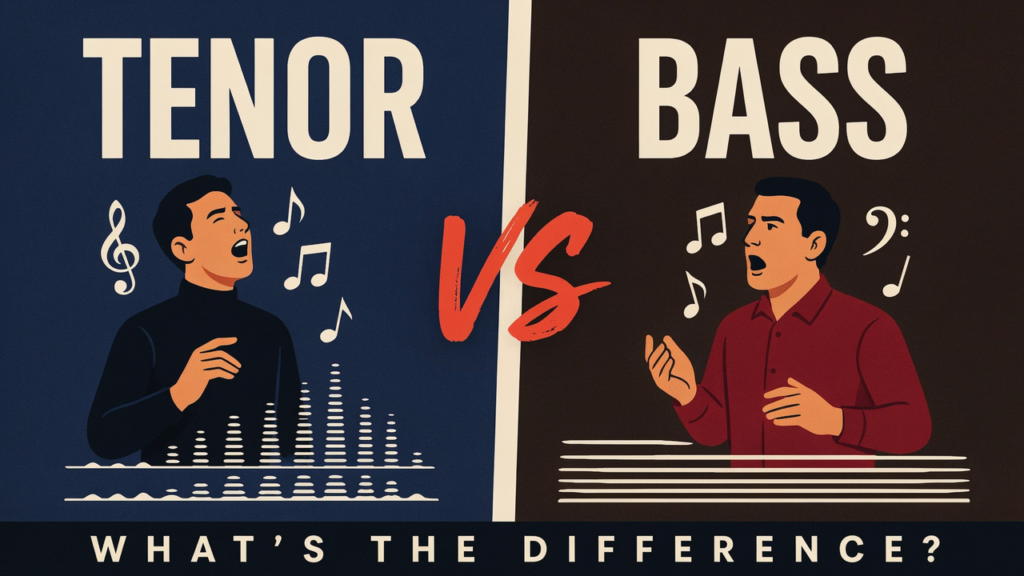
Tenor vs Bass: What’s the Difference?
Why “Tenor vs Bass” Is So Commonly Misunderstood
This comparison is confusing because it mixes several different systems and assumptions. Choirs assign parts based on balance rather than anatomy. Social media glorifies extreme low or high notes. Range charts reduce complex vocal behavior into simple numbers.
Male voices also mature slowly. A voice that sounds very low in the teenage years may rise or rebalance later, while a voice that seems light early on may gain depth with age. Early labeling is often inaccurate.
Many users discover pitch editing through OnlinePitchChanger.
What a Tenor Is
A tenor is the highest commonly encountered male voice type in classical music. It is defined by:
- A tessitura that favors the upper-middle range
- A brighter, clearer timbre
- Less overall vocal weight than lower voices
- Upper notes that feel accessible rather than forced
Tenors are not defined by a single high note. Instead, they are comfortable sustaining phrases higher in the staff, where other voice types would fatigue.
What a Bass Is
A bass is the lowest male classical voice type and is significantly rarer than baritones. It is characterized by:
- A consistently low tessitura
- Dark, heavy vocal color
- Substantial vocal mass
- Strong resonance in the low register without forcing
A true bass does not need to manufacture darkness or push downward to sound low. The depth is inherent and stable across repertoire.
Range vs Tessitura: Where Most Errors Begin
Many explanations focus on range, but range alone is misleading.
Approximate ranges are often cited as:
- Tenor: roughly C3 to C5
- Bass: roughly E2 to E4
These ranges overlap, which is why range-based classification fails.
Tessitura matters far more. Tessitura describes where the voice feels comfortable, resonant, and sustainable over time. A singer who can touch low notes is not necessarily a bass. A bass lives comfortably in the lower range without strain.
Timbre and Vocal Weight
When range is ambiguous, timbre and weight provide clarity.
A tenor voice tends to sound lighter and brighter, especially as it ascends. The sound opens upward rather than thickening.
A bass voice sounds darker and heavier, with a dense core. Even middle-range notes carry depth, and the voice resists brightness rather than seeking it.
Trying to artificially darken a tenor does not create a bass voice. It only creates tension.
Choir Labels vs Classical Voice Types
In choirs, singers are often labeled “tenor” or “bass” for practical reasons. Bass sections need numbers. Lower voices are assigned downward even if they are baritones or undeveloped voices.
This leads to a common misconception:
“If I sing bass in choir, I must be a bass.”
In reality, many choir basses are baritones, and some are young voices that have not yet settled. Choir placement does not define voice type.
Why True Basses Are Rare
True bass voices are uncommon for several reasons. Human male voices naturally center higher. Many low voices are actually baritones. Bass repertoire is specialized and demanding. Young voices are often misidentified before full maturation.
As a result, genuine basses are far less common than choir labels suggest.
Tenor and Bass Compared
A tenor is a higher male voice with an upper-middle tessitura, brighter timbre, and lighter vocal weight. Tenors are less common and are comfortable sustaining higher passages.
A bass is the lowest male voice with a low tessitura, dark timbre, and heavy vocal weight. Basses are rare and feel most at home in the lower range over extended periods.
The difference is functional, not just pitch-based.
Famous Examples (Used Carefully)
Classical singers illustrate these distinctions clearly.
Luciano Pavarotti represents the tenor voice at its most iconic, with effortless upper tessitura and ringing clarity.
Kurt Moll exemplifies the true bass voice, known for immense depth, weight, and resonance in the lowest register.
These examples reflect classical classification, not pop marketing or choir labels.
Common Myths That Cause Vocal Problems
Bass does not simply mean “very low.” Tenors can sing low notes. Lowest note does not determine voice type. Voice classification is not fixed in the teenage years.
Each of these myths encourages singers to force their voices into extremes that are unsustainable.
How to Tell Which One You Are (Safely)
Instead of asking how low or high you can sing, ask where your voice feels most comfortable over time. Notice where long phrases feel easy rather than exhausting. Listen to your natural timbre rather than an artificially dark or bright sound.
A qualified vocal teacher is essential in this process. Choir placement and internet quizzes are not reliable guides.
Forcing low notes to “prove” bass status is one of the fastest ways to create vocal tension.
Why This Distinction Matters
Understanding whether your voice functions as a tenor or a bass helps you choose healthy repertoire, train efficiently, and protect long-term vocal health.
Misclassification often leads to chronic fatigue, stalled progress, and avoidable strain.
Final Verdict
Tenor and bass are defined by how the voice functions, not by extreme notes.
Tenor is the higher male voice type, lighter and brighter in character. Bass is the lowest male voice type, darker, heavier, and significantly rarer.
- To contrast male extremes with female lows, this breakdown of the alto and contralto difference offers useful perspective.
- When seeing how these voices fit into group singing, this guide to choral range layouts adds practical context.
- Many singers compare their reach to a four-octave span when weighing tenor versus bass potential.
- For a clean, distraction-free way to study vocal categories, this text-only format keeps the focus on range and timbre.
- If you prefer a stripped-down reference, this no-image version makes comparisons easier to follow.
- To hear how lighter voices sit against male extremes, this profile of Aaliyah’s range offers a contrasting example.
- For a high-male comparison point, this look at Barry Gibb’s vocal span shows how tenor traits can stretch upward.

Mayer is a music production and audio editing writer specializing in pitch shifting, vocal processing, sound manipulation, and online audio tools for musicians, producers, singers, and creators. He creates practical content focused on pitch changing, vocal editing workflows, audio enhancement, and music production techniques.