
Harry Styles’s vocal range spans approximately D2 to B5 — about three and a half octaves including falsetto. His voice type is most accurately classified as a lyric baritone — though the debate between baritone and tenor is one of the more active in contemporary pop vocal analysis, with some analysts using the “baritenor” label to describe the hybrid character of his voice.
What makes the classification genuinely interesting is that his tone is warm and low like a baritone, but his melodies often sit higher than typical baritone territory — he has developed his upper register, particularly his falsetto, to navigate tenor-range notes that would strain most baritones. The result is a voice that sounds baritonal but performs in a range that strains the standard category.
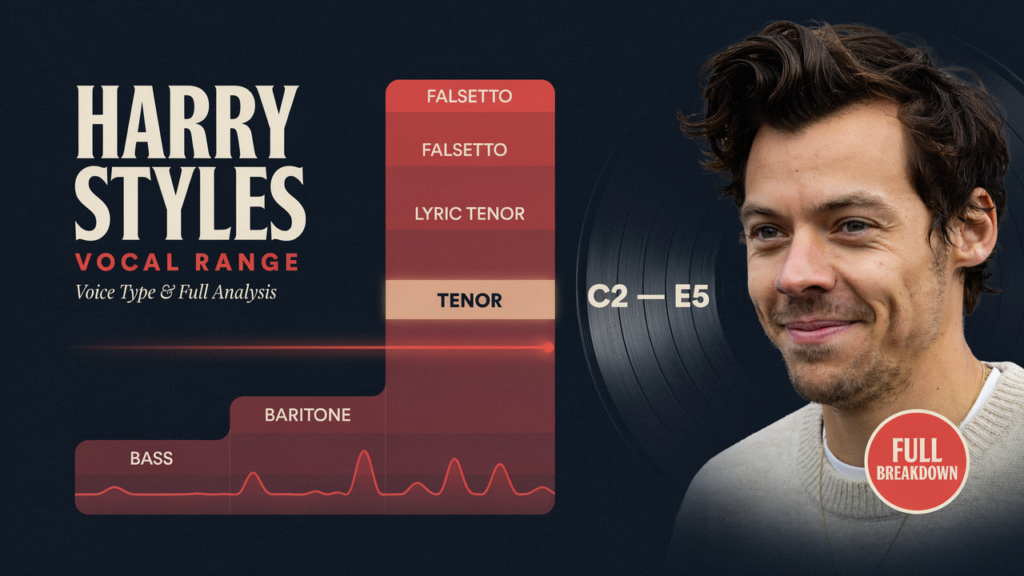
Vocal Range at a Glance
| Lowest documented note | D2 |
| Highest documented note | B5 (falsetto) |
| Approximate span | ~3.5 octaves |
| Voice type | Lyric baritone |
| Tessitura | A2 – E4 |
| Belt ceiling | ~C5 (in mix/chest) |
| Strongest register | Mid-range; warm lower register; smooth falsetto |
Voice Type — Lyric Baritone
Harry Styles is a lyric baritone. The lyric designation reflects the lightness and warmth of his voice — he does not have the heavy, dark weight of a dramatic baritone. His voice carries a natural warmth and darkness in the A2–E4 zone that is characteristic of the baritone type, and his comfort below C3 — sustaining notes that most tenors would find effortful — further supports the baritone classification.
The case for the baritone-tenor hybrid label: his falsetto extends to B5 (half a step below soprano C), which is unusually high for a baritone, and many of his melody lines sit in the G4–B4 zone — higher than most baritone vocal lines, though not as high as a standard tenor tessitura. His vocal coach Ron Anderson worked with him significantly after his One Direction years, and the development of his upper register since 2016 has moved his performing range noticeably upward.
Technical Characteristics
Warm lower register. Harry Styles’s most distinctive natural quality is the warmth of his voice in the A2–E4 zone — a dark, slightly husky quality that is immediately attractive and identifiable. This zone is where his voice has the most character and natural resonance.
Falsetto quality. His falsetto is smooth, breathy, and well-controlled — one of his most developed technical features. Rather than serving as a range extension used sparingly, his falsetto appears regularly as an expressive register in its own right. The vibrato in his falsetto is a particularly noted quality.
Vocal development arc. His voice developed substantially between his boy-band years with One Direction (where his technique was less developed and his upper belts were often pushed and tense) and his solo work, particularly “Fine Line” (2019) and “Harry’s House” (2022). The development of breath support, head voice connection, and control in the upper register is audible across the discography.
Rolling vibrato. A consistently noted characteristic of his voice — a natural, rolling vibrato that adds warmth to sustained notes without the forced quality of trained vibrato in underdeveloped voices.
Rock-influenced delivery. His solo work moved progressively toward a rock-inflected, raw vocal style influenced by artists like David Bowie, Stevie Nicks, and Fleetwood Mac — a deliberate artistic choice that shaped his vocal approach as much as any technical development.
Notable Songs That Showcase His Voice
“Sign of the Times” (2017) — The debut solo single. Demonstrates the upper register reach and the emotional directness of his mid-range. The F4 passages show him navigating the higher end of his chest voice.
“Watermelon Sugar” (2019) — Mid-range focus. Comfortable tessitura zone, showing his natural tonal quality at its most relaxed and resonant.
“Adore You” (2019) — Shows the mix between chest and head voice across the melodic range. The lighter falsetto passages contrast with the warmer chest voice in the verses.
“Fine Line” (2019) — Falsetto showcase. The extended falsetto passages at the top of the song demonstrate the smooth, well-developed quality of his upper register.
“As It Was” (2022) — His most commercially successful solo recording. The melody sits in his mid-range tessitura and demonstrates his most consistent and controlled vocal delivery.
“Late Night Talking” (2022) — Upper register focus. Shows the B4–C5 zone of his mix voice and the transition into falsetto above that.
The Baritone vs Tenor Debate
The Harry Styles voice type debate is one of the most commonly searched in contemporary pop vocal analysis. The key factors:
For baritone: His speaking voice fundamental is low and dark. He sustains notes below C3 with ease — unusual for tenors. His upper belts in the A4–C5 zone feel pushed rather than natural — a baritone reaching into tenor territory. His most resonant and natural zone is A2–E4.
For tenor: His melody lines often sit above F4 — higher than standard baritone repertoire. His falsetto extends to B5, unusually high for baritones. His voice shows tenor-range agility in the G4–B4 zone.
The most accurate conclusion is lyric baritone performing in a wide range that extends into tenor territory — the same pattern as Freddie Mercury, Elton John, and other rock-era baritones who developed their upper registers through intensive performance. Calling him a “baritenor” captures the hybrid reality but is not a standard classical classification.
Singing Harry Styles Songs — Key Considerations
His songs sit in a range that is genuinely accessible to both baritones and lighter tenors. The melody tessitura in most songs (G3–D5) falls within both voice types’ comfortable zones, though the upper passages (A4–C5) will feel more natural to tenors and more like a stretch for lower baritones.
Use the online key changer to shift any song down by 1–2 semitones if the chorus consistently sits at the top of your comfortable range. The key for your vocal range guide walks through finding the right key for any song in detail.
Frequently Asked Questions
What is Harry Styles’s vocal range?
Approximately D2 to B5 — about three and a half octaves including falsetto. His working range in most recorded material sits between A2 and C5, with falsetto appearing regularly in the E5–B5 zone.
Is Harry Styles a tenor or baritone?
A lyric baritone — though some analysts use “baritenor” to describe the hybrid character of his voice. His natural tone and lower register comfort support the baritone classification; his upper register development and melody placement show tenor-range capability. The baritone label is the more accurate standard classification.
Has Harry Styles’s voice changed since One Direction?
Yes — significantly. His technique, breath support, and upper register development all improved substantially during and after working with vocal coach Ron Anderson from 2016 onward. His early One Direction recordings show the voice at an earlier, less developed stage; his solo catalogue shows more consistent control and a notably broader upper register capability.
What key are most Harry Styles songs in?
His songs span a wide range of keys. The song key finder identifies the key of any specific track. His melodies tend to sit in the middle-to-upper part of the male range — most comfortably in keys that place the melody between G3 and D5.
Related Pages
Elton John Vocal Range — baritone performing in tenor range comparison. Freddie Mercury Vocal Range — baritone-tenor comparison. Ed Sheeran Vocal Range — light tenor comparison. Male Voice Types Compared — tenor, baritone, bass explained. Vocal Ranges — Complete Guide — all voice types with ranges. Online Key Changer — transpose Harry Styles songs to your key. Vocal Range Test — find out how your range compares.

Mayer runs Online Pitch Changer (OnlinePitchChanger.com) independently. Mayer maintains the site’s free browser tools for changing the pitch, key and tempo of audio, video and voice, and writes and checks its guides on keys, semitones, transposition and vocal ranges. Each rebuilt tool is tested before release with measured test tones, and app steps in the guides are checked against official manuals such as the Audacity manual and Apple’s GarageBand guide. Audio processed with the tools never leaves the reader’s browser. Mayer is not affiliated with YouTube, Google or any audio software company. For corrections or tool problems, see the Contact page.