
Prince’s documented vocal range spans approximately E2 to B6 — nearly five octaves, including his extraordinary falsetto. He is classified as a lyric tenor with an exceptional upper register — both a powerful falsetto and documented whistle register notes that extend into the sixth octave. His voice combined the light agility of a high tenor with the soul and funk physicality of James Brown, producing an instrument that could move from a deep, earthly E2 grunt to a soaring B6 falsetto within the space of a single performance.
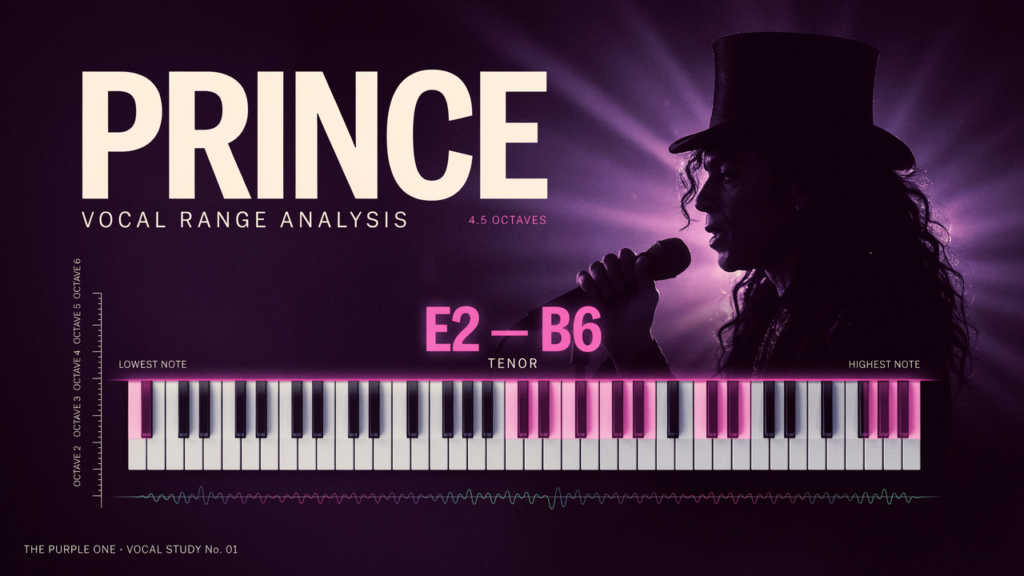
Vocal Range at a Glance
| Lowest documented note | E2 |
| Highest documented note | B6 (falsetto/whistle) |
| Approximate span | ~4–5 octaves |
| Voice type | Lyric tenor |
| Tessitura | D3 – G4 |
| Belt ceiling | ~G4–A4 |
| Strongest register | Mid-range; exceptional falsetto |
Voice Type — Lyric Tenor
Prince is a lyric tenor. His modal voice (chest voice) operates in the tenor range with a bright, forward quality in the D3–G4 zone. But his voice type classification barely captures the full picture — the falsetto and upper register extensions that define his most iconic vocal moments extend well above what any standard voice type framework describes.
His soul and funk influences — James Brown, Sly Stone, and gospel tradition — shaped a vocal approach in which register switching between chest voice and falsetto became a primary expressive technique rather than a limitation to manage.
Technical Characteristics
Register switching as expression. Prince’s movement between chest voice and falsetto — often within a single phrase, sometimes on a single word — is one of the most distinctive features of his vocal identity. Where many singers manage the register transition to make it inaudible, Prince emphasised it, using the contrast between chest voice weight and falsetto lightness as a deliberate expressive tool.
Falsetto quality. His falsetto has an extraordinary quality — light, piercing, and emotionally charged — that is immediately recognisable and has influenced countless singers in R&B, pop, and rock. It is well-connected to his chest voice rather than feeling like a separate register.
Funk physicality. His vocal delivery integrates directly with his physical performance and guitar playing. The grunts, shrieks, and vocalisations that appear throughout his catalogue are integrated with his instrumental approach — not decorative but structural.
Notable Songs
“Kiss” (1986) — Falsetto-focused. Demonstrates the upper register at its most consistent and characteristic.
“Purple Rain” (1984) — Full emotional range. From the restrained opening to the falsetto climax — one of the most discussed transitions in rock history.
“Raspberry Beret” (1985) — Light tenor tessitura. Natural and effortless mid-range.
“When Doves Cry” (1984) — Register versatility. Shows the movement between low, mid, and upper register across a single song.
Frequently Asked Questions
What was Prince’s vocal range?
Approximately E2 to B6 — nearly five octaves including falsetto. His working range in most recordings sits between D3 and A4, with falsetto appearing regularly above that and documented whistle register notes above C6.
What voice type was Prince?
Lyric tenor — though his documented range, including falsetto and upper register extensions, extends well above standard tenor classification. His use of register contrast as a primary expressive technique is the most distinctive aspect of his vocal approach.
Related Pages
Michael Jackson Vocal Range — contemporary peer comparison. Bruno Mars Vocal Range — lyric tenor comparison. The Weeknd Vocal Range — falsetto-heavy contemporary comparison. Male Voice Types Compared — tenor, baritone, bass explained. Vocal Ranges — Complete Guide — all voice types. Online Key Changer — transpose Prince songs to your key.

Mayer runs Online Pitch Changer (OnlinePitchChanger.com) independently. Mayer maintains the site’s free browser tools for changing the pitch, key and tempo of audio, video and voice, and writes and checks its guides on keys, semitones, transposition and vocal ranges. Each rebuilt tool is tested before release with measured test tones, and app steps in the guides are checked against official manuals such as the Audacity manual and Apple’s GarageBand guide. Audio processed with the tools never leaves the reader’s browser. Mayer is not affiliated with YouTube, Google or any audio software company. For corrections or tool problems, see the Contact page.