
Elton John’s vocal range spans approximately D2 to G5 — about three and a half octaves. He is classified as a baritone, though his performing range extends comfortably into tenor territory — a pattern shared with other rock-era baritones who developed their upper registers through intensive performance. His voice is characterised by a powerful, emotionally direct mid-range and a falsetto that has become increasingly prominent in his later career as his voice has settled lower with age.
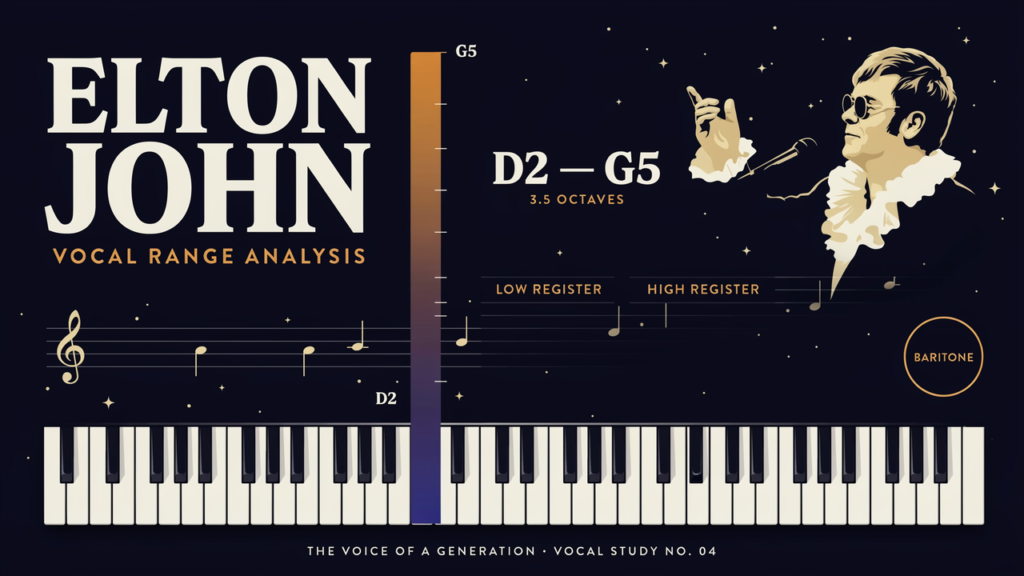
Vocal Range at a Glance
| Lowest documented note | D2 |
| Highest documented note | G5 (falsetto) |
| Approximate span | ~3.5 octaves |
| Voice type | Baritone (performs in tenor range) |
| Tessitura | D3 – F4 |
| Belt ceiling | ~G4–Bb4 in prime years |
| Strongest register | Mid-range; emotional belt |
Voice Type — Baritone
Elton John is a baritone. His speaking voice and his most natural resonance zone sit in the baritone range (D3–F4), and his voice carries the warmth and weight characteristic of the baritone rather than the brighter, lighter quality of a tenor. His performing range in his prime extended into tenor territory — sustained Bb4 and occasional B4 notes appear in concert recordings — but the natural character and weight of his voice is baritone.
Like many rock-era singers, his voice classification in classical terms and his performing range do not align neatly. He trained himself through performance to access a range above his natural tessitura, which is common and legitimate but means the upper notes carry less of his characteristic tonal quality.
Technical Characteristics
Mid-range power. Elton John’s D3–G4 zone is where his voice has its most distinctive quality — warm, powerful, and immediately recognisable. The emotional directness of his delivery in this zone is the primary characteristic of his vocal identity.
Piano-voice integration. Unlike singers who accompany themselves on guitar, his piano playing integrates directly with his vocal phrasing — the rhythmic and harmonic relationship between the two is unusual and adds a specific character to his vocal delivery.
Longevity. Across more than five decades of performing, his voice has changed significantly — the upper belt has settled lower, the head voice has become more prominent — but the core identity of his mid-range character has remained consistent.
Notable Songs
“Crocodile Rock” (1972) — Upper register emphasis. The falsetto sections show the highest part of his prime-era range.
“Rocket Man” (1972) — Mid-range tessitura. Demonstrates the natural character of his voice in its most comfortable zone.
“Tiny Dancer” (1971) — Full ballad range. Shows the lower register character and the sustained mid-range quality.
“Your Song” (1970) — The simplest and most direct showcase of his natural voice quality.
Frequently Asked Questions
What voice type is Elton John?
Baritone. His natural tessitura and vocal weight are baritone, though his performing range extended into tenor territory during his prime years.
What is Elton John’s vocal range?
Approximately D2 to G5 — about three and a half octaves, including falsetto. His working range in most recorded material sits between D3 and Bb4.
Related Pages
Billy Joel Vocal Range — baritone comparison. Freddie Mercury Vocal Range — baritone-tenor comparison. Bob Dylan Vocal Range — baritone storyteller comparison. Male Voice Types Compared — tenor, baritone, bass explained. Vocal Ranges — Complete Guide — all voice types. Online Key Changer — transpose Elton John songs to your key.

Mayer runs Online Pitch Changer (OnlinePitchChanger.com) independently. Mayer maintains the site’s free browser tools for changing the pitch, key and tempo of audio, video and voice, and writes and checks its guides on keys, semitones, transposition and vocal ranges. Each rebuilt tool is tested before release with measured test tones, and app steps in the guides are checked against official manuals such as the Audacity manual and Apple’s GarageBand guide. Audio processed with the tools never leaves the reader’s browser. Mayer is not affiliated with YouTube, Google or any audio software company. For corrections or tool problems, see the Contact page.