
Michael Jackson’s vocal range spans approximately A2 to F6, including his extensive falsetto — approximately three and a half to four octaves in total. He is classified as a lyric tenor, and his voice is one of the most immediately recognisable in the history of recorded music: a bright, forward tone with distinctive tonal quirks — the hiccups, the spoken interjections, the slides and grunts — that are inseparable from both the vocal identity and the dance-performance approach that defined his career.
His falsetto is one of the most discussed in pop vocal analysis — not because of its extreme range, but because of its specific quality: light, clear, and well-connected to his chest voice in a way that makes register transitions virtually seamless.
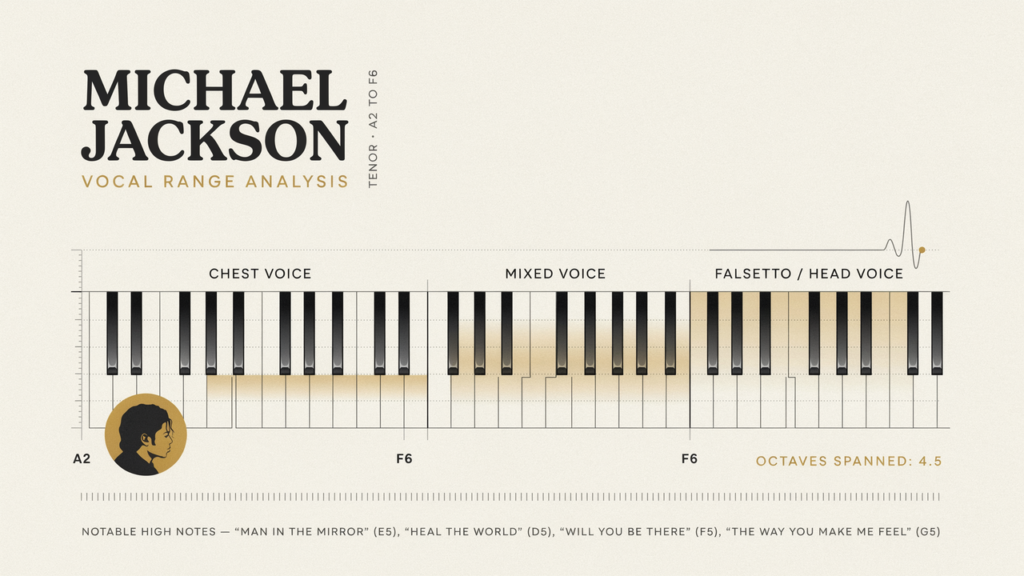
Vocal Range at a Glance
| Lowest documented note | A2 |
| Highest documented note | F6 (falsetto) |
| Approximate span | ~3.5–4 octaves (including falsetto) |
| Voice type | Lyric tenor |
| Tessitura | D3 – G4 |
| Belt ceiling | ~F#4–G4 in chest/mix |
| Strongest register | Mid-range; distinctive falsetto |
Voice Type — Lyric Tenor
Michael Jackson is a lyric tenor. His voice has the characteristic brightness and forward quality of the tenor range, with a tessitura centred in the D3–G4 zone. His passaggio falls in the standard tenor range, and his voice above G4 carries a light, ringing quality rather than the pressed, heavier sound of a baritone working in tenor territory.
His voice went through significant changes across his career — the high, light quality of his early Motown years (as a child and young adult with the Jackson 5) evolved into a darker, more characterful mid-range voice in the Thriller and Off the Wall era, then settled into the recognisable mature voice of Bad, Dangerous, and HIStory. The core tenor classification remained constant.
Technical Characteristics
Distinctive vocal quirks. The hiccups, spoken interjections (“ow,” “hee-hee,” “shamone”), slides, and grunts are not affectations — they are an integrated part of his vocal technique, derived from James Brown and gospel tradition, and deployed with precise rhythmic intention. Removing them from his performances would leave a fundamentally different artist.
Falsetto quality. Michael Jackson’s falsetto is notable for its connectivity and tonal continuity with his chest voice. Where many singers’ falsettos sound disconnected — thinner, breathier, and clearly in a different register — his transitions are smooth enough that the register change is not always audible. The falsetto itself has a light, sweet, focused quality that is immediately recognisable.
Emotional delivery. His ability to load a single note with emotional weight — through vibrato, dynamic shading, or rhythmic placement — is one of his most discussed technical attributes. A held note in “She’s Out of My Life” carries more emotional information than most singers can convey across an entire phrase.
Rhythmic precision. Jackson’s vocal delivery is deeply rhythmic — he treats the voice as a percussion instrument as much as a melodic one. This connects directly to his dance background: the voice and the body were conceived as part of the same performance.
Notable Songs That Showcase His Voice
“She’s Out of My Life” (1979) — Ballad showcase. The emotional weight he places on sustained mid-range notes in this performance is one of the most analysed in pop vocal history.
“Man in the Mirror” (1988) — Full range demonstration across a gospel-influenced anthem. Shows the belt quality and the emotionally charged upper range.
“Billie Jean” (1983) — The most famous Michael Jackson vocal performance. Mid-range precision, rhythmic delivery, and the integration of vocal quirks with the musical material.
“Human Nature” (1982) — Smooth, falsetto-focused. Demonstrates the light upper register quality at its most lyrical.
“P.Y.T. (Pretty Young Thing)” (1983) — Agility and funk influence. The runs and stylistic vocal movements show the soul tradition influence at its most direct.
Frequently Asked Questions
What is Michael Jackson’s vocal range?
Michael Jackson’s documented vocal range spans approximately A2 to F6, including his extensive falsetto — approximately three and a half to four octaves total. His working range in most recorded material sits between D3 and G4, with falsetto appearing regularly above that.
What voice type was Michael Jackson?
Lyric tenor. His voice has characteristic tenor brightness and forward quality, with a tessitura in the D3–G4 zone. His falsetto extends well above the standard tenor range and is notably smooth and well-connected.
How did Michael Jackson’s voice change over his career?
His voice as a child (Jackson 5 era, 1969–1975) was a high, pure boy soprano before his voice broke during adolescence. Through the Off the Wall and Thriller era (1979–1982), his adult voice settled into the recognisable lyric tenor quality. The voice darkened slightly in the Bad and Dangerous era while retaining its core tenor classification. He maintained the distinctive tonal qualities of his voice through to his final recordings.
Related Pages
Bruno Mars Vocal Range — lyric tenor comparison; direct stylistic descendant. Prince Vocal Range — contemporary peer comparison. The Weeknd Vocal Range — contemporary tenor with similar falsetto use. Male Voice Types Compared — tenor, baritone, bass explained. Vocal Ranges — Complete Guide — all voice types with ranges. Online Key Changer — transpose Michael Jackson songs to your key.

Mayer runs Online Pitch Changer (OnlinePitchChanger.com) independently. Mayer maintains the site’s free browser tools for changing the pitch, key and tempo of audio, video and voice, and writes and checks its guides on keys, semitones, transposition and vocal ranges. Each rebuilt tool is tested before release with measured test tones, and app steps in the guides are checked against official manuals such as the Audacity manual and Apple’s GarageBand guide. Audio processed with the tools never leaves the reader’s browser. Mayer is not affiliated with YouTube, Google or any audio software company. For corrections or tool problems, see the Contact page.