
Bruno Mars’s vocal range spans approximately D2 to Bb5 — about three and a half octaves. He is classified as a lyric tenor with a strong belt, influenced deeply by James Brown, Prince, Michael Jackson, and classic soul and funk vocalists. His voice combines the brightness and upper-register reach of a tenor with a powerful, soulful mid-range belt that gives his recordings an energy and physicality uncommon in contemporary pop.
He is one of the few major pop artists whose live performances consistently match or exceed his studio recordings in power and precision — a combination of technical training, strong breath support, and the performance energy of a genuinely functional live act.
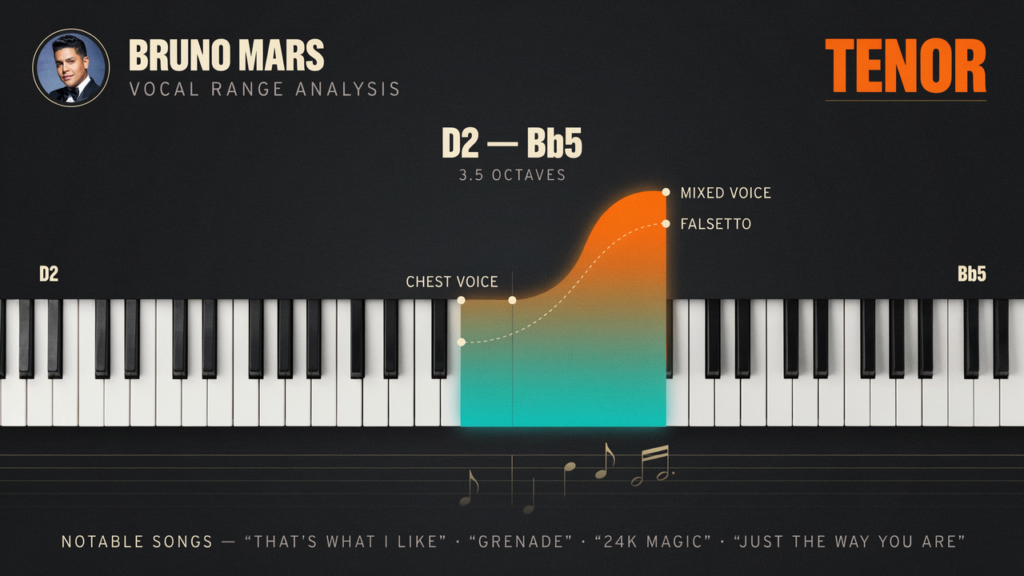
Vocal Range at a Glance
| Lowest documented note | D2 |
| Highest documented note | Bb5 (falsetto extensions) |
| Approximate span | ~3.5 octaves |
| Voice type | Lyric tenor |
| Tessitura | D3 – G4 |
| Belt ceiling | ~A4–Bb4 in full chest/mix |
| Strongest register | Mid-range belt; falsetto |
Voice Type — Lyric Tenor
Bruno Mars is a lyric tenor — a tenor with a warm, agile voice suited to melodic, soulful material. His voice carries more weight and body than a light lyric tenor like Ed Sheeran, but he does not have the heavy power of a dramatic tenor. The lyric tenor classification reflects the balance between brightness and warmth that characterises his sound.
His tenor classification is supported by the consistent brightness of his voice in the D3–G4 zone (his primary melodic territory), the location of his passaggio, and his ability to sustain notes above G4 with power and resonance — notes that would require significant strain for a true baritone.
Technical Characteristics
Soul and funk influence. Bruno Mars’s vocal technique is heavily shaped by the soul, funk, and R&B tradition. He uses melisma, growls, grunts, and stylistic bent notes in a way that connects directly to James Brown, Prince, and Michael Jackson — not as borrowed techniques but as fundamental elements of his vocal identity.
Belt quality. His belt from A4 to Bb4 carries a bright, powerful ring that sustains under the physical demands of live performance. Unlike many contemporary pop singers who belt with a pressed, shouty quality at the top, his belt retains shape and tone.
Falsetto. Light, agile, and well-connected to his chest voice. He uses falsetto both as a stylistic tool and for sustained upper-register notes. The transition between chest and falsetto is one of his technical strengths.
Showmanship as technique. Bruno Mars’s physical performance — the choreography, the intensity, the projection — is inseparable from his vocal technique. His breath support and core engagement are developed to sustain full vocal quality under movement, which most singers cannot do at the level he demonstrates.
Notable Songs That Showcase His Voice
“Grenade” (2010) — Shows the lower and mid-range in ballad mode. D2 low notes appear in the lower passages.
“Locked Out of Heaven” (2012) — Upper range focus. The falsetto passages and the belt quality in the chorus B4 zone are clear.
“Treasure” (2013) — Funk-influenced mid-range delivery. Shows the soul-influenced chest voice quality in its natural territory.
“That’s What I Like” (2016) — R&B-influenced smoothness. Demonstrates his mid-range tessitura and stylistic vocal runs.
“24K Magic” (2016) — Performance energy and vocal range combined. One of the best live showcases for understanding the full character of his voice.
Frequently Asked Questions
What is Bruno Mars’s vocal range?
Approximately D2 to Bb5 — about three and a half octaves. His working range in most recorded material sits between D3 and A4, with falsetto extensions above that.
What voice type is Bruno Mars?
Lyric tenor. His voice has tenor brightness in the upper register, a strong soulful belt in the mid-range, and a lower register that extends to D2 with characteristic weight and body.
How does Bruno Mars’s voice compare to Michael Jackson’s?
Both are tenors with a strong soul and funk influence and similar mid-range tessitura. Michael Jackson’s falsetto extended higher and was more agile; Bruno Mars’s belt is arguably stronger in the A4–Bb4 zone. The stylistic influence is direct — Mars has cited Jackson as a primary influence. See Michael Jackson vocal range for the full comparison.
Related Pages
Michael Jackson Vocal Range — tenor comparison, primary influence. The Weeknd Vocal Range — contemporary tenor comparison. Adam Levine Vocal Range — tenor with similar range. Male Voice Types Compared — tenor, baritone, bass explained. Online Key Changer — transpose Bruno Mars songs to your key. Vocal Ranges — Complete Guide — all voice types with ranges.

Mayer runs Online Pitch Changer (OnlinePitchChanger.com) independently. Mayer maintains the site’s free browser tools for changing the pitch, key and tempo of audio, video and voice, and writes and checks its guides on keys, semitones, transposition and vocal ranges. Each rebuilt tool is tested before release with measured test tones, and app steps in the guides are checked against official manuals such as the Audacity manual and Apple’s GarageBand guide. Audio processed with the tools never leaves the reader’s browser. Mayer is not affiliated with YouTube, Google or any audio software company. For corrections or tool problems, see the Contact page.