
Brendon Urie’s documented vocal range spans approximately A2 to C7 — close to five octaves — including one of the most documented male whistle registers in contemporary popular music. He is classified as a tenor with exceptional upper register development, combining a bright, powerful mid-range with head voice and whistle register capability that extends well into soprano territory.
He is one of a small number of male pop artists with a confirmed whistle register — the highest vocal register, above head voice and falsetto — and his C7 is one of the highest documented notes by a male singer in mainstream popular music.
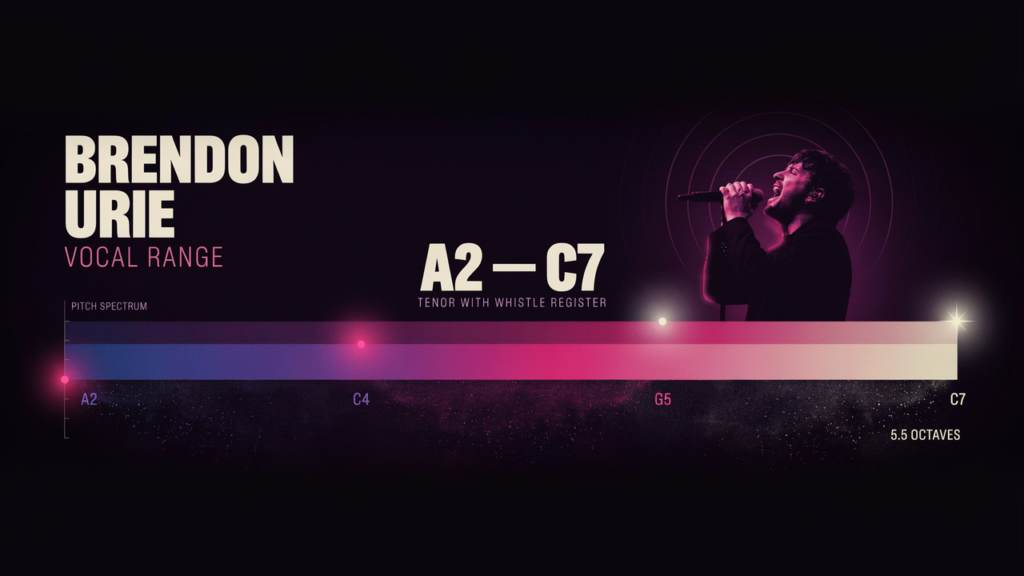
Vocal Range at a Glance
| Lowest documented note | A2 |
| Highest documented note | C7 (whistle register) |
| Approximate span | ~5 octaves |
| Voice type | Tenor (with exceptional upper register) |
| Tessitura | D3 – B4 |
| Belt ceiling | ~C5 (in full mix/chest voice) |
| Whistle register | Yes — documented to C7 |
Voice Type — Tenor with Extended Upper Register
Brendon Urie is a tenor. His modal (chest) voice sits in the tenor tessitura — D3 to B4 — and his passaggio falls in the tenor zone. His songs with Panic! at the Disco consistently sit in tenor melodic territory, with the upper belt around Bb4–C5 and the head voice above that.
What makes him exceptional is the development of his upper register beyond the standard tenor ceiling. His head voice extends cleanly through the C5–G6 zone, and above G6 he accesses what analysts have identified as the whistle register — the highest vocal register, produced through a specific vocal fold configuration distinct from head voice. His documented C7 places him in a very small group of male singers with a confirmed whistle register.
Technical Characteristics
Belt quality. His belt in the A4–C5 zone is powerful and bright — characteristic of a well-developed tenor upper register with good breath support and efficient technique.
Head voice connection. The transition from his chest voice through head voice is smooth — the different registers do not sound disconnected but form a continuous line of tone.
Whistle register. Confirmed to C7 in documented recordings. The whistle register requires a specific vocal fold configuration distinct from head voice; most male singers, even trained tenors, cannot access it.
Theatrical influence. His background in theatrical performance — Panic! at the Disco’s stage-show aesthetic — shaped an approach to vocal delivery that is more performance-oriented than most rock vocalists. Dynamic shaping, tonal variety, and range as expressive tool all reflect this.
Notable Songs
“High Hopes” (2018) — The most commercially successful showcase. The belt in the Bb4 zone and the head voice passages demonstrate the mid-to-upper range in a pop context.
“This Is Gospel” (2013) — Emotional range and dynamic control. Shows the full working range in a more dramatic context.
“Death of a Bachelor” (2015) — The Vegas-influenced theatrical approach to vocal delivery at its most developed.
Frequently Asked Questions
What is Brendon Urie’s vocal range?
A2 to C7 — approximately five octaves including his whistle register. His working range in most recorded material sits between D3 and C5, with head voice and whistle register appearing in specific passages.
Does Brendon Urie have a whistle register?
Yes — one of the most documented male whistle registers in contemporary popular music. His C7 is confirmed in recordings and is one of the highest documented notes by a male mainstream artist. For more on the whistle register, see the whistle register guide.
Related Pages
Adam Lambert Vocal Range — wide-range rock countertenor comparison. Axl Rose Vocal Range — wide-range rock vocalist comparison. Whistle Register Guide — how the whistle register works. Tenor Vocal Range — his voice type explained. Online Key Changer — transpose Panic! at the Disco songs to your key.

Mayer is a music production and audio editing writer specializing in pitch shifting, vocal processing, sound manipulation, and online audio tools for musicians, producers, singers, and creators. He creates practical content focused on pitch changing, vocal editing workflows, audio enhancement, and music production techniques.