
Amy Lee’s vocal range spans approximately D3 to E6 — just over three octaves. She is classified as a dramatic soprano — a soprano with significant power and weight in the upper register, capable of sustained projection at full volume in a demanding rock and orchestral context. Her voice is one of the most distinctive in rock music: a classically influenced soprano quality deployed in a heavy rock production setting, combining the power of opera-adjacent technique with the emotional intensity of hard rock.
She is the most prominent classically-trained soprano voice in mainstream rock, and her approach to blending operatic technique with rock production has been one of the defining sounds of symphonic and gothic metal since the early 2000s.
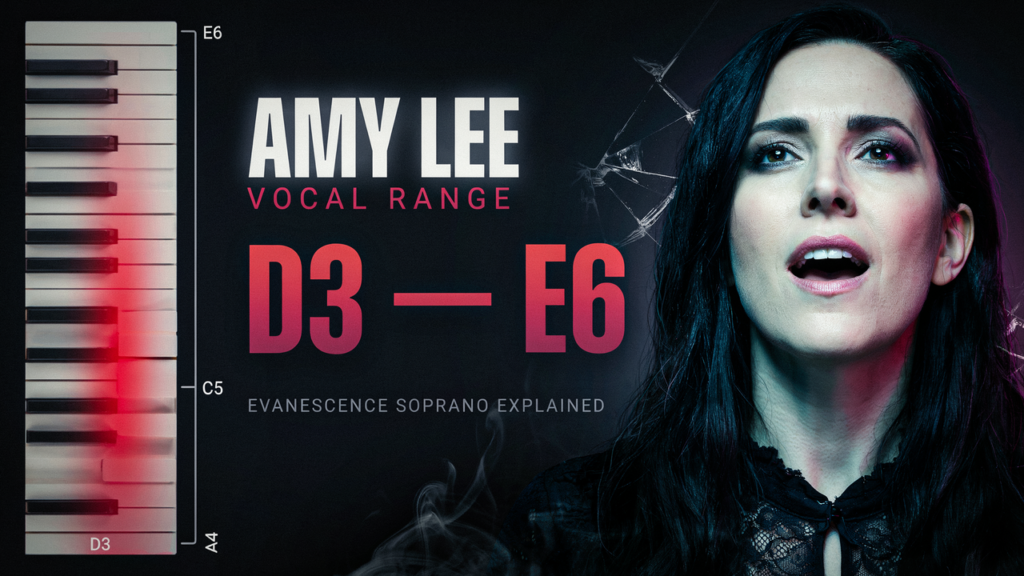
Vocal Range at a Glance
| Lowest documented note | D3 |
| Highest documented note | E6 |
| Approximate span | ~3+ octaves |
| Voice type | Dramatic soprano |
| Tessitura | D4 – B5 |
| Belt ceiling | ~C6 |
| Strongest register | Upper register power; sustained soprano belt |
Voice Type — Dramatic Soprano
Amy Lee is a dramatic soprano. The dramatic soprano classification reflects the primary character of her voice: significant weight and power in the upper register, capable of projection at full volume over heavy rock instrumentation without losing tonal quality. This is different from a lyric soprano — warmer and lighter — and from a coloratura soprano — agile and high.
Her classical training is audible in her technique — the breath support, the vowel placement, the consistency of vibrato, and the ability to project without microphone assistance that she has demonstrated in acoustic contexts. In a fully amplified rock setting, this training allows her to cut through dense instrumentation with a focused, piercing upper register.
Technical Characteristics
Upper register power. Her ability to sustain full-resonance notes in the Bb5–C6 zone while projecting over rock instrumentation is the defining technical capability of her voice. Most sopranos can access these notes — far fewer can sustain them at performance volume.
Classical technique in rock context. The vowel placement, breath support, and vibrato control she uses are classical in origin, applied within a rock production context. This gives her voice a distinctive character — more focused and resonant than a typical rock vocalist in the upper register.
Emotional intensity. Her delivery approach matches the emotional content of Evanescence’s material — the dark, searching quality of the lyrics is reflected in the intensity of the vocal delivery.
Piano-vocal connection. Like Alicia Keys and Billy Joel, Amy Lee is a trained pianist, and her relationship with the instrument shapes her vocal phrasing.
Notable Songs
“Bring Me to Life” (2003) — The commercial breakthrough. Upper register power over heavy rock production. The D5–D6 zone in the chorus is the most striking demonstration of her range ceiling in a mainstream commercial context.
“My Immortal” (2003) — The ballad showcase. Lower register quality and the emotional directness of her delivery without rock production context.
“Lithium” (2006) — Mid-range and full-range. The full working range across a single song.
“Your Star” (2006) — Upper register sustained quality. Demonstrates the E6 zone at the top of her range.
Frequently Asked Questions
What is Amy Lee’s vocal range?
D3 to E6 — just over three octaves. Her working range in most recorded material sits between D4 and B5, with the most characteristic delivery in the Bb4–Bb5 zone.
What voice type is Amy Lee?
Dramatic soprano. Her voice has the weight, power, and projection capability of the dramatic soprano subcategory — capable of sustaining upper register notes at full volume in demanding production contexts.

Mayer is a music production and audio editing writer specializing in pitch shifting, vocal processing, sound manipulation, and online audio tools for musicians, producers, singers, and creators. He creates practical content focused on pitch changing, vocal editing workflows, audio enhancement, and music production techniques.