
Aaliyah’s vocal range spanned approximately G3 to D5 — about an octave and a half to two octaves. She is classified as a lower mezzo-soprano — sometimes described as an alto — with a naturally dark, warm, slightly breathy lower register that became one of the most influential vocal personalities in 1990s R&B.
Her voice was not remarkable for range width or technical power. What was remarkable was its immediate recognisability, the specific warmth and intimacy of her tone, and the way it combined with the production style of Timbaland to create a sonic signature that changed the direction of contemporary R&B.
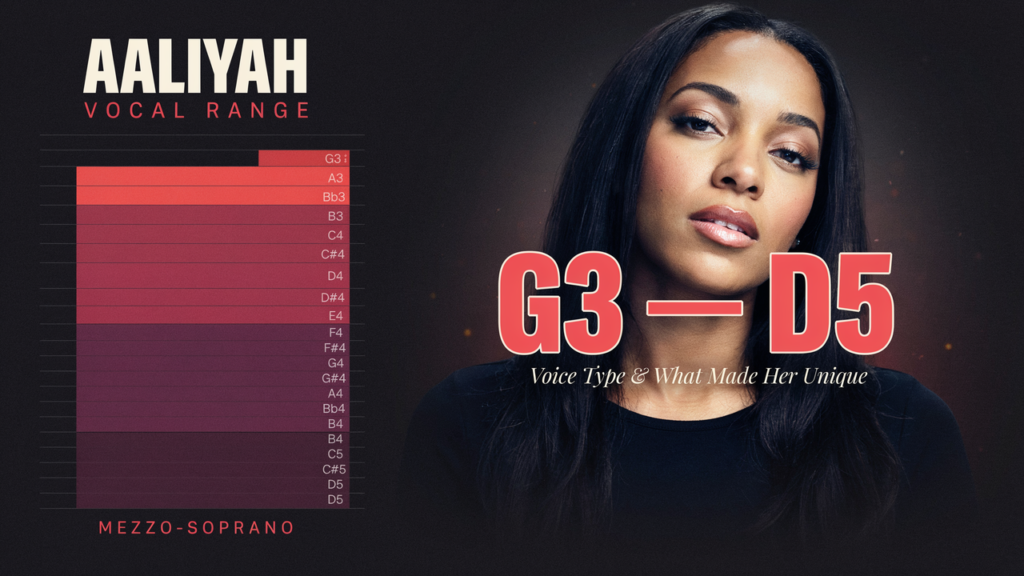
Vocal Range at a Glance
| Lowest documented note | G3 |
| Highest documented note | D5 |
| Approximate span | ~1.5–2 octaves |
| Voice type | Lower mezzo-soprano (alto-adjacent) |
| Tessitura | A3 – C5 |
| Strongest register | Mid-range; breathy intimate delivery |
Voice Type — Lower Mezzo-Soprano
Aaliyah is classified as a lower mezzo-soprano — sometimes called an alto in popular music contexts, though the classical contralto classification is generally considered too low for her voice. Her tessitura sits in the A3–C5 zone, with the most characteristic tonal quality in the lower half of that range.
Her voice has a naturally dark, slightly husky quality in the lower register — particularly in the A3–D4 zone — that is the source of its immediate recognisability. This quality is not produced by technique; it is the natural character of her voice at rest.
The Timbaland Sound — Voice and Production
Aaliyah’s voice cannot be fully discussed without the production context that shaped her most iconic recordings. Her collaboration with Timbaland — on “Are You That Somebody,” “Try Again,” and the self-titled album — produced a sonic architecture specifically designed around her voice: rhythmically complex drum programming, stuttered vocal loops, and a production texture that placed her intimate mid-range delivery front and centre.
The production and the voice are mutually defining. Her voice sounds different outside this production context; the production sounds different with a different voice. The combination was singular.
Notable Songs
“Are You That Somebody?” (1998) — The definitive sonic document. The Timbaland production and her voice at their most mutually defining.
“Try Again” (2000) — Demonstrates the full character of her voice in the most commercially successful context of her career.
“One in a Million” (1996) — The breakthrough album’s title track. The lower register quality and the breathy delivery at their most characteristic.
“More Than a Woman” (2001) — Later period. The voice in a more expansive context.
Frequently Asked Questions
What was Aaliyah’s vocal range?
G3 to D5 — approximately one and a half to two octaves. This is a modest range by pop standards, but every note within it was used with precision and characteristic tonal quality.
What voice type was Aaliyah?
Lower mezzo-soprano, sometimes classified as alto. Her tessitura sits toward the lower end of the standard female range, and her characteristic tonal quality — dark, warm, slightly breathy — is consistent with this classification.
Related Pages
Amy Winehouse Vocal Range — contralto comparison. Brandy Vocal Range — mezzo-soprano R&B comparison. Billie Eilish Vocal Range — lower mezzo-soprano with similar intimate delivery. Contralto Vocal Range — lower female voice type guide. Female Voice Types Compared — all female voice types. Online Key Changer — transpose Aaliyah songs to your key.

Mayer is a music production and audio editing writer specializing in pitch shifting, vocal processing, sound manipulation, and online audio tools for musicians, producers, singers, and creators. He creates practical content focused on pitch changing, vocal editing workflows, audio enhancement, and music production techniques.