
Choral vocal ranges are organized into Soprano, Alto, Tenor, and Bass (SATB). Their typical written ranges are about Soprano C4–A5, Alto G3–D5, Tenor C3–A4, and Bass E2–E4. These ranges are designed for blend, balance, and vocal safety, not to show off extreme notes.
Standard choral vocal ranges:
Soprano C4–G5
Alto G3–D5
Tenor C3–G4
Bass E2–C4
These are practical choir ranges; overlap is common and varies by skill and repertoire.
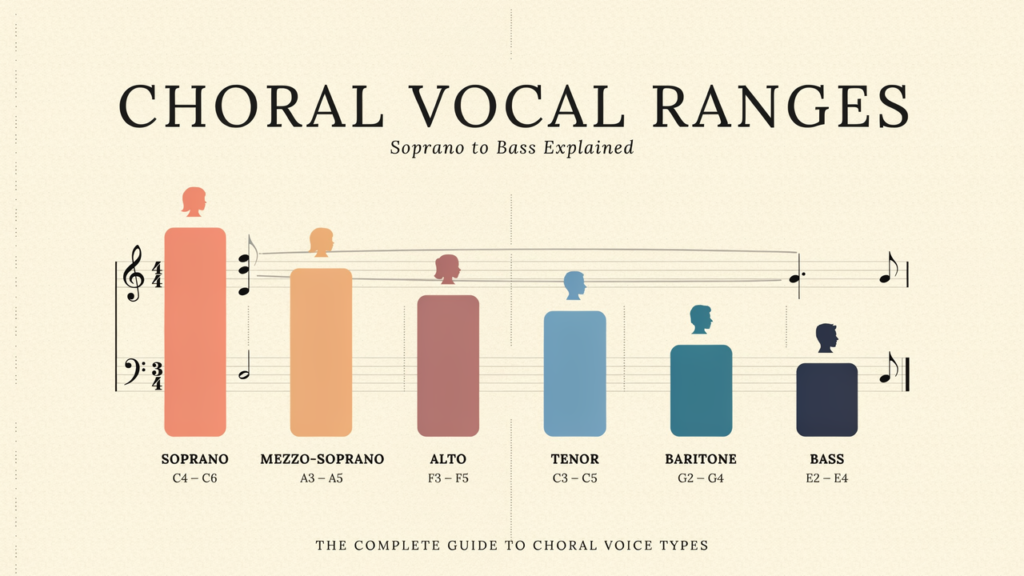
What “choral vocal range”
In choir music, a vocal range is not a measurement of your maximum high or low note. It refers to the notes composers normally write for that part—the area where singers spend most of their time.
Two concepts matter:
- Range – the highest and lowest notes in the written music
- Tessitura – where the music sits most of the time
Choir directors choose repertoire based on tessitura, because that determines comfort, blend, and endurance.
Vocalists frequently move songs into a new key before rehearsals.
The standard SATB choir ranges
Here are the ranges most choral scores are written for:
| Part | Typical Written Range | Core Tessitura |
|---|---|---|
| Soprano | C4 – A5 | G4 – E5 |
| Alto | G3 – D5 | C4 – A4 |
| Tenor | C3 – A4 | E3 – E4 |
| Bass | E2 – E4 | G2 – C4 |
These numbers aren’t arbitrary. They reflect:
- Where voices project best
- Where tuning is most stable
- Where singers can perform for long rehearsals without fatigue
Why choral ranges overlap
You might notice that:
- Altos and tenors share some notes
- Sopranos and altos overlap
- Tenors and basses overlap
This is intentional.
Choral harmony requires stacked voices, not isolated ones. Overlap allows:
- Better chord tuning
- Smooth voice-leading
- Flexible casting
It also means that a singer’s choir part is not the same as their voice type.
Soprano in choral music
Sopranos sing the highest lines in mixed choirs.
Typical range: C4–A5
They usually carry:
- The melody
- The top of harmonies
- The brightness of the choir
Even though sopranos can often sing higher, choral music usually keeps them in the G4–E5 area for stability and blend.
Altos sing the lower female harmony.
Alto in choral music
Typical range: G3–D5
Important truth:
Altos provide:
- Harmonic glue
- Warmth
- Inner structure
They are the bridge between soprano brightness and tenor depth.
Tenor in choral music
Tenors are the high male voices.
Typical range: C3–A4
They sing:
- Countermelodies
- Upper harmony
- Emotional tension in chords
Even though the tenor part sounds high, most of it sits between E3 and E4, where the male voice resonates most freely.
Bass in choral music
Basses are the foundation.
Typical range: E2–E4
They sing:
- Roots
- Fifths
- Rhythmic and harmonic anchors
Although very low notes may appear, most bass writing centers around G2–C4, where pitch and power are reliable.
Other common choir voicings
Not all choirs are SATB.
SSA
Two soprano parts and one alto. Common in:
- Women’s choirs
- School choirs
SSAA
Four female parts for richer harmony.
TTBB
Two tenor parts and two bass parts, used in:
- Men’s choirs
- Barbershop
SAB
Used when tenor numbers are limited, especially in youth choirs.
Each voicing shifts the written ranges slightly, but the core tessitura remains similar.
How directors assign choral parts
You are not placed based on your highest note.
Directors listen for:
- Where your voice sounds strongest
- Where it blends best
- Where it stays in tune
- Where you don’t strain
A soprano may sing alto.
A baritone may sing bass.
A high tenor may sing soprano lines in falsetto.
Choir is about ensemble function, not labels.
Range vs voice type
A common mistake:
Not necessarily.
Choir parts are musical roles.
Voice types are biological and technical categories.
Many sopranos sing alto.
Many baritones sing bass.
Choirs prioritize blend, not classification.
Why choirs avoid extremes
Solo singers may chase:
- High notes
- Low notes
- Power
Choirs avoid them because:
- Tuning becomes unstable
- Voices fatigue faster
- Blend suffers
Choral music lives in the sweet spot of the voice.
FAQ
Can a soprano sing alto?
Yes. Many sopranos sing alto for balance.
What if I can sing both tenor and bass?
You’ll be placed where your voice sounds fuller and more stable.
Do professional choirs use wider ranges?
Slightly, but even pros stay within these tessituras for blend.
Is alto the same as contralto?
No. Alto is a choir part; contralto is a rare voice type.
- To see how individual voices are grouped in choirs, this overview of the choir range system gives a clear foundation.
- When comparing women’s parts, this guide on the alto and mezzo difference adds helpful context.
- For lower female voices, this breakdown of the mezzo and contralto range is useful.
- To understand men’s sections better, this comparison of tenor and baritone roles clarifies placement.
- When looking at the deepest voices, this guide on baritone versus bass shows how they differ.
- For singers wondering how wide their voice should be, this look at a three-octave range gives perspective.
- If you want to train for choir work, these range-building exercises are a practical starting point.

Mayer is a music production and audio editing writer specializing in pitch shifting, vocal processing, sound manipulation, and online audio tools for musicians, producers, singers, and creators. He creates practical content focused on pitch changing, vocal editing workflows, audio enhancement, and music production techniques.