
Most choirs use four main vocal parts—Soprano, Alto, Tenor, and Bass (SATB). Their typical written ranges are approximately Soprano C4–A5, Alto G3–D5, Tenor C3–A4, and Bass E2–E4. These ranges overlap by design so choirs can blend smoothly.
Standard choir vocal ranges:
Soprano: C4–G5
Alto: G3–D5
Tenor: C3–G4
Bass: E2–C4
These are practical choral ranges, with overlap common between parts depending on skill and arrangement.
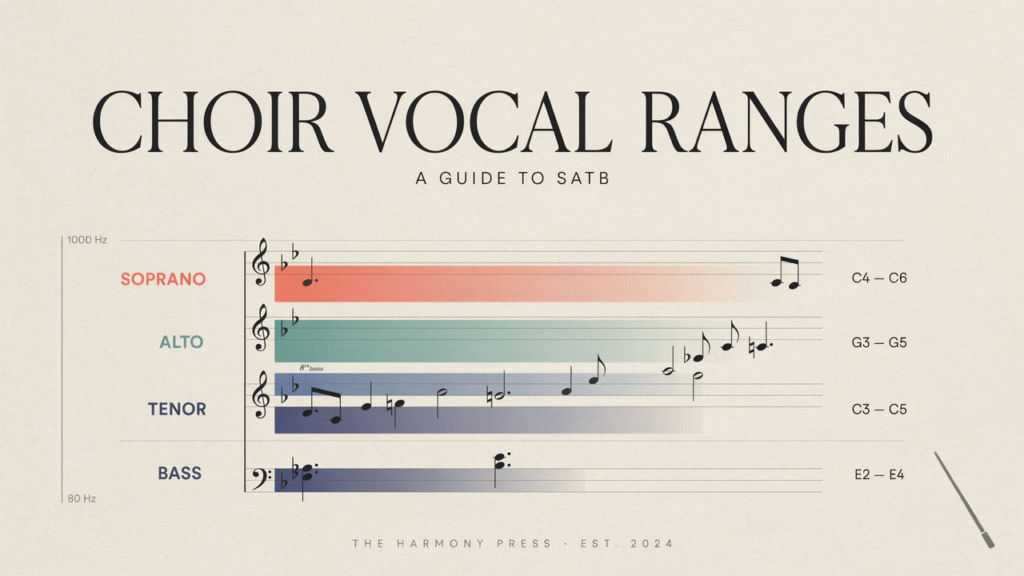
What choir vocal ranges actually mean
In choral music, a “range” is not the same as a singer’s total vocal ability. It refers to the notes commonly written for that part—the zone where most of the music lives.
Two key concepts matter:
- Range – the highest and lowest notes in the written music
- Tessitura – where the part sits most of the time
Choir directors choose music based on tessitura, not extremes. A part might touch a high note once, but if it lives there, it belongs to a different voice group.
The standard SATB choir ranges
Here are the ranges most choral music is written for:
| Choir Part | Typical Written Range | Core Tessitura |
|---|---|---|
| Soprano | C4 to A5 | G4–E5 |
| Alto | G3 to D5 | C4–A4 |
| Tenor | C3 to A4 | E3–E4 |
| Bass | E2 to E4 | G2–C4 |
These are not limits — they are safe, sustainable working zones.
Choir composers use these ranges because they:
- Project well
- Blend easily
- Avoid vocal strain
Why choir ranges overlap
You might notice:
- Alto and tenor overlap
- Soprano and alto overlap
- Tenor and bass overlap
That is intentional.
Choirs are designed for harmonic layering, not strict vocal separation. Overlap allows:
- Smoother chord voicing
- Easier tuning
- Flexible casting
This is why a singer’s voice type (soprano, mezzo, baritone, etc.) is not the same as their choir part.
Soprano range explained
Sopranos sing the highest lines in mixed choirs.
Typical range: C4–A5
They usually carry:
- The melody
- Bright harmonic color
- The top of chords
Sopranos often sing above the staff, but most choral soprano writing centers around G4–E5, not the extreme high notes.
Alto range explained
Altos sing the lower female harmony.
Typical range: G3–D5
Important truth:
Altos provide:
- Warmth
- Inner harmony
- Stability
The alto part often sits where female voices feel most comfortable, which is why many singers are placed there even if they can sing higher.
Tenor range explained
Tenors are the high male voices.
Typical range: C3–A4
They sing:
- High harmony
- Countermelodies
- Emotional tension in chords
Tenors often work in their upper middle range. The part sounds high, but most of it sits between E3–E4.
Bass range explained
Basses provide the foundation of the choir.
Typical range: E2–E4
They sing:
- Root notes
- Harmonic grounding
- Rhythmic weight
Most bass music lives between G2 and C4. Very low notes appear occasionally, but are not constant.
Other choir formations
Not all choirs are SATB.
SSA (Soprano–Soprano–Alto)
Common in:
- Women’s choirs
- School choirs
Ranges shift upward.
SSAA
Used for:
- Female choirs
- Chamber ensembles
TTBB
Used for:
- Male choirs
- Barbershop
Ranges go lower, with two tenor parts and two bass parts.
SAB
Used when:
- Few tenors are available
- Youth choirs are transitioning
This editor lets you raise or lower song pitch with precision.
How to find your choir part
Your part is determined by comfort, not extremes.
Ask:
- Where can I sing for 30 minutes without fatigue?
- Where do my notes feel stable?
- Where does my voice blend best?
A soprano who can sing low is still a soprano.
A bass who can hit high notes is still a bass.
Choir placement is about where you sound best most of the time.
Range vs voice type
A common mistake is thinking:
Not true.
Choir parts are musical roles.
Voice types are physiological categories.
A mezzo-soprano may sing alto.
A baritone may sing bass.
A high tenor may sing soprano lines in falsetto.
Choirs prioritize blend, not labels.
Why choir music avoids extremes
Professional soloists may sing:
- Very high
- Very low
- With dramatic dynamics
Choirs avoid this because:
- Group tuning becomes unstable
- Voices fatigue faster
- Blend suffers
Choral music is written to keep singers in their strongest zones.
FAQ
Can a soprano sing alto?
Yes. Many sopranos sing alto for balance or blend.
What if I can sing both tenor and bass?
You will be placed where your voice sounds fuller and more stable.
Are choir ranges the same for all music?
No. Renaissance, pop, gospel, and classical use different extremes, but the core tessitura remains similar.
Why do altos sometimes sing higher than sopranos?
Occasionally for harmony, but the soprano line still sits higher overall.
- To compare women’s lower parts with choir roles, this breakdown of the alto and contralto difference adds helpful context.
- When mapping out female sections, this guide on the mezzo and contralto range gives useful clarity.
- For understanding how higher and lower male parts differ, this comparison of tenor versus baritone fits naturally here.
- When placing the deepest voices, this overview of baritone and bass roles helps define each section.
- To see how choir parts relate to comfortable singing zones, this explainer on what tessitura means is relevant.
- Many choir singers aim for at least a three-octave span to stay versatile.
- To build the range needed for choir work, these vocal range exercises are a practical starting point.

Mayer is a music production and audio editing writer specializing in pitch shifting, vocal processing, sound manipulation, and online audio tools for musicians, producers, singers, and creators. He creates practical content focused on pitch changing, vocal editing workflows, audio enhancement, and music production techniques.