
For most nasal voices, dynamic microphones with smooth, controlled midrange—not hyped condensers—sound the most flattering. Models like the Shure SM7B and Electro-Voice RE20 are famous for taming nasal “bite.” Neutral large-diaphragm condensers can also work if you use the right placement and EQ.
The best mic for a nasal voice is usually a dynamic microphone with a smooth upper-mid response. It tames harsh nasal frequencies better than bright condensers, producing a warmer, more natural tone—especially in untreated rooms or close-mic setups.
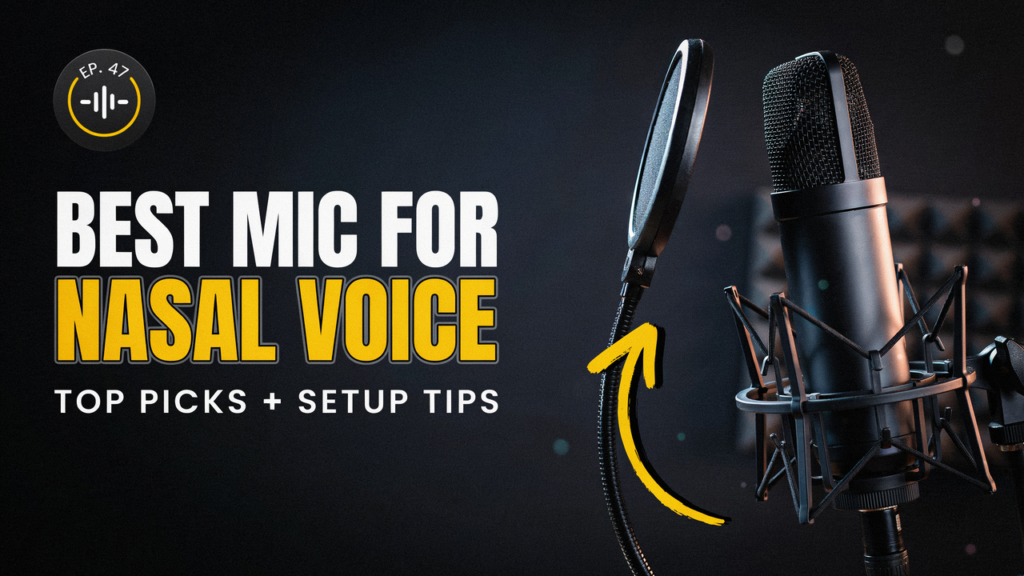
Why nasal voices can sound harsh on the wrong mic
A “nasal” tone usually means extra energy around 800 Hz–2 kHz—the same band that gives clarity and speech intelligibility. Many modern microphones (especially budget condensers) boost that exact range to make vocals cut. Stack that boost on top of an already nasal voice and you get:
- Honk
- Quack
- Thinness
- Fatiguing brightness
The goal isn’t to remove your character—it’s to avoid doubling down on it.
You can easily change the key of a song without re-recording it.
Dynamic vs. condenser: what actually works better
Dynamic microphones (often the safest bet)
Why they help nasal voices
- Naturally smoother upper-mid response
- Less sensitive to room reflections
- Handle loud or close singing without harshness
Trade-off
- Require more preamp gain
- Slightly less “air” on top
For nasal singers, that trade-off is usually a win.
Condenser microphones (can work with care)
Why they can be risky
- Many boost 1–5 kHz for “presence”
- Sensitive rooms can add extra boxy reflections
When they work
- Neutral or warm-voiced condensers
- Treated rooms
- Off-axis placement and light EQ
The best microphone types for nasal voices
1) Broadcast-style dynamics (top tier)
These are famous for making difficult voices sound smooth.
- Shure SM7B
Thick low-mids, gentle highs, excellent for taming nasal bite. - Electro-Voice RE20
Flat, controlled midrange with very little proximity effect—great if you move while singing or speaking. - Heil PR40 / PR30
Slightly brighter than the SM7B, but still smoother than most condensers.
Best for: Studio vocals, voice-over, podcasting, streaming, and even some singing styles.
2) Stage dynamics (live performance)
If you sing live, these are workhorses that don’t exaggerate nasality.
- Shure SM58
The classic—mid-forward but not harsh. - Sennheiser e935 / e945
Clear but smoother than many “super-bright” stage mics. - Electro-Voice ND86
Strong rejection and balanced mids for nasal voices on loud stages.
Best for: Live gigs, rehearsal rooms, small stages.
3) Neutral large-diaphragm condensers (studio)
If you want condenser detail without nasal harshness, look for flat or warm voicing.
- AKG C214 / C414 (neutral settings)
- Lewitt LCT 440 Pure
- Warm Audio WA-47 Jr
Avoid condensers marketed as “extra presence” or “air boost” if you’re nasal.
Mic placement matters as much as the mic
You can often reduce nasality more with placement than with gear.
Try these techniques:
1) Go slightly off-axis
Aim the mic 10–30° away from your mouth instead of straight on. This softens upper-mid harshness without killing clarity.
2) Increase distance
Backing up 4–8 inches reduces proximity-boosted nasal mids.
3) Raise the mic
Aim slightly downward toward your mouth. This reduces direct nasal cavity reflections.
4) Use a pop filter or foam windscreen
These subtly roll off harsh upper mids and sibilance.
EQ: the final polish
Even the best mic may need a touch of EQ.
Start here:
- Cut 1–3 dB around 900 Hz–1.5 kHz
- Avoid boosting 2–4 kHz
- Add warmth at 150–300 Hz if needed
- Add air above 8–10 kHz only if the voice sounds dull
Do not scoop aggressively—just tame.
Recording vs. live vs. podcasting
For recording
Choose:
- SM7B, RE20, or neutral condenser
- Treated room
- Off-axis placement
- Gentle EQ
For live singing
Choose:
- SM58, e935, ND86
- Slightly off-axis technique
- Avoid “presence boost” EQ at the mixer
For podcasting or streaming
Choose:
- SM7B or RE20
- Close-mic (but not on-axis)
- Foam windscreen
Common myths
“A condenser is always better.”
False. For nasal voices, condensers often make things worse.
“You need a brighter mic to cut through.”
A smoother mic with better EQ beats harsh brightness every time.
“A mic can fix my voice.”
No mic changes your anatomy—but the right one can stop exaggerating your nasal frequencies.
How to test if a mic suits your voice
Record the same phrase on two mics:
- One dynamic
- One condenser
Listen for:
- How sharp the “N” and “M” sounds feel
- Whether your voice feels full or thin
- How fatiguing it is after 30 seconds
Pick the one that sounds less annoying—not more detailed.
- To really understand how to capture tone accurately, it helps to know how the vocal cords work.
- Many vocalists with nasality also benefit from improving their control with these vocal exercises.
- When deciding how your voice sits in a mix, understanding what tessitura means adds useful insight.
- Some performers compare their spans to a four-octave range to gauge recording potential.
- For singers exploring throat control and resonance, this guide on how vibrato works offers relevant technique tips.
- If you’re comparing different singing roles, this overview of the vocal fach system provides helpful classification.
- For context on expressive delivery, this profile of Adam Levine’s range offers an interesting perspective.

Mayer is a music production and audio editing writer specializing in pitch shifting, vocal processing, sound manipulation, and online audio tools for musicians, producers, singers, and creators. He creates practical content focused on pitch changing, vocal editing workflows, audio enhancement, and music production techniques.