
Yes—a 3 octave vocal range is good and more than enough for most singing.
A three-octave range gives a singer flexibility across styles and repertoire, but it does not automatically mean the singer is advanced, professional, or better than someone with fewer octaves. What matters far more is how consistently and comfortably those notes function.
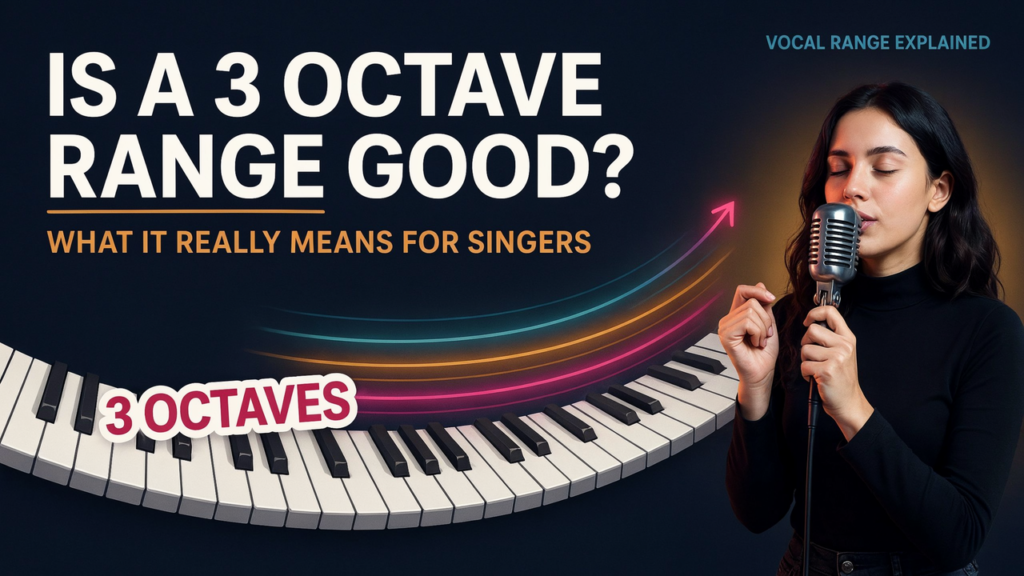
What a 3 Octave Vocal Range Actually Means
A three-octave range means you can produce usable notes spanning three full octaves from your lowest to highest pitch.
However, that definition matters. A true, meaningful three-octave range implies that the notes are:
- In tune
- Repeatable
- Relatively stable
- Not produced through strain
Many singers can touch three octaves, but only part of that range may be reliable in real music.
To explore the tool further, click here.
Is a 3 Octave Range Enough for Singing?
Yes—easily.
Most vocal music across genres is written within:
- About one and a half to two octaves
- A comfortable tessitura
- Sustainable vocal production
This includes:
- Choir music
- Pop and contemporary styles
- Musical theatre
- Folk and worship music
- Large portions of classical repertoire
A three-octave range already exceeds what most songs actually require.
Range vs Tessitura: Why This Matters More Than the Number
This distinction explains almost all confusion around octave counts.
Range is the total number of notes you can sing.
Tessitura is where your voice feels comfortable, sounds best, and can sustain music over time.
A singer with:
- A solid two-octave tessitura
- Good stamina and control
will outperform a singer with a three-octave range who struggles with consistency or fatigue.
Professional singers are hired and cast based on tessitura and reliability, not maximum range.
Is a 3 Octave Range Impressive?
It can be—but context matters.
Among untrained singers, a true three-octave range is above average. Among trained singers, it is fairly common. In neither case does it automatically signal artistry, professionalism, or superior technique.
What audiences and directors notice first is:
- Tone quality
- Pitch accuracy
- Musical phrasing
- Emotional communication
None of these depend on having three octaves.
Do Professional Singers Have 3 Octaves?
Some do. Many don’t—and that’s perfectly normal.
Even singers who technically have more than three octaves often use far less in performance. Their functional singing range—the notes they rely on consistently—usually stays closer to two octaves.
Extreme notes are occasional effects, not the foundation of real-world singing.
Why Bigger Ranges Are Often Overvalued
Large ranges are easy to advertise but hard to interpret.
Octave counts often include:
- Notes sung very quietly
- Notes produced briefly
- Notes from different registers
- Notes that cannot be sustained
These notes rarely appear in actual repertoire. A smaller range that works reliably will always be more valuable than a larger one that only works occasionally.
This is why experienced teachers focus on quality within range, not expanding it endlessly.
Can a 3 Octave Range Improve With Training?
Yes—sometimes.
Healthy vocal training can:
- Improve coordination between registers
- Smooth transitions
- Recover notes lost to tension
- Slightly expand usable range
However, training is not about chasing numbers. The goal is to make your voice:
- More consistent
- More flexible
- More expressive
- More sustainable
Many singers sound dramatically better long before they gain additional notes.
Common Myths About a 3 Octave Range
Myth: Three octaves means you’re an advanced singer
Reality: Control and consistency define advancement
Myth: You need three octaves to sing professionally
Reality: Most professional music fits within two octaves
Myth: More range equals better technique
Reality: Technique shows up in stability and stamina
Myth: Range defines voice type
Reality: Voice type depends on tessitura and timbre
Why Chasing More Than Three Octaves Can Be Risky
Singers who fixate on range size often:
- Push high notes
- Force low notes
- Ignore fatigue signals
- Practice extremes excessively
This can lead to:
- Vocal strain
- Loss of reliability
- Reduced endurance
- Long-term injury
A healthy voice develops from comfort outward, not from extremes inward.
What Actually Makes a Singer “Good”
Singing quality depends on:
- Breath coordination
- Pitch accuracy
- Tone consistency
- Dynamic control
- Musical phrasing
- Emotional communication
None of these require more than three octaves—and most don’t even require that.
A singer with a stable two-octave tessitura often sounds more confident and musical than someone with a larger but unreliable range.
How to Evaluate Your Voice More Accurately
Instead of asking “Is my range big enough?”, ask:
- Can I sing full songs without fatigue?
- Does my tone stay consistent?
- Can I repeat phrases reliably?
- Do I feel comfortable in my repertoire?
If the answer is yes, your range is already doing its job.
A qualified vocal teacher can help you identify your tessitura and guide safe development without unnecessary comparison.
Final Verdict
Yes, a 3 octave vocal range is good.
It is more than sufficient for most singing styles and gives you flexibility across repertoire.
However, range alone does not define vocal skill. Consistency, comfort, stamina, and musical control matter far more than how many notes you can hit.
- To see how this kind of range compares across voice categories, this breakdown of the alto and mezzo difference adds helpful context.
- When judging how those octaves are actually used in songs, understanding what tessitura means makes the picture clearer.
- Many singers step up from a two-octave voice before reaching this level.
- To expand beyond your current span, these vocal range exercises are a practical foundation.
- For perspective on what’s possible, this look at a five-octave voice offers a striking contrast.
- Understanding how wide ranges are produced starts with how the vocal cords work.
- To see how a three-octave span appears in famous singers, this profile of Adam Levine’s range gives a real-world example.

Mayer is a music production and audio editing writer specializing in pitch shifting, vocal processing, sound manipulation, and online audio tools for musicians, producers, singers, and creators. He creates practical content focused on pitch changing, vocal editing workflows, audio enhancement, and music production techniques.