
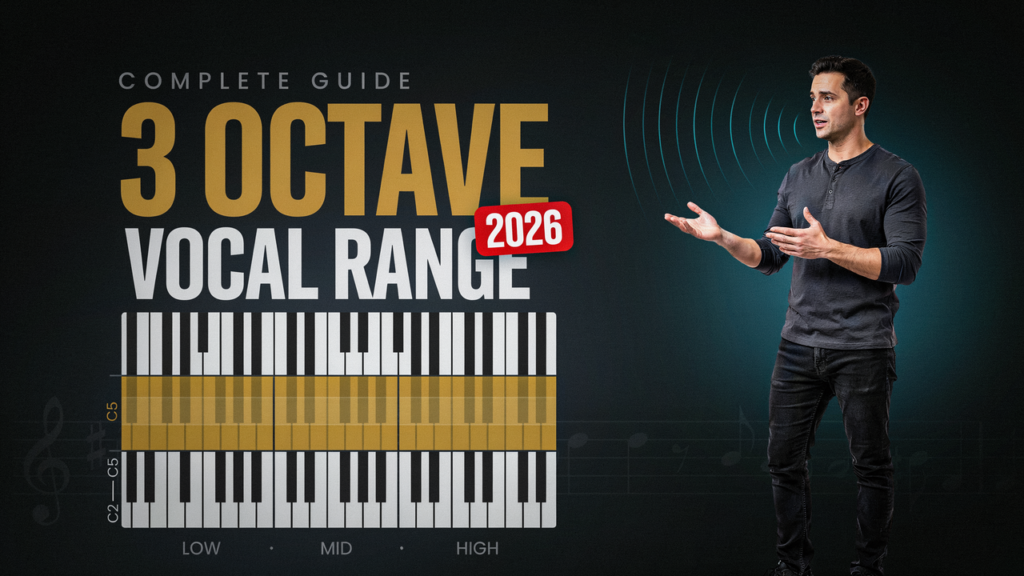
A 3 octave vocal range means a singer can produce pitches spanning three full octaves—but it does not mean those notes are all comfortable, usable, or musically reliable.
Range alone does not indicate vocal skill, voice type, or singing quality. Tessitura, consistency, stamina, and control matter far more than the total number of notes.
A 3-octave vocal range means a singer can sing across three full octaves with usable sound. It’s above average, but range alone doesn’t define skill—tone, control, and tessitura matter more than how many notes you can reach.
Why the Idea of a “3 Octave Range” Gets So Much Attention
The phrase 3 octave vocal range is popular because it sounds impressive and measurable. Social media challenges, talent shows, and celebrity comparisons have turned octave count into a perceived benchmark of talent.
This creates two common reactions:
- Singers with less than three octaves feel inadequate
- Singers who reach three octaves assume they are exceptional
Both conclusions are usually wrong.
What a 3 Octave Vocal Range Actually
An octave is the distance between one note and the same note at a higher or lower pitch. A three-octave range simply means the singer can produce notes across three of these spans.
Crucially, this measurement usually includes:
- Notes sung quietly or briefly
- Notes produced with different registers
- Notes that may not be usable in real music
A singer might technically phonate a note, but that does not mean it can be sung:
- In tune
- With consistent tone
- At performance volume
- Repeatedly without fatigue
This is why range must never be confused with usable singing range.
You can try a Online pitch changer tool without downloads.
Is a 3 Octave Vocal Range “Good”?
The honest answer: it depends on how those octaves function.
A singer with:
- Two well-controlled octaves
- Excellent tone
- Strong stamina
- Musical consistency
will outperform a singer with three or more octaves that are unstable or strained.
In classical and professional contexts, singers are judged by:
- Consistency, not extremes
- Comfort, not reach
- Musical reliability, not novelty
A three-octave range is neither required nor particularly rare among trained singers.
How Common Is a 3 Octave Vocal Range?
For untrained singers, a three-octave range is uncommon but not extraordinary. For trained singers, it is fairly typical if all registers are counted.
However, this often includes:
- A limited low register
- A lightly produced upper register
- Notes that are not part of the singer’s tessitura
This is why claims like “most singers don’t have three octaves” are misleading. Many do—but only a portion of that range is usable for real music.
Range vs Tessitura: The Difference That Actually Matters
This distinction explains almost all confusion around octave counts.
Range is the total span of notes you can produce at all.
Tessitura is the range where your voice feels comfortable, sounds best, and can sustain music over time.
A singer may have a three-octave range but only a one-and-a-half octave tessitura. That is normal.
Professional repertoire is written for tessitura, not range. No composer expects singers to live at their extremes.
Does a Larger Range Mean a Better Singer?
No—and this is one of the most damaging myths in vocal culture.
Vocal quality is determined by:
- Breath coordination
- Tone consistency
- Pitch accuracy
- Musical phrasing
- Stamina
None of these are guaranteed by octave count.
Some of the most respected singers in history had relatively modest ranges but exceptional control and expressiveness. Conversely, many singers with extreme ranges struggle with consistency.
Do Whistle Notes or Vocal Fry Count?
This is where octave counts often become inflated.
Technically:
- Whistle tones and fry tones are pitches
- They can be included in a raw range measurement
Musically:
- They are often not part of functional singing
- They may not be usable in repertoire
- They are rarely sustained or amplified naturally
Including these notes may increase the number on paper, but it does not change the singer’s usable vocal ability.
This is why many teachers distinguish between extended range and functional range.
Can Training Increase Your Vocal Range?
Yes—within limits.
Training can:
- Improve coordination between registers
- Smooth transitions
- Strengthen weak areas
- Recover notes lost to tension
Training cannot:
- Override anatomy
- Force permanent extremes
- Turn range into tessitura
Healthy training expands what is available, not what is natural to live in.
Why Chasing a 3 Octave Range Can Be Risky
Singers who fixate on octave count often:
- Force high or low notes
- Ignore fatigue signals
- Practice extremes excessively
- Neglect musical fundamentals
This can lead to:
- Vocal strain
- Loss of consistency
- Reduced stamina
- Long-term injury
Professional singers prioritize longevity, not numerical milestones.
How Many Octaves Do Singers Actually Need?
Far fewer than most people think.
Most real-world singing requires:
- About one and a half to two octaves
- Reliable control
- Consistent tone
Choir, musical theatre, pop, and classical repertoire are all written with this reality in mind. Extreme notes are occasional, not constant.
If your comfortable tessitura fits the music you sing, your range is sufficient.
How to Evaluate Your Own Range Realistically
Instead of asking “How many octaves do I have?”, ask:
- Which notes can I sing comfortably every day?
- Where does my voice sound stable and resonant?
- Where can I sing for long periods without fatigue?
- Which notes hold up under repetition?
These answers are far more meaningful than octave counts.
A qualified vocal teacher can help separate usable range from novelty notes and guide safe development.
Final Verdict
A 3 octave vocal range is neither rare nor a reliable measure of vocal skill.
It simply describes how many pitches a singer can produce—not how well they sing, how long they can sing, or what music suits them.
What matters most is tessitura, consistency, stamina, and musical control.
If your voice works comfortably and reliably in the music you love, your range is already enough.
- To see how three octaves compare across male voice types, this breakdown of the tenor and baritone difference adds useful context.
- When judging how usable those notes are in songs, understanding what tessitura means makes the picture clearer.
- For singers looking beyond this milestone, this look at a four-octave span shows what comes next.
- To expand your range safely past three octaves, these vocal range exercises are a solid foundation.
- Understanding how different registers are produced starts with how the vocal cords work.
- For a famous real-world example, this profile of Billy Joel’s range shows how three octaves are used musically.
- To see how ensemble singing treats range differently, this guide to choral vocal ranges offers useful contrast.

Mayer is a music production and audio editing writer specializing in pitch shifting, vocal processing, sound manipulation, and online audio tools for musicians, producers, singers, and creators. He creates practical content focused on pitch changing, vocal editing workflows, audio enhancement, and music production techniques.