
Tenor and baritone are not defined by how high or low a singer can reach, but by tessitura, timbre, and how the voice functions over time.
A tenor is the higher male classical voice, with a tessitura that favors the upper-middle range and a brighter, lighter timbre.
A baritone is the middle male classical voice, the most common male voice type, with a lower tessitura, darker color, and greater vocal weight.
Many singers who believe they are tenors are actually baritones who can sing high notes.
Tenor vs baritone: Tenors sing higher (≈C3–C5) with a bright, light tone. Baritones sing lower (≈A2–A4) with a darker, fuller sound. The key difference is comfortable range (tessitura), not highest notes.
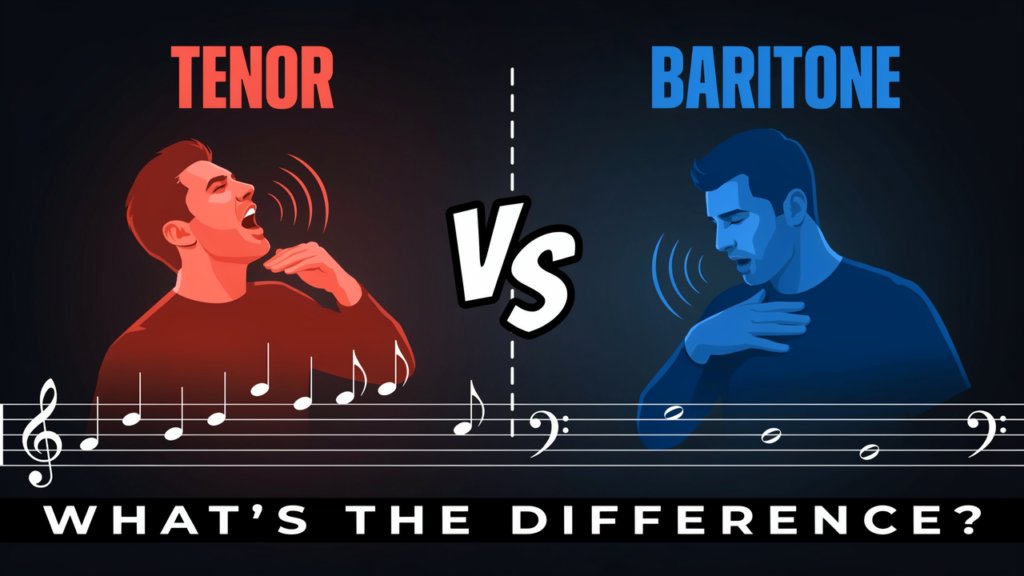
Tenor vs Baritone Comparison
Why This Comparison Causes So Much Confusion
The question “tenor vs baritone” appears so often because male voices are frequently labeled too early. Choir placement, social media emphasis on high notes, and simplified range charts all contribute to misunderstanding.
Male voices also mature later than female voices, which means early classifications often change with time. What feels like a tenor voice in adolescence may settle naturally into baritone territory in adulthood.
What a Tenor Is
A tenor is the highest common male voice type in classical singing. It is characterized by a tessitura that sits higher in the staff, a naturally brighter timbre, and upper notes that feel accessible rather than strained.
Tenors are comfortable sustaining phrases in the upper-middle range. Their voices tend to favor clarity and brilliance rather than weight. High notes are not special events for a tenor; they are part of the voice’s normal operating range.
What a Baritone Is
A baritone is the middle male voice and the most frequently occurring male voice type. It is defined by a lower tessitura, a darker and richer vocal color, and greater vocal mass.
Baritones often have strong middle and lower-middle registers. While many baritones can sing high notes, their voices are not built to remain there for long periods without fatigue.
Range vs Tessitura: The Core Distinction
Many explanations rely on vocal range, but this is where most errors begin. Ranges overlap significantly between tenors and baritones.
What matters more is tessitura—the range where the voice feels comfortable, resonant, and sustainable over time. A singer who can reach high notes is not necessarily a tenor. A tenor can live comfortably in higher territory without forcing.
Timbre: What the Voice Sounds Like
When range is ambiguous, timbre becomes the clearest indicator.
A tenor voice typically sounds brighter, clearer, and lighter, especially as it ascends. Upper notes tend to open and bloom rather than tighten.
A baritone voice sounds darker and heavier, with a thicker core. The middle range is the natural home, and upper notes require more preparation and energy.
Artificially brightening a baritone does not turn it into a tenor.
Why Baritones Are Often Mistaken for Tenors
Baritones are frequently misidentified as tenors for several reasons. Younger voices often sit higher before settling. Choirs have constant demand for tenors and push singers upward. Popular music rewards high notes with attention and praise. Range is often mistaken for voice type.
This combination leads many baritones to train too high for too long, which can cause fatigue and long-term vocal issues.
Tenor and Baritone Compared
A tenor is a higher male voice with an upper-middle tessitura, brighter timbre, and lighter vocal weight. Tenors are less common and are comfortable sustaining high passages.
A baritone is a middle male voice with a lower tessitura, darker timbre, and heavier vocal weight. Baritones are the most common male voice type and excel in the middle range, even though they may sing high notes when needed.
Famous Examples (Used Carefully)
Classical singers illustrate these differences clearly.
Luciano Pavarotti is a textbook tenor, known for effortless upper tessitura and ringing high notes.
Dietrich Fischer-Dieskau exemplifies the baritone voice, with rich color, expressive depth, and a powerful middle range.
Plácido Domingo demonstrates how voices can evolve over time, moving toward heavier repertoire as the voice matures.
Pop singers are often mislabeled as tenors based solely on range, which does not reflect classical classification.
Common Myths That Cause Vocal Problems
Singing high does not automatically make someone a tenor. Baritone is not a lesser or limited voice type. Voice classification is not fixed in the teenage years. Baritones are allowed to sing high notes, but should not live there constantly.
Each of these myths leads singers to push their voices in unhealthy ways.
How to Tell Which One You Are (Safely)
Instead of asking how high you can sing, ask where your voice feels most relaxed and sustainable. Notice where long phrases feel easy rather than exhausting. Pay attention to where your voice transitions between registers and whether it naturally prefers brightness or weight.
A qualified vocal teacher is essential in this process. Choir placement and internet quizzes are not reliable guides.
Forcing high notes to prove tenor status is one of the fastest ways to damage a voice.
Why This Distinction Matters
Correct classification allows singers to choose appropriate repertoire, train efficiently, and build long-term vocal health. Misclassification often results in chronic strain, stalled progress, and frustration.
Understanding whether your voice functions as a tenor or a baritone is about longevity, not labels.
A free pitch changer online is useful for simple adjustments.
Final Verdict
Tenor and baritone are defined by how the voice functions, not by extreme notes.
Baritone is the most common male voice type. Tenor is higher, lighter, and less common. Many singers who initially identify as tenors will later settle naturally as baritones, which is a healthy and expected outcome.
- To compare these male categories with female voice types, this breakdown of the mezzo and contralto difference adds useful contrast.
- When looking at how these voices blend in ensembles, this overview of choir vocal ranges provides helpful context.
- Many singers evaluate their flexibility against a three-octave span when choosing between tenor and baritone.
- For a distraction-free way to study vocal categories, this text-only format keeps the focus on tone and range.
- If you want a minimal layout for reference, this no-image version makes comparisons easier.
- To see how a modern pop tenor uses his range, this profile of Adam Levine’s voice offers a real-world example.
- For a deeper timbre comparison, this look at Bob Dylan’s vocal span shows how baritone qualities sound in practice.

Mayer is a music production and audio editing writer specializing in pitch shifting, vocal processing, sound manipulation, and online audio tools for musicians, producers, singers, and creators. He creates practical content focused on pitch changing, vocal editing workflows, audio enhancement, and music production techniques.