
Extending vocal range is not about forcing your voice higher or lower; it is about developing efficient coordination among your breath, resonance, and vocal fold behavior.
When singers train these elements systematically, they typically gain additional pitches, smoother transitions, and stronger tonal control. This guide outlines how to extend vocal range using a scientifically informed approach and practical exercises designed to strengthen your voice safely over time.
To extend vocal range: warm up daily, use breath support, practice scales and sirens, strengthen head/mixed voice, stay relaxed, hydrate, and rest. Increase range gradually—never strain. Consistent technique over time expands range safely.
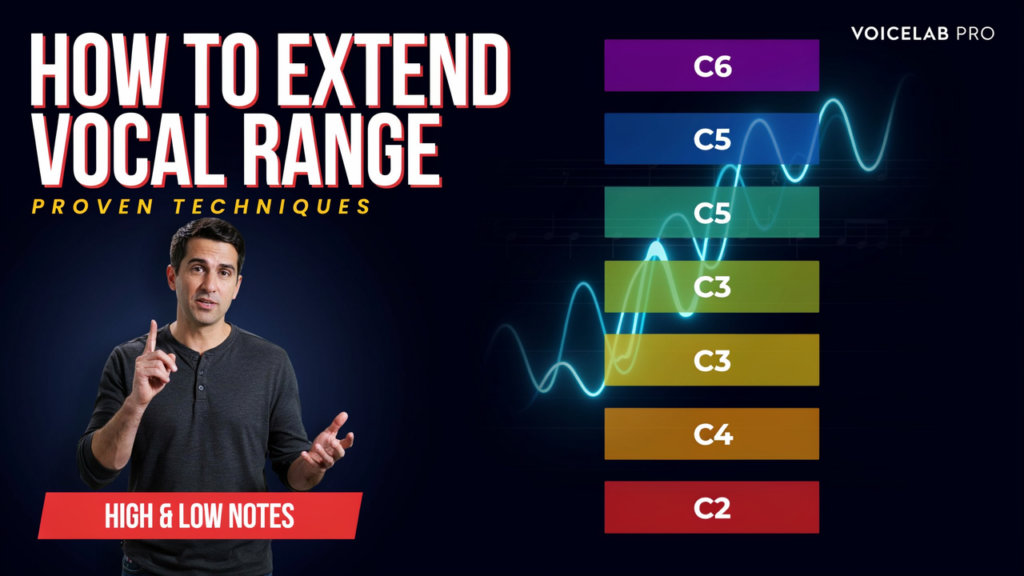
What Actually Determines Your Vocal Range
Your vocal range reflects how effectively your vocal folds stretch and relax, how efficiently your breath supports phonation, and how well your resonance adjusts to changing pitch. Range increases when these systems work in harmony rather than tension.
Many musicians rely on OnlinePitchChanger for practice.
How Vocal Folds Adjust for High and Low Notes
High Notes
- Vocal folds stretch, thin, and increase tension.
- Requires minimal muscular resistance and consistent airflow.
Low Notes
- Vocal folds shorten and thicken, lowering vibration frequency.
- Requires relaxation without collapsing airflow.
The Importance of Breath Regulation
Breath support drives pitch stability.
Breath–Pitch Relationship
- Excess air pressure overloads high notes.
- Weak airflow destabilizes low notes.
- Balanced breath allows the folds to adjust freely.
Resonance Adjustments and Tone Placement
Resonance must shift as pitch changes.
Resonance Principles
- Forward placement helps with high-note clarity and ease.
- Slightly deeper resonance supports low tones.
- Tension in neck, jaw, or tongue disrupts resonance movement.
Register Integration
Chest, mix, and head voice must connect smoothly.
Why Integration Matters
Breaks, cracks, or sudden tone shifts indicate inefficient register transitions—one of the primary limitations on range.
Essential Warm-Ups Before Attempting Range Extension
Warm-ups prepare vocal folds for stretching and relaxing. They build flexibility without strain and should always be done before targeted range work.
Lip Trills
Lip trills equalize airflow and reduce throat tension.
Technique
- Relax lips and allow gentle vibration.
- Glide from low pitches to high and return.
- Maintain steady airflow rather than volume.
Why It Works
Semi-occluded airflow improves efficiency and reduces the muscular effort needed for pitch changes.
Sirens
Sirens activate the full vocal register spectrum.
Technique
- Glide smoothly from your lowest comfortable pitch to your highest on “oo” or “ee.”
Benefits
- Connects chest, mix, and head voice
- Improves flexibility across pitch extremes
- Prepares the folds for range training
Exercises to Extend Upper Vocal Range
Higher notes depend on efficient closure, forward resonance, and minimal tension. These exercises strengthen the technical foundations required for upper-range freedom.
“Gee” Exercise for Forward Resonance
“Gee” encourages bright resonance and helps the folds coordinate cleanly.
Technique
- Use a focused, narrow “Gee.”
- Sing ascending 5-note scales or octave leaps.
- Keep airflow steady without pushing.
Why It Works
The “ee” vowel narrows the vocal tract, creating an acoustically efficient environment for high notes.
“Nay” Octave Slides for Mix Voice Reinforcement
This exercise stabilizes the passaggio (transition zone), crucial for clean upper-range access.
Technique
- Use a slightly brassy, speech-based “Nay.”
- Slide from mid-range to an octave above.
- Keep tone forward and light, not heavy or pushed.
Benefits
- Strengthens mix voice
- Reduces pitch breaks
- Builds upper-range control without strain
Straw Phonation (SOVT)
Widely supported by vocal science, SOVT trains optimal airflow and fold efficiency.
Technique
- Place a straw lightly between the lips.
- Glide from low to high with gentle phonation.
- Maintain consistent airflow through the straw.
Why It Works
Back pressure from the straw stabilizes the folds and improves access to higher notes.
Exercises to Extend Lower Vocal Range
Lower-range expansion requires relaxation, depth of resonance, and controlled airflow rather than force.
Descending Scale Patterns
Descending scales help the folds relax gradually.
Technique
- Use syllables like “Lah,” “Vuh,” or “Yah.”
- Start in mid-range and step downward slowly.
- Allow tone to drop naturally, avoiding artificial darkening.
Benefits
- Enhances low-note clarity
- Improves fold thickening coordination
- Reduces jaw and tongue tension
Gentle Vocal Fry Slides
Vocal fry strengthens closure patterns needed for stable low tones.
Technique
- Produce a quiet, relaxed vocal fry.
- Slide up into modal voice gently.
- Maintain minimal airflow.
Why It Works
Fry trains the folds to maintain closure at low frequencies and supports low-range stability.
Breath-Support Exercises Essential for Range Expansion
Breath management determines how effectively you can maintain pitch control at high and low extremes.
Long Hiss Exercise
Enhances overall breath stability.
Technique
- Inhale quietly for four seconds.
- Exhale on a controlled hiss (“ssss”) for 20–40 seconds.
Benefits
- Smooths airflow
- Reduces strain on high notes
- Builds endurance for sustained phrases
Pulse Hiss Exercise
Improves fine breath control necessary for register transitions.
Technique
- Produce rhythmic pulses: “ss-ss-ss.”
Benefits
- Strengthens micro-coordination
- Stabilizes tone across pitch shifts
- Helps control airflow in delicate areas of the range
A Daily Routine to Extend Vocal Range Efficiently
This structured routine supports long-term progress through consistency rather than intensity. It can be completed in 12–15 minutes.
Step 1: Warm-Up (2 minutes)
Include
- Lip trills
- Sirens
Step 2: Upper-Range Training (4 minutes)
Include
- “Gee” ascending patterns
- “Nay” octave slides
Step 3: Lower-Range Training (2 minutes)
Include
- Descending scales
- Fry slides
Step 4: Breath-Control Development (2–3 minutes)
Include
- Long hiss
- Pulse hiss
Step 5: Cooldown (1 minute)
Include
- Light humming
- Gentle SOVT
Frequency Recommendation
Practice 5–6 days per week, adjusting intensity when fatigued.
Mistakes That Prevent Vocal Range Development
Avoiding common errors accelerates improvement and protects vocal health.
Pushing Chest Voice Beyond Its Functional Range
Why It’s Harmful
Raises the larynx, increases tension, and blocks mix voice engagement.
Relying on Loudness Instead of Technique
Why It Fails
High notes require precision in resonance, not brute force.
Tension in Tongue, Jaw, or Neck
Consequence
Restricts resonance mobility and limits pitch accessibility.
Neglecting Breath Consistency
Result
Cracking, instability, and premature fatigue.
Training Without Warm-Ups
Result
Cold vocal folds resist stretching and risk strain.
How Long It Takes to Extend Vocal Range
Range extension is gradual, but consistent training produces predictable progress.
Expected Timeline
Weeks 2–3
Improved fluidity in register transitions.
Weeks 4–6
More reliable access to higher and lower notes.
Weeks 8–12
- To understand how wider notes are physically produced, this explainer on how the vocal cords work gives essential context.
- When choosing which notes to focus on, knowing what tessitura means helps target safe practice.
- Many singers track progress toward a three-octave span as a practical milestone.
- For drills that directly support this goal, these range-building exercises are a core resource.
- To see how professionals manage wide ranges, this profile of Brendon Urie’s voice offers a useful example.
- Understanding extreme high notes becomes clearer with this guide to whistle voice technique.
- For singers pushing limits, this overview of vocal coaching benefits explains why expert guidance matters.

Mayer is a music production and audio editing writer specializing in pitch shifting, vocal processing, sound manipulation, and online audio tools for musicians, producers, singers, and creators. He creates practical content focused on pitch changing, vocal editing workflows, audio enhancement, and music production techniques.