
SZA’s vocal range spans approximately Eb3 to Bb5 — about two and a half to three octaves. She is classified as a light lyric mezzo-soprano, with a tessitura centred in the mid-range and a vocal approach built around breathy, intimate delivery, controlled airflow, and emotional directness rather than power or technical display.
Her voice is one of the most distinctive in contemporary R&B — not because of its range width or technical ambition, but because of the specific tonal quality she has developed: a soft, slightly airy, conversational delivery with precise pitch control that makes technically demanding soft singing sound effortless. It is not effortless. Maintaining a consistent, controlled breathy tone at low volumes with accurate pitch and emotional charge is a genuine technique.
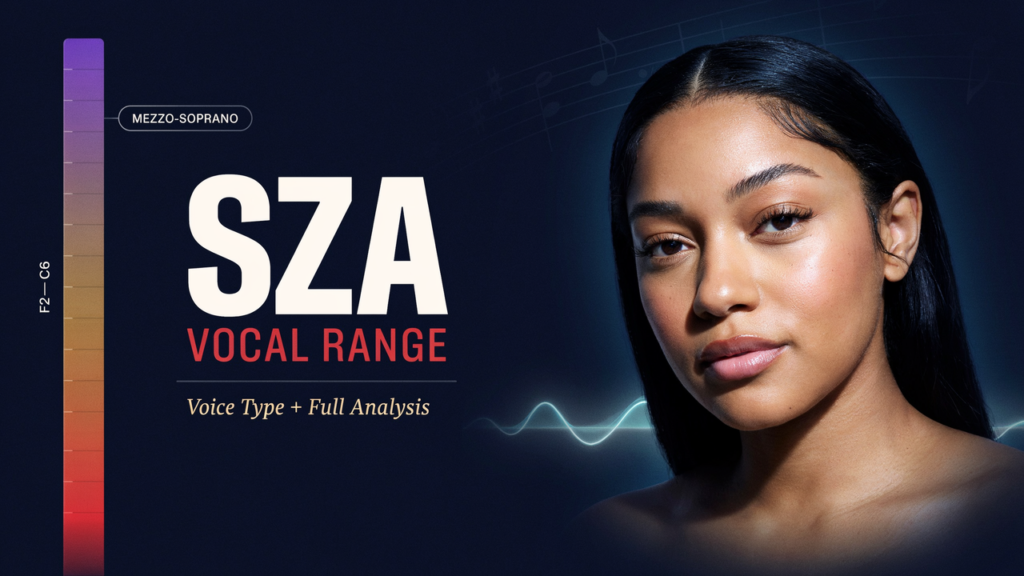
Vocal Range at a Glance
| Lowest documented note | Eb3 |
| Highest documented note | Bb5 (head voice/falsetto) |
| Approximate span | ~2.5–3 octaves |
| Voice type | Light lyric mezzo-soprano |
| Tessitura | A3 – D5 |
| Strongest register | Mid-range; airy head voice; mix |
Voice Type — Light Lyric Mezzo-Soprano
SZA is a light lyric mezzo-soprano. The mezzo classification reflects where her voice sits most naturally — the A3–D5 zone — which is the mid-register characteristic of the mezzo-soprano voice type. The “light” qualification reflects the relatively low weight her voice carries: it is not a heavy, dramatic mezzo but a lighter, more agile voice with a softer tonal character.
Her voice type is sometimes confused with soprano because her head voice and falsetto extensions reach into soprano territory — Bb5 has been documented in performances. But her most characteristic, resonant, and natural zone is firmly in the mezzo range. The airy quality of her delivery makes her sound lighter than she is; the actual tessitura tells the story of a mezzo-soprano rather than a soprano.
What Makes Her Sound Distinctive
Controlled breathiness. SZA’s signature sound involves a specific air-to-sound ratio — enough breathiness to create intimacy and vulnerability, but with sufficient support to keep pitch accurate and tone consistent. This is much harder than it sounds. Uncontrolled breathiness produces wobbly, pitchy singing; SZA’s controlled version produces a specific emotional effect that has defined her stylistic identity.
Conversational phrasing. Her vocal delivery follows the cadence of natural speech very closely — the rhythm, the emphasis, the slides between words all follow how the lyric would feel if spoken rather than sung. This gives her performances an immediacy and authenticity that formal vocal training often works against.
Mix voice deployment. Most of her strongest upper notes are produced in mix — a blend of chest and head voice coordination — rather than in pure chest belt. This allows her to reach notes in the C5–Bb5 zone without the pushed, strained quality that a heavier belt approach would produce.
Harmonic layering. In studio recordings, SZA’s voice is often layered in complex harmonics — her own voice stacked in multiple parts to create a full, textured sound from a single instrument. This production technique is inseparable from her artistic identity and requires both pitch accuracy and tonal consistency across multiple takes.
Notable Songs That Showcase Her Voice
“Good Days” (2021) — The most technically demanding showcase of her approach. The airy, controlled delivery at soft dynamics across an extended melody requires exceptional breath support. Deceptively difficult to sing.
“Kill Bill” (2022) — Clear demonstration of her mid-range tessitura. The voice is at its most natural and resonant in this zone.
“Snooze” (2022) — Emotional ballad delivery. Shows her dynamic range and the way she uses dynamics as an expressive tool rather than simply a volume control.
“Shirt” (2022) — Lower register focus. Shows the Eb3–A3 zone and the characteristically warm, slightly dark quality of her lower chest voice.
“Love Galore” (2017) — Earlier career showcase. The layered harmonics demonstrate the studio technique and the voice’s capability in the mid-range.
“Broken Clocks” (2017) — Upper register head voice use. Demonstrates the airy, light quality of her falsetto at its most characteristic.
Singing SZA Songs — What to Expect
SZA’s songs are frequently described as “easy to listen to, hard to sing” — an accurate observation. The challenge is not range but technique. Maintaining the controlled breathiness, the conversational phrasing, and the precise pitch at soft dynamics requires more technical development than most people expect from material that sounds this gentle.
For singers trying SZA songs in their own key, the online key changer can shift the key up or down to place the melody in the most comfortable part of your range. Her tessitura (A3–D5) suits mezzo-sopranos well in the original keys; sopranos may want to transpose up by 1–2 semitones; altos may need to transpose down.
The what key should I sing in guide walks through the full process of matching a song to your voice.
Frequently Asked Questions
What is SZA’s vocal range?
Approximately Eb3 to Bb5 — about two and a half to three octaves. Her working range in most recorded material sits between A3 and D5, which is her natural tessitura. Head voice and falsetto notes up to Bb5 appear in specific performances.
What voice type is SZA?
Light lyric mezzo-soprano. Her tessitura centres around A3–D5, which is the mid-register characteristic of the mezzo-soprano voice type. The “light” qualifier reflects the relatively low weight and airy quality of her voice rather than a heavy, powerful mezzo character.
Why is SZA difficult to sing despite her soft delivery?
Controlled soft singing requires more technical precision than loud singing. The controlled breathiness she uses — maintaining a consistent air-to-sound ratio without pitch wavering — requires developed breath support. Add in her conversational phrasing, subtle dynamic shaping, and precise pitch at low volumes, and SZA’s songs are technically demanding in ways that are not obvious from the recordings.
How does SZA’s voice compare to Billie Eilish?
Both use soft, breathy, intimate delivery as their primary expressive tool, and both are classified as mezzo-sopranos. SZA’s voice tends to sit slightly higher (her tessitura is A3–D5 vs Eilish’s C4–D5), and her production style uses more harmonic layering. Eilish’s approach is more ASMR-influenced and close-miked; SZA’s is more R&B-rooted with more melodic ornamentation. Both represent a generation of female vocalists who built careers on restraint rather than power.
Related Pages
Billie Eilish Vocal Range — contemporary soft-delivery mezzo comparison. Adele Vocal Range — mezzo-soprano with contrasting power-based approach. Taylor Swift Vocal Range — mezzo-soprano storytelling comparison. Female Voice Types Compared — soprano, mezzo-soprano, alto explained. Vocal Ranges — Complete Guide — all voice types with ranges. Online Key Changer — transpose SZA songs to your key. What Key Should I Sing In — find the right key for your voice.

Mayer runs Online Pitch Changer (OnlinePitchChanger.com) independently. Mayer maintains the site’s free browser tools for changing the pitch, key and tempo of audio, video and voice, and writes and checks its guides on keys, semitones, transposition and vocal ranges. Each rebuilt tool is tested before release with measured test tones, and app steps in the guides are checked against official manuals such as the Audacity manual and Apple’s GarageBand guide. Audio processed with the tools never leaves the reader’s browser. Mayer is not affiliated with YouTube, Google or any audio software company. For corrections or tool problems, see the Contact page.