
Mariah Carey’s documented vocal range spans F2 to G7 — over five octaves — making her one of the most ranged vocalists in the documented history of popular music. Her voice type is a lyric coloratura soprano: a soprano characterised by a light, agile quality and exceptional upper register extension, including one of the most discussed and well-documented whistle registers in contemporary music.
She is the most direct benchmark for whistle register capability in pop — the standard against which other singers with extended upper registers are measured. Her 1991 single “Emotions,” which reaches a G7 in the whistle register, remains one of the most analysed vocal moments in pop history.
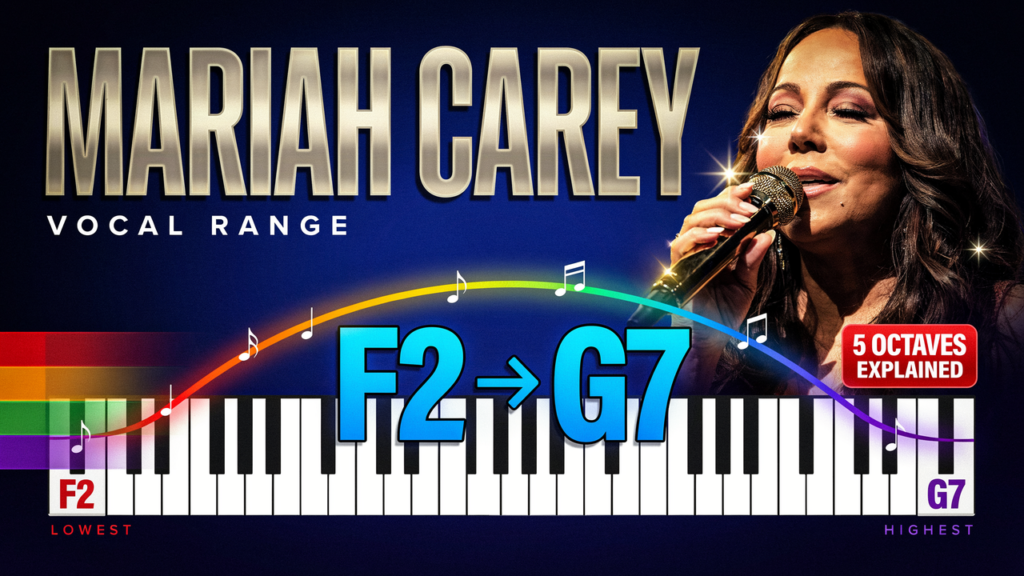
Vocal Range at a Glance
| Lowest documented note | F2 |
| Highest documented note | G7 (whistle register) |
| Approximate span | ~5 octaves |
| Voice type | Lyric coloratura soprano |
| Tessitura | G4 – G5 |
| Whistle register | Yes — documented to G7 |
| Belt ceiling | ~E5 (in prime years) |
Voice Type — Lyric Coloratura Soprano
Mariah Carey is a lyric coloratura soprano. The coloratura designation reflects her exceptional upper register agility — the capacity for rapid, ornate melismatic passages across multiple registers, including the whistle register. The lyric qualification distinguishes her from a dramatic soprano: her voice carries light to moderate weight, with an agility and flexibility that heavier voices cannot match.
Her tessitura sits in the G4–G5 zone — the upper-middle soprano range — where her voice resonates most naturally and powerfully. Notes below E4 are accessible but thinner and less characteristic of her natural voice; notes in the G4–E5 zone are where the voice has its most distinctive quality.
The Whistle Register
Mariah Carey’s whistle register is her most discussed vocal attribute. Documented starting around G6 and extending to G7 in her prime, the whistle register produces a piercing, flute-like tone that is immediately recognisable.
Her “Emotions” (1991) contains the most documented whistle register passage in contemporary pop — a G7 that she sang with apparent ease. Her ability to sustain, move pitch within, and execute rapid passages in the whistle register — rather than simply touching isolated notes — is what distinguishes her whistle register use from less developed examples.
The whistle register is discussed in detail in the whistle register guide. Ariana Grande is the most frequently cited contemporary artist with comparable whistle register capability, though her range does not extend as high as Carey’s documented G7.
Technical Characteristics
Melismatic agility. Mariah Carey’s vocal runs are among the fastest and most accurate in pop history. The rapid movement across multiple notes and registers — with consistent pitch accuracy and tonal control — is the defining technical feature alongside the whistle register.
Head voice and whistle register connection. Where many singers have an audible break between head voice and whistle register, Carey developed an unusually smooth transition. Her ability to glide from head voice into whistle register without an obvious disconnection is one of the most studied features of her technique.
Belt quality. At her peak (late 1980s–early 2000s), her belt up to approximately E5 was powerful, bright, and well-supported. Her belt has been more variable in later years — a common development in voices that experienced sustained high-intensity use — but at its peak was one of the most resonant soprano belts in pop.
Emotional expressiveness. The technical capability is well-documented; equally significant is her ability to deploy it in service of emotional delivery. Her slowdown of melismatic runs at moments of high emotional intensity — using fewer, more sustained notes rather than demonstrating agility — shows an awareness that technique serves the song, not the reverse.
Notable Songs
“Emotions” (1991) — The whistle register showcase. G7 documented. Also demonstrates the melismatic agility across the full range from lower passages through to the whistle register ceiling.
“I’ll Be There” (1992, MTV Unplugged) — Considered by many to be the finest live vocal performance of her career. Full range demonstrated in an acoustic context without production enhancement.
“Hero” (1993) — Sustained belt quality in the mid-range. Emotional delivery as the primary focus.
“Always Be My Baby” (1996) — The melismatic runs in the head voice zone at the peak of her commercial success.
“Heartbreaker” (1999) — Upper register showcase with falsetto passages.
Frequently Asked Questions
What is Mariah Carey’s vocal range?
F2 to G7 — over five octaves, including whistle register. Her working range in most recorded material sits between G4 and E5, with the whistle register appearing in specific songs and passages.
Does Mariah Carey still have her full range?
Her range has changed significantly since her peak years in the early 1990s and 2000s. The lower register has become more accessible and the belt quality has been more variable in recent years. The whistle register — while still accessible — does not appear as consistently or at the same pitch ceiling as in her prime. This is a normal development for voices that experienced sustained intensive use.
How does Mariah Carey’s range compare to Whitney Houston’s?
Mariah Carey’s range is wider — approximately five octaves versus Whitney Houston’s approximately three. Whitney Houston’s belt zone was arguably more powerful at equivalent pitches. The two voices are different instruments: Carey’s is lighter and more agile with extreme upper range; Whitney’s is heavier and more powerful with a shorter but more concentrated belt zone. See Whitney Houston vocal range.
Related Pages
Ariana Grande Vocal Range — most comparable contemporary whistle register. Whitney Houston Vocal Range — contemporary comparison. Whistle Register Guide — how the whistle register works. Vocal Ranges — Complete Guide — all voice types with ranges. Online Key Changer — transpose Mariah Carey songs to your key.

Mayer runs Online Pitch Changer (OnlinePitchChanger.com) independently. Mayer maintains the site’s free browser tools for changing the pitch, key and tempo of audio, video and voice, and writes and checks its guides on keys, semitones, transposition and vocal ranges. Each rebuilt tool is tested before release with measured test tones, and app steps in the guides are checked against official manuals such as the Audacity manual and Apple’s GarageBand guide. Audio processed with the tools never leaves the reader’s browser. Mayer is not affiliated with YouTube, Google or any audio software company. For corrections or tool problems, see the Contact page.