
Ed Sheeran’s vocal range spans approximately G2 to B5, with falsetto extensions documented to A5 in live performance. His voice type is a light lyric tenor — though his warm, conversational tone leads some to misclassify him as a baritone. The tenor classification is supported by where his songs consistently sit melodically, the location of his passaggio, and the natural brightness his voice takes on above E4.
His vocal approach is deliberately understated — prioritising storytelling delivery, conversational phrasing, and emotional directness over technical display. He is often compared to Bob Dylan or James Taylor in his approach: a songwriter first, whose voice serves the lyric rather than demonstrating range or power.
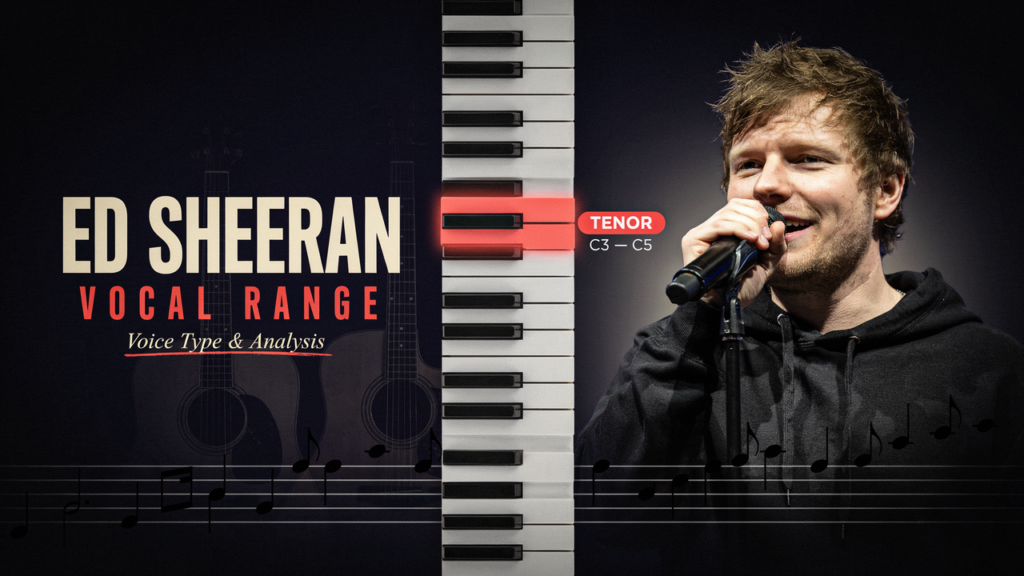
Vocal Range at a Glance
| Lowest documented note | G2 |
| Highest documented note | B5 (falsetto) |
| Approximate span | ~3 octaves |
| Voice type | Light lyric tenor |
| Tessitura | G3 – A4 |
| Strongest register | Mid-range; light mix and falsetto |
Voice Type — Light Lyric Tenor
Ed Sheeran is a light lyric tenor. The most common point of confusion is that his speaking voice is warm and relatively low, which leads to baritone assumptions. But tone colour is not the same as voice type. His songs consistently sit in the tenor melodic range, his passaggio falls in the tenor zone (around D4–E4), and his upper register is light and agile — characteristics of a lighter tenor voice rather than a baritone.
The “light” designation reflects a voice without significant weight or chest power. Where a dramatic tenor fills a concert hall with volume, Sheeran’s voice is conversational, intimate, and flexible — suited to acoustic singer-songwriter contexts rather than operatic or belt-heavy pop.
Technical Characteristics
Storytelling delivery. The most dominant feature of his vocal approach. He prioritises the rhythm, articulation, and emotional delivery of lyrics over technical vocal display. His precise rhythmic placement of words — particularly in his rap-influenced passages — is central to his artistic identity.
Falsetto. His falsetto is extensive, light, and well-controlled, regularly reaching A5 in live performance. It serves as both an expressive register and a range extension — the contrast between the conversational chest voice and the lighter falsetto is one of his primary dynamic tools.
Mix technique. Sheeran blends chest and head voice smoothly, particularly in the B4–D5 zone where many tenors show register instability. His mix is light and well-managed, enabling the smooth dynamic shifts characteristic of his ballad work.
Melodic phrasing. Particularly in his earlier acoustic material, his phrasing follows speech rhythms closely — sentences breathe naturally, emphasis falls where it would in spoken language. This gives his singing an immediacy and directness that formal technique rarely produces.
Notable Songs That Showcase His Voice
“Shape of You” (2017) — Mid-range focus in the G#2–B3 zone, showing the lower end of his working range.
“Photograph” (2014) — C3 to C5 range, demonstrating his comfortable tessitura across the full song.
“Perfect” (2017) — G3 to G#4, sitting squarely in his most resonant zone. Clean demonstration of his mid-range quality.
“Bad Habits” (2021) — Upper range focus, with the melody reaching B5 in falsetto, showing his extended upper register.
“Give Me Love” (2011) — G2 to B4, one of his most complete showcases across the full working range.
Frequently Asked Questions
Is Ed Sheeran a tenor or baritone?
A light lyric tenor. His warm tone suggests baritone to some listeners, but his melody placement, passaggio location, and upper register capability all align with tenor classification. His tessitura (G3–A4) sits comfortably in the tenor range.
What is Ed Sheeran’s vocal range?
Approximately G2 to B5, with falsetto extensions documented to A5 in live performance — approximately three octaves total. His working range for most songs sits between C3 and A4.
Can I sing Ed Sheeran songs as a baritone?
Yes. Most of his songs sit in a range that is comfortably accessible for baritones, particularly those with a strong upper register. The G3–A4 tessitura falls within baritone territory as well as tenor, and the falsetto sections are often within reach. Use the online key changer if you need to lower specific songs by a semitone or two.
Related Pages
Bob Dylan Vocal Range — baritone storyteller comparison. Billy Joel Vocal Range — singer-songwriter baritone comparison. Bruno Mars Vocal Range — contrasting tenor with more belt power. Male Voice Types Compared — tenor, baritone, bass explained. Vocal Ranges — Complete Guide — all voice types with ranges. Online Key Changer — transpose Ed Sheeran songs to your key.

Mayer runs Online Pitch Changer (OnlinePitchChanger.com) independently. Mayer maintains the site’s free browser tools for changing the pitch, key and tempo of audio, video and voice, and writes and checks its guides on keys, semitones, transposition and vocal ranges. Each rebuilt tool is tested before release with measured test tones, and app steps in the guides are checked against official manuals such as the Audacity manual and Apple’s GarageBand guide. Audio processed with the tools never leaves the reader’s browser. Mayer is not affiliated with YouTube, Google or any audio software company. For corrections or tool problems, see the Contact page.