
Taylor Swift’s vocal range spans approximately A2 to G5 — just over three octaves. Her voice type is most accurately classified as a light-lyric mezzo-soprano, though vocal analysts occasionally argue for light-lyric soprano based on where her songs tend to sit. The disagreement itself is informative: her voice sits on the boundary between the two classifications, which is why the debate persists.
What defines Taylor Swift vocally is not range extremes or technical pyrotechnics. It is consistency, expressive precision, and a storytelling delivery that prioritises clarity and emotional communication over demonstrating vocal athleticism.
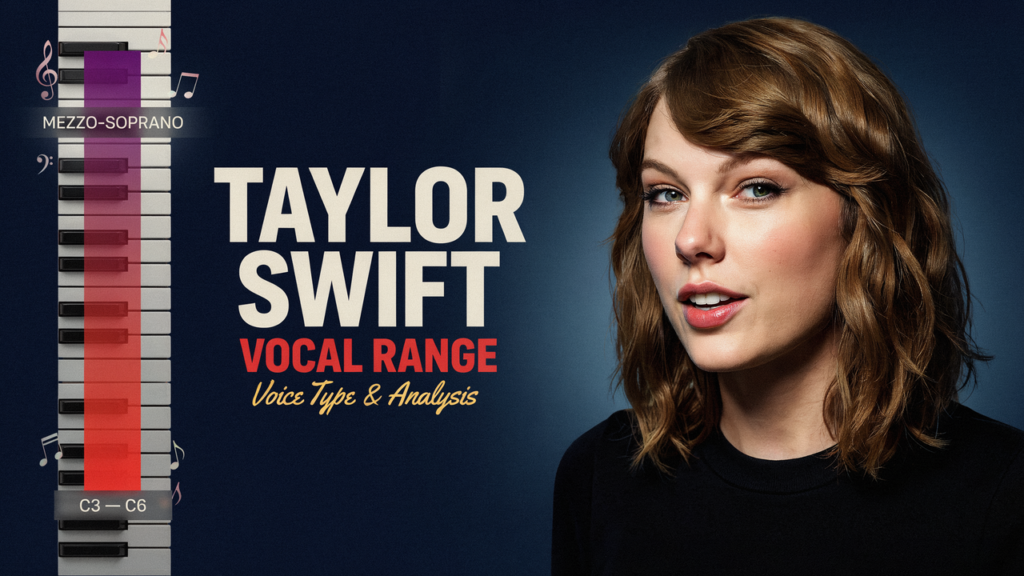
Vocal Range at a Glance
| Lowest documented note | A2 |
| Highest documented note | G5 (head voice extensions to D6 noted) |
| Approximate span | ~3 octaves |
| Voice type | Light-lyric mezzo-soprano |
| Tessitura (sweet spot) | B4 – D5 |
| Strongest register | Mid-range and chest-head transition zone |
Voice Type — Mezzo-Soprano or Soprano?
The classification debate around Taylor Swift is one of the more discussed in contemporary pop vocal analysis. The key facts:
The case for mezzo-soprano: Her songs consistently sit in the mid-register. Her tessitura — where the voice sounds most natural and resonant — centres around B4 to D5, which is slightly lower than a typical soprano tessitura. Her lower register is usable and present, with documented notes as low as A2. She rarely ventures above E5 in chest voice or G5 in head voice, which is a relatively moderate ceiling for a soprano.
The case for light-lyric soprano: Her songs actually sit quite high relative to true mezzo-soprano repertoire. Her lower register below E3 tends to become airy and thin, which is more characteristic of a soprano whose voice loses weight at the low end than a mezzo whose lower register is typically a strength. Some analysts classify her as a light-lyric soprano with an unusually low speaking voice and a tessitura that pulls lower than most sopranos.
The most accurate practical label is light-lyric mezzo-soprano — a mezzo-soprano subtype with a bright, youthful tone, a comfortable tessitura in the middle register, and a range that extends modestly into soprano territory at the top without the full soprano weight and projection in the upper register.
Tessitura — Where Her Voice Actually Lives
Taylor Swift’s tessitura sits around B4 to D5. This is the zone where her voice sounds most natural, most resonant, and most emotionally direct. It is where she spends the majority of her time across most of her catalogue, and it is where her characteristic clarity and expressiveness are most evident.
The practical implication for singers: Taylor Swift’s songs are generally more singable for mezzo-sopranos and lighter sopranos than for true sopranos who need material in the upper register, or for altos whose voices are most comfortable below A3. Her music sits in the mid-register — not too high, not too low — which is part of why it appeals to such a wide range of casual singers.
Registers and Technical Characteristics
Lower register (below E3): Taylor Swift’s lower range extends to A2, which is impressively low for her voice type. However, notes below E3 tend to become airy and lack the density and projection of a true contralto or mezzo-soprano in that zone. She uses these notes for emotional effect — particularly in her country and folk-influenced material — rather than for display purposes.
Middle register (E3–B4): The most reliable and consistent part of her voice. Here the tone is warm, clear, and expressive. Her storytelling delivery — the conversational, direct quality that defines much of her vocal approach — is most natural in this zone.
Upper register (B4–E5): Her tessitura zone, where the voice is at its brightest and most resonant. The chest-to-head voice transition is managed smoothly. This is where the emotional peaks of most of her songs land.
Head voice (E5–G5): Accessible and clear, though lighter and less powerful than her mid-range. She uses head voice deliberately for specific moments — she rarely pushes into the upper extremes.
Register switching: One of Taylor Swift’s consistent technical strengths is her ability to move between chest and head voice cleanly and without an audible break. This gives her performances a smooth, connected quality across the range.
What Makes Her Voice Work
Taylor Swift is not a technically exceptional singer in the way that Mariah Carey, Whitney Houston, or Ariana Grande are considered exceptional. She has no documented whistle register, no extraordinary high notes, and her live performances have historically been inconsistent compared to studio recordings. What she does exceptionally well is different:
Storytelling delivery. Her vocal choices serve the narrative of the lyric — pitch inflections, rhythmic placement, and dynamic shifts are deployed in service of the story rather than vocal exhibition. This is a legitimate and demanding skill.
Consistency across long performances. The Eras Tour ran over three hours per night, and maintaining consistent tone and pitch across that duration at stadium volume is a serious athletic and technical achievement.
Register transitions. The movement between her lower, middle, and upper register is consistently smooth — a technical foundation that enables the expressive range of her performances.
Emotional directness. The quality of her tone in the mid-register has a particular clarity and vulnerability that is immediately recognisable and effective at communicating emotional content.
Notable Songs That Showcase Her Range
“Cruel Summer” (2019) — Uses an A2 in the low octave section and an A3 in the higher octave of the same phrase, demonstrating her lower register and the span of her working range clearly.
“I Don’t Wanna Live Forever” with ZAYN (2017) — Contains an E5 that represents the upper ceiling of her documented chest voice range.
“Shake It Off” (2014) — Mid-register focused, sitting comfortably in her tessitura and demonstrating the bright, forward quality of her voice in its natural zone.
“All Too Well (10-Minute Version)” (2021) — One of the strongest showcases of her emotional range as a singer. The performance sits almost entirely in her tessitura and demonstrates her ability to sustain intensity without relying on high notes.
Comparing Taylor Swift to Artists with Similar Ranges
If you want to sing Taylor Swift songs and need to know how the key relates to your voice:
Her catalogue is generally accessible to mezzo-sopranos and lighter sopranos singing in their natural range. Songs like “Love Story,” “Blank Space,” and “Anti-Hero” sit in a mid-register key that suits a comfortable mezzo tessitura.
For male singers, Taylor Swift songs typically need to be transposed down by approximately one octave (12 semitones) or worked in the original key as a head-voice arrangement. Use the online key changer to shift any of her backing tracks to a key that suits your range.
For a full comparison of where her range sits relative to other artists, see the complete vocal ranges guide.
Frequently Asked Questions
What is Taylor Swift’s vocal range?
Taylor Swift’s documented vocal range spans approximately A2 to G5 — just over three octaves. Her working range for most of her recorded material sits between D3 and E5, with her tessitura (the zone where her voice sounds most comfortable and resonant) centred around B4 to D5.
Is Taylor Swift a soprano or mezzo-soprano?
Most vocal analysts classify her as a light-lyric mezzo-soprano, though some argue for light-lyric soprano based on where her songs tend to sit melodically. The debate is genuinely contested — her voice sits on the boundary between the two classifications. Mezzo-soprano is the more commonly cited label and the more accurate one given her tessitura location.
Can a soprano sing Taylor Swift songs?
Yes. Taylor Swift’s songs sit in a range that is accessible to both sopranos and mezzo-sopranos. The keys of her recorded material are generally comfortable for female voices singing in the mid-to-upper part of their range. True altos may find her higher chorus passages a stretch without transposing down.
How does Taylor Swift’s voice compare to Adele’s?
Both are classified as mezzo-sopranos, but the voices are quite different. Taylor Swift’s voice is brighter, lighter, and more youthful in tone — a lyric quality with less weight in the lower register. Adele’s voice is heavier, darker, and more powerful in the lower-middle register, with a belt quality that Taylor Swift does not typically employ. See Adele vocal range for the full comparison.
Related Pages
Adele Vocal Range — fellow mezzo-soprano comparison. Billie Eilish Vocal Range — another contemporary mezzo-soprano. Beyoncé Vocal Range — soprano comparison. Vocal Ranges — Complete Guide — all voice types with ranges and Hz data. Online Key Changer — transpose Taylor Swift songs to your key. Vocal Range Test — find out how your range compares. Female Voice Types Compared — soprano, mezzo-soprano, alto explained.

Mayer runs Online Pitch Changer (OnlinePitchChanger.com) independently. Mayer maintains the site’s free browser tools for changing the pitch, key and tempo of audio, video and voice, and writes and checks its guides on keys, semitones, transposition and vocal ranges. Each rebuilt tool is tested before release with measured test tones, and app steps in the guides are checked against official manuals such as the Audacity manual and Apple’s GarageBand guide. Audio processed with the tools never leaves the reader’s browser. Mayer is not affiliated with YouTube, Google or any audio software company. For corrections or tool problems, see the Contact page.