
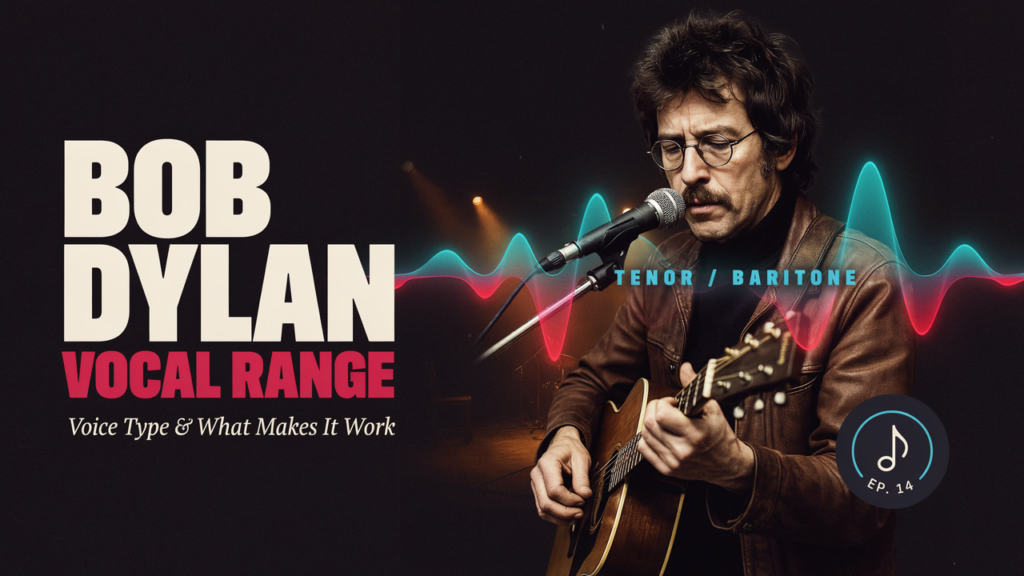
Bob Dylan’s vocal range spans approximately G2 to C5 — about two and a half octaves. He is a baritone, with a naturally warm and slightly rough-edged voice in the lower-middle male range. His is one of the most controversial voices in popular music history — a voice that serious critics and scholars have debated since his first recordings, and that has never been described as conventionally beautiful.
What has never been debated is the effectiveness of his voice as a vehicle for his material. No singer in the history of American popular music has demonstrated more clearly that technical voice quality is one dimension of singing, and expression is another — and that the second matters more than the first.
Vocal Range at a Glance
| Lowest documented note | G2 |
| Highest documented note | C5 |
| Approximate span | ~2.5 octaves |
| Voice type | Baritone |
| Tessitura | A2 – E4 |
| Strongest register | Mid-range; conversational delivery |
Voice Type — Baritone
Bob Dylan is a baritone. His natural voice sits in the lower-middle male range, with a warm, slightly nasal quality in the mid-register that is immediately recognisable. His voice has deepened and changed significantly over his career — particularly from his early acoustic folk years (where the voice was higher and lighter) through to his later recordings (where it settles into a deeper, rougher quality).
The change reflects normal vocal development — particularly the deepening effect that sustained performing through six decades produces — rather than vocal damage.
What Makes His Voice Work
Rhythmic precision. Dylan’s vocal delivery is precisely rhythmic — even when it sounds conversational or approximate, the placement of syllables against the beat is intentional and exact. This is the foundation of the apparent effortlessness of his phrasing.
Lyric servicing. His voice functions as a delivery mechanism for the lyric. Every vocal choice — pitch inflection, emphasis, ornament, timing — is calibrated to serve the meaning of the words rather than demonstrate vocal quality. This is rare.
Nasal placement. The characteristic nasal quality of his voice — audible throughout his career — is a stylistic choice as much as a natural feature. It adds a clarity and specificity to his diction that a rounder, more conventionally beautiful tone might obscure.
Evolution as choice. The changes in his voice across decades have been incorporated into his art rather than resisted. The rougher, deeper voice of his later career is not a diminished version of his earlier voice — it is a different instrument being used differently.
Notable Songs
“Blowin’ in the Wind” (1963) — Early showcase. The lighter quality of the young voice in its characteristic delivery.
“Like a Rolling Stone” (1965) — The mid-career breakthrough. The compressed, slightly confrontational quality of his mid-range at peak commercial power.
“Tangled Up in Blue” (1975) — Storytelling delivery at its most refined. The full mid-range across a complex narrative lyric.
“Not Dark Yet” (1997) — Later career. The deeper, rougher voice in a more reflective context.
Frequently Asked Questions
What is Bob Dylan’s vocal range?
G2 to C5 — approximately two and a half octaves. This is a modest range by pop star standards but genuinely sufficient for his entire catalogue.
What voice type is Bob Dylan?
Baritone. His natural voice sits in the lower-middle male range. The voice has deepened significantly over his career through natural aging and sustained use, but the baritone classification holds throughout.
Related Pages
Ed Sheeran Vocal Range — light tenor storyteller comparison. Billy Joel Vocal Range — baritone singer-songwriter comparison. Elton John Vocal Range — baritone pop era comparison. Baritone Vocal Range — his voice type explained. Online Key Changer — transpose Bob Dylan songs to your key.

Mayer is a music production and audio editing writer specializing in pitch shifting, vocal processing, sound manipulation, and online audio tools for musicians, producers, singers, and creators. He creates practical content focused on pitch changing, vocal editing workflows, audio enhancement, and music production techniques.