
Billie Eilish’s documented vocal range spans approximately A2 to G5 — about two and a half to three octaves. Her voice type is a lower mezzo-soprano: a mezzo-soprano whose tessitura sits toward the darker, lower end of the mezzo range, with a chest voice that carries a characteristically husky, intimate quality in the lower register.
What defines Billie Eilish vocally is not range width or technical power but the opposite: restraint, breath, intimacy, and a deliberate use of softness and airiness that has become one of the most imitated vocal styles in contemporary pop. Her approach centres on what is absent — the power, brightness, and volume that most pop singers emphasise — and what fills the space instead: vulnerability, precision at low volumes, and an extraordinary tonal control that works specifically at the close-miked, intimate end of the dynamic spectrum.
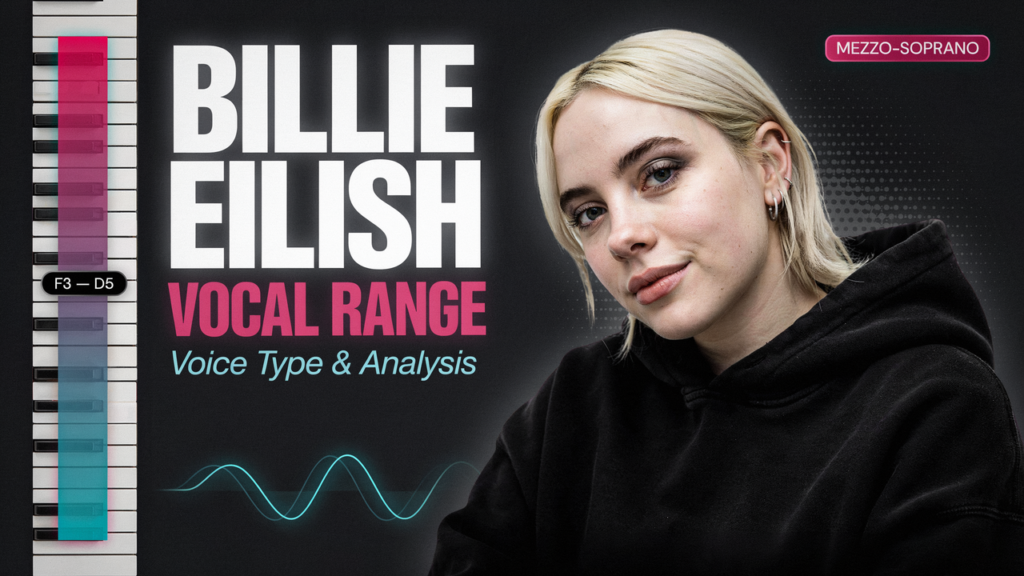
Vocal Range at a Glance
| Lowest documented note | A2 |
| Highest documented note | G5 (head voice) |
| Approximate span | ~2.5–3 octaves |
| Voice type | Lower mezzo-soprano |
| Tessitura | C4 – D5 |
| Strongest register | Mid-range and chest voice; breathy head voice |
Voice Type — Lower Mezzo-Soprano
Billie Eilish is a mezzo-soprano whose natural tessitura sits toward the lower end of the mezzo range. The classification is mezzo-soprano rather than contralto — she is often perceived as darker and lower than she is because of her deliberately breathy, intimate delivery, but her voice does not have the weight and chest resonance of a true contralto in the C3–F4 zone.
Her most comfortable and characteristic vocal zone sits between C4 and D5. Her chest voice at A2–D4 carries a dark, husky quality that is unusual for her age and gives her music an atmospheric depth, but the voice above D4 becomes lighter and brighter — more characteristic of a mezzo-soprano than a lower voice type.
The “lower” qualification distinguishes her from a more typical mezzo whose tessitura sits around E4–F5. Eilish’s songs consistently sit lower, her chest voice quality darker, and her overall tonal profile sits closer to the alto register without having the defining characteristics of a true contralto.
What Makes Her Sound Distinctive
Breathy delivery as technique. The high air-to-sound ratio in her chest voice — the breathiness — is deliberate and controlled, not a technical limitation. Eilish uses airiness as an expressive tool, creating an intimacy and vulnerability that carries emotional weight. This requires genuine technical control: maintaining a consistent breathy quality without the sound cutting out or becoming unstable.
Soft dynamics as a primary tool. Where most pop singers build emotional climaxes through volume and power, Eilish builds them through restraint. Her performances often become more intense as they get quieter — the opposite of the standard pop dynamic model.
Close-miked production. The recording and production approach developed with her brother Finneas amplifies the intimate vocal style — the microphone closeness that turns breath into music and makes whispers carry. This is inseparable from the vocal style itself; the voice and the production are designed together.
Head voice quality. Her head voice is bright, clear, and piercing — notably brighter than the darker quality of her chest voice. The contrast between the two registers is one of her defining sonic characteristics, particularly on songs like “Ocean Eyes.”
Notable Songs That Showcase Her Voice
“Ocean Eyes” (2016) — The early showcase. Head voice quality at its clearest and most distinctive.
“When the Party’s Over” (2018) — Full display of the breathy, intimate delivery technique across the mid-range tessitura.
“Bury a Friend” (2019) — Demonstrates the darker, lower register quality and the dynamic contrast between whispered verses and stronger passages.
“No Time to Die” (2020) — The most orchestrally produced vocal performance. Shows her upper register capability and dynamic range in a more traditional power-ballad context.
“Happier Than Ever” (2021) — Most dramatic dynamic range in her catalogue. The quiet verse to loud, aggressive chorus contrast is one of the starkest in contemporary pop.
Frequently Asked Questions
What is Billie Eilish’s vocal range?
Billie Eilish’s documented vocal range spans approximately A2 to G5 — about two and a half to three octaves. Her working range in most recorded material sits between C4 and D5, with lower notes appearing in specific passages and head voice notes in the G5 zone appearing in select recordings.
Is Billie Eilish a mezzo-soprano?
Yes — most vocal analysts classify her as a mezzo-soprano, specifically a lower mezzo-soprano with a tessitura that sits toward the darker end of the mezzo range. She is not a contralto, despite the perception that her voice sits low, because her upper register becomes lighter and brighter rather than retaining the chest weight of a true contralto.
Why does Billie Eilish sing so softly?
The soft, breathy delivery is a deliberate artistic choice and a core element of her vocal identity — not a technical limitation. Maintaining consistent, controlled breathiness at low volumes requires significant technique. The approach is integral to the emotional effect of her music, and the production style (close-miking, minimal room ambience) is designed specifically around it.
What key are Billie Eilish songs in?
Her songs span a range of keys but tend to sit in keys that place the melody in the C4–D5 range — her tessitura. For finding the key of any specific track use the song key finder. For transposing to a different key, use the online key changer.
Related Pages
Taylor Swift Vocal Range — lighter mezzo-soprano comparison. Adele Vocal Range — fellow mezzo-soprano with different stylistic approach. Amy Winehouse Vocal Range — contralto comparison. Female Voice Types Compared — soprano, mezzo-soprano, alto explained. Vocal Ranges — Complete Guide — all voice types with ranges. Online Key Changer — transpose Billie Eilish songs to your key. Vocal Range Test — find out how your range compares.

Mayer runs Online Pitch Changer (OnlinePitchChanger.com) independently. Mayer maintains the site’s free browser tools for changing the pitch, key and tempo of audio, video and voice, and writes and checks its guides on keys, semitones, transposition and vocal ranges. Each rebuilt tool is tested before release with measured test tones, and app steps in the guides are checked against official manuals such as the Audacity manual and Apple’s GarageBand guide. Audio processed with the tools never leaves the reader’s browser. Mayer is not affiliated with YouTube, Google or any audio software company. For corrections or tool problems, see the Contact page.