
The whistle register is the highest vocal register available to the human voice — above head voice, producing an extremely high, clear, flute-like tone that extends well beyond the normal singing range. It gets its name from the sound it produces: sharp, pure, and bright, like a flute or a referee’s whistle.
Mariah Carey’s use of the whistle register — documented as high as G7 in her 1991 single “Emotions” — is its most famous contemporary example, but the register itself appears across classical opera, gospel, and R&B singing. It is not exclusive to female singers or to professional performers. With the right approach and patience, most singers can access some version of the whistle register.
What the Whistle Register Actually Is
The whistle register is the highest of the four standard vocal registers:
- Vocal fry — the lowest register, the creaky, gravelly sound at the very bottom of the voice
- Chest voice (modal voice) — the primary speaking and singing register used for most of the range
- Head voice — the upper register used for higher notes, extending in trained singers to around Eb6
- Whistle register — above head voice, typically above E6, produced through a distinct mechanical configuration of the vocal folds
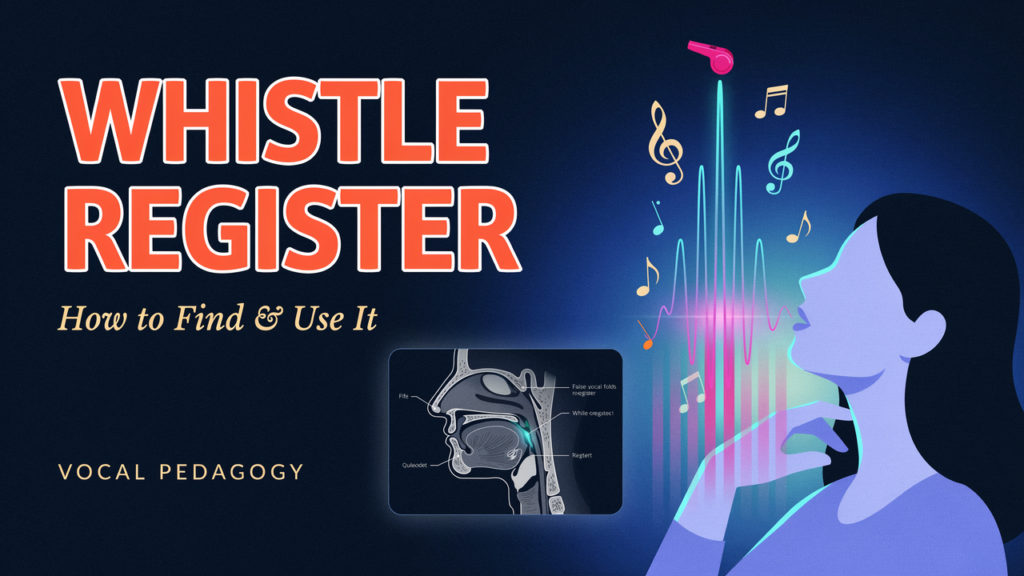
The key difference between the whistle register and head voice is in how the vocal folds produce the sound. In head voice, the folds vibrate across much of their surface area in a stretched, thinned state. In the whistle register, the folds zip up almost completely — leaving only a tiny aperture — and the column of air is forced through that small opening with a specific pressure, producing the characteristic high, clear, whistle-like sound.
This mechanism is sometimes called the flageolet register or the flute register. It mimics the acoustic principle of a flute — a small aperture with controlled airflow producing a high, pure tone.
Who Can Access the Whistle Register?
Any singer can potentially access the whistle register — it is not physiologically exclusive to sopranos, women, or professional singers. Male singers with whistle registers exist, though the pitches reached tend to sit lower than female whistle registers due to the longer, heavier vocal folds of the male larynx.
The register is more commonly developed in:
- Soprano and mezzo-soprano singers whose head voice already extends to C6 and above, giving them a closer starting point
- Singers with extensive upper register training who have developed control and flexibility throughout the head voice range
- Singers who have specifically trained the whistle register as a separate technical skill
Access to the whistle register is not a prerequisite for great singing. Most successful professional singers do not use it. It is a specific extended technique — useful for certain stylistic effects and highly impressive when controlled, but not a fundamental element of singing technique.
Famous Singers Who Use the Whistle Register
Mariah Carey is the most documented whistle register singer in contemporary popular music. Her range extends from approximately F2 to G7, with the whistle register appearing prominently in “Emotions,” “Fantasy,” and “Heartbreaker.” Her “Emotions” (1991) showcased the register to a mainstream audience for the first time in a commercial pop context, reaching a documented G7.
Ariana Grande uses the whistle register regularly throughout her catalogue. Her range extends to around E7 in whistle, appearing in songs like “Emotions” (the Mariah Carey cover), “God is a Woman,” and numerous live performances.
Brendon Urie has documented whistle register access extending to C7, making him one of the best-known male whistle register singers in contemporary pop music.
Minnie Riperton — the R&B singer known for “Lovin’ You” — had one of the most controlled and well-documented whistle registers in music history, extending to F7 and above.
How the Whistle Register Feels Different From Head Voice
The most common description from singers who have found the whistle register: it feels effortless in a way that is hard to achieve by pushing head voice higher. Rather than straining to reach the highest head voice notes, the whistle register clicks in — often unexpectedly at first — with a sense of release rather than effort.
The tone is noticeably different from head voice: lighter, cleaner, more concentrated, and with a specific ringing quality that is immediately recognisable. It does not feel like “more of the same” as head voice — it feels like a distinct register that operates differently.
One challenge is that the whistle register requires less air than head voice — pushing more air through can break the mechanism rather than strengthen it. This is counterintuitive for singers trained to use breath support for high notes. In the whistle register, the goal is efficient, minimal airflow through the small aperture, not increased pressure.
How to Find Your Whistle Register — Step by Step
Finding the whistle register for the first time requires patience and the right approach. Do not try to push head voice higher — that approach reaches a ceiling. Instead, the goal is to discover the register by approaching it through a different mechanism.
Step 1 — Warm up thoroughly first. Never approach the whistle register cold. Spend at least ten minutes warming up through your full chest voice and head voice range before exploring the whistle register. A cold exploration of the extremes of the voice risks strain.
Step 2 — Speak in an extremely high, squeaky voice. The fastest entry point for most singers is not through singing but through speaking. Try to speak in the highest, most squeaky voice you can produce — as if imitating a cartoon character or speaking in a very high falsetto. Push this as high as you can go. This high-speaking voice is close to the mechanism of the whistle register.
Step 3 — Maintain that mechanism and gently add tone. While in that extremely high-speaking voice, try to sustain a pure vowel (“oh” or “ah”) with minimal air pressure. The goal is a clear, sustained tone rather than a breathy or squeaky sound. Do not push — if you feel tension, release the attempt completely and try again with less air pressure.
Step 4 — Find the tone with gentle, sustained airflow. The whistle register responds to a specific combination of minimal air pressure and a particular vocal fold configuration. It often feels like balancing on a precise point — not pushing, not pulling back, but finding a sustained equilibrium. When you find it, the tone will be clear and high with a distinctive ringing quality.
Step 5 — Explore pitch within the register. Once you have found the register even briefly, try sliding the pitch around within it. Most singers find they can move pitch within the whistle register by adjusting the tension of the folds rather than through the usual muscle memory of head voice. The range within the whistle register can be developed over time.
Step 6 — Practice on consecutive days, not in single long sessions. The whistle register responds better to frequent short sessions than to extended practice in one sitting. Ten minutes of exploration daily for a month produces more progress than an hour once a week.
Safety and Vocal Health Considerations
The whistle register, when accessed correctly, should not hurt. The correct mechanism involves minimal air pressure and a specific configuration — not strain or force. If you experience pain, tension, or discomfort when attempting whistle register, stop immediately.
The most common mistake is trying to push head voice higher. Head voice has a ceiling, and pushing through it creates tension and potential strain. The whistle register is reached by releasing into a different mechanism, not by forcing through the ceiling of head voice.
Hoarseness, loss of range, or any unusual vocal sensation after whistle register practice are signals to rest the voice and, if symptoms persist, consult a laryngologist. Never push for whistle register when the voice is tired, strained, or recovering from illness.
The Whistle Register vs Head Voice vs Falsetto
A common source of confusion:
Head voice produces sustained high notes with full or near-full vocal fold closure. It extends in trained singers to approximately Eb6–E6. It has resonance and carrying power. It connects to the chest voice below through mixed voice technique.
Falsetto uses incomplete vocal fold closure, producing a breathy, lighter tone. It can extend very high but lacks the resonance and power of a developed head voice. Many male singers mistake their falsetto for head voice.
Whistle register uses an entirely different mechanism — the folds zip up with a small aperture, and the air pressure is minimal. It produces a tone above head voice range with a distinct flute-like quality. It is disconnected from the lower registers in a way that head voice is not.
A singer can have a strong head voice without ever developing whistle register. A singer can access whistle register without having exceptional head voice. They are related but separate capabilities.
Connecting the Whistle Register to the Rest of Your Voice
One of the more advanced goals in whistle register development — achieved by very few singers — is creating a smooth connection between the head voice and whistle register so the transition is not audible. Mariah Carey and Ariana Grande are notable for their ability to pass through the transition between head voice and whistle register with minimal break.
For most singers developing the register for the first time, the whistle register will initially feel disconnected from the rest of the voice. This is normal. The connection develops with time, repetition, and training through the transition zone between the top of head voice and the bottom of the whistle register — a process similar to developing mixed voice through the chest-to-head transition at the passaggio.
Understanding the passaggio and register transitions is covered in detail in head voice vs chest voice.
Frequently Asked Questions
Does every singer have a whistle register?
Most singers have access to some version of the whistle register given sufficient training and patience. The pitches accessible in the whistle register vary significantly between individuals — some singers access notes in the E6–G6 range; exceptional singers reach C7 and above. Ability to sustain and control notes in the whistle register varies even more widely. It is a trainable skill, but the degree of development varies with anatomy, training history, and individual vocal characteristics.
Is the whistle register bad for your voice?
Accessing the whistle register correctly — with minimal air pressure, good warm-up, and without forcing through tension — is not harmful. The risk comes from trying to push head voice higher rather than releasing into the whistle register mechanism, which creates the same kind of muscular tension that causes strain anywhere in the voice. Stop at any sign of pain or tension.
Can male singers use the whistle register?
Yes. Male whistle register exists and is well-documented. Brendon Urie has demonstrated a documented whistle register reaching C7. The pitches accessible in the male whistle register tend to be lower than in female voices due to the longer, heavier vocal folds of the male larynx, but the register itself is available to male singers with appropriate training.
How long does it take to develop the whistle register?
This varies considerably between singers. Some singers stumble on the register relatively quickly — within days or weeks of targeted practice. Others take months of consistent, gentle exploration. The process is not linear, and the register can feel elusive and inconsistent in the early stages before it becomes more reliable. Consistency over time — short, frequent sessions rather than long, infrequent ones — is the most effective approach.
What songs should I practice the whistle register on?
Start with exercises rather than songs. Slides and glides on neutral vowels within the register, moving pitch gently up and down, build the register more reliably than jumping to song material. Once the register feels more accessible and consistent, light passages in the upper range of Mariah Carey’s or Ariana Grande’s catalogues provide useful song-context practice.
Related Tools and Guides
Vocal Range Test — measure your current range including upper register limits. Mariah Carey Vocal Range — full breakdown of the most famous whistle register in popular music. Ariana Grande Vocal Range — analysis of another prominent whistle register user. Brendon Urie Vocal Range — a leading male whistle register example. Head Voice vs Chest Voice — understanding registers and how they connect. How to Extend Your Vocal Range — structured approach to expanding the upper range. Vocal Exercises to Increase Range — exercises for building range through all registers. Vocal Ranges — Complete Guide to Every Voice Type — where the whistle register sits relative to standard voice type ranges. 5-Octave Vocal Range — what having a 5+ octave range actually means. 6-Octave Vocal Range — the most exceptional documented ranges and how whistle register contributes.

Mayer is a music production and audio editing writer specializing in pitch shifting, vocal processing, sound manipulation, and online audio tools for musicians, producers, singers, and creators. He creates practical content focused on pitch changing, vocal editing workflows, audio enhancement, and music production techniques.