
The Alexander Technique helps musicians improve posture, breathing, and coordination by teaching them to recognize and release unnecessary tension. When applied to singing or playing an instrument, it supports greater ease, stamina, and control, and it’s widely used to manage performance stress and physical strain.
The Alexander Technique helps musicians reduce unnecessary tension, improve posture, and move more efficiently while playing or singing. By relearning natural alignment and coordination, musicians gain better tone, endurance, and injury prevention without forcing technique.
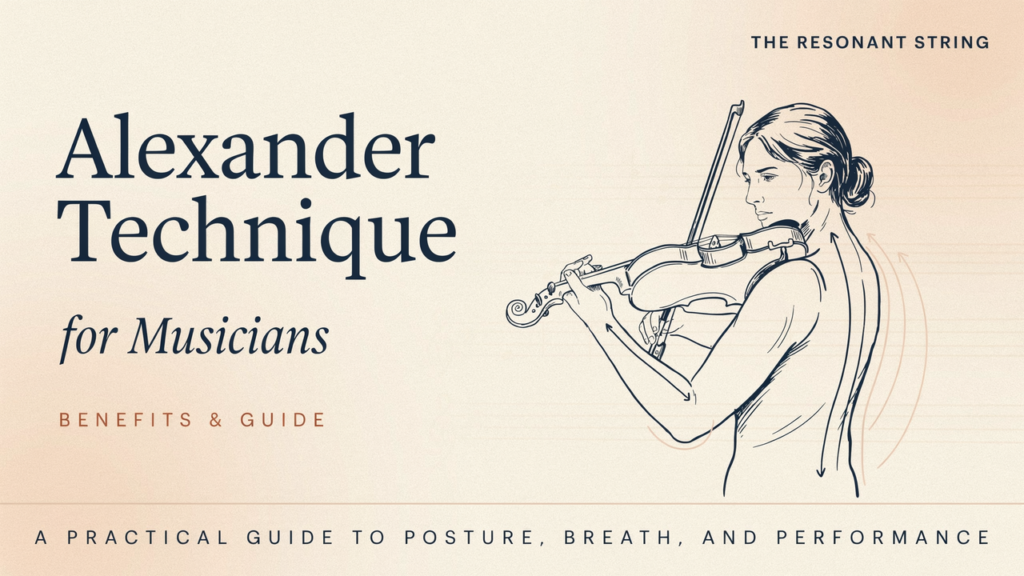
What the Alexander Technique actually is
The Alexander Technique (AT) is not a workout, therapy, or stretching routine. It is a mind–body learning method that trains you to notice and change habitual patterns of tension and movement that interfere with efficient use of your body.
For musicians, those habits often include:
- Collapsing the chest or locking the ribs while breathing
- Tightening the neck and jaw
- Raising the shoulders
- Bracing the lower back
- Holding unnecessary muscular effort while playing or singing
AT teaches you to pause, notice, and choose more efficient coordination.
This guide covers how a song pitch editing tool works.
Why musicians struggle physically
Playing or singing well requires:
- Precise coordination
- Sustained posture
- Fine motor control
- Emotional intensity
Under pressure, the nervous system often responds by tightening. That tension:
- Restricts breathing
- Reduces endurance
- Makes tone less free
- Increases injury risk
- Amplifies performance anxiety
The Alexander Technique targets how you use your body while performing, not just the musical task itself.
The core principles (in musician terms)
1. Inhibition
This means not reacting automatically. Instead of tightening when you take a breath or hit a high note, you pause long enough to avoid old habits.
2. Direction
You learn to send gentle mental cues such as:
- “Neck free”
- “Head balanced”
- “Back long and wide”
These are not physical commands — they guide coordination.
3. Primary control
This refers to the dynamic relationship between head, neck, and torso. When that relationship is free, breathing, arm movement, and vocal production become easier.
How it helps musicians
Better posture without stiffness
AT does not force you into a rigid “good posture.” It allows the body to organize itself so you can sit or stand for long rehearsals without collapse or strain.
Freer breathing
When the ribs, spine, and neck are not braced, the lungs can expand more naturally. This is especially powerful for singers and wind players.
Reduced tension
You learn to detect subtle tightening in:
- Jaw
- Shoulders
- Throat
- Hands
before it becomes a problem.
Improved stamina
Less wasted effort means you can rehearse and perform longer without fatigue.
Greater control under pressure
Because AT trains awareness of how you react, it’s often used to manage performance anxiety.
Singing and the Alexander Technique
For singers, AT is often transformational because the voice is directly affected by posture, breathing, and neck tension.
Common vocal improvements include:
- Easier inhalation
- Less throat constriction
- More stable tone
- Better dynamic control
- Reduced vocal fatigue
AT does not replace vocal technique — it supports it by removing physical interference.
Instrumentalists and AT
Different instruments stress the body in different ways:
- Violinists often tighten the neck and jaw
- Pianists brace shoulders and forearms
- Guitarists collapse posture
- Wind players restrict rib movement
AT helps musicians maintain supportive alignment while playing, reducing overuse injuries and improving fluidity.
What the research says
Studies on AT show the strongest and most consistent benefit in:
- Reducing performance anxiety
- Improving body awareness
- Enhancing perceived ease of movement
Results are more mixed when it comes to:
- Direct changes in sound quality
- Measurable posture changes
This doesn’t mean AT doesn’t help musicians — it means it’s a learning method, not a mechanical fix. Outcomes depend heavily on:
- Teacher skill
- Student engagement
- Length of training
Medium for specific performance metrics; High for tension and anxiety management.
What Alexander Technique lessons look like
Most lessons are:
- One-on-one
- Hands-on and verbal
- Focused on everyday movements like sitting, standing, breathing, or playing
You may work on:
- Getting in and out of a chair
- Holding your instrument
- Beginning a phrase
- Breathing for a note
The goal is to bring this awareness into real performance.
How long does it take to work?
You may notice changes in:
- Tension
- Ease
- Awareness
within a few sessions.
Lasting improvement typically requires:
- 10–30 lessons
- Regular practice of attention during daily activities
- Applying AT principles while rehearsing and performing
This is skill-building, not a quick fix.
Who benefits most?
The Alexander Technique is especially useful for musicians who:
- Feel physically tight or uncomfortable
- Struggle with breathing
- Experience stage fright
- Have recurring pain
- Want more ease and endurance
It is less useful if you are looking for:
- Instant technical upgrades
- A replacement for vocal or instrumental training
AT supports technique — it does not replace it.
FAQ
Is the Alexander Technique the same as posture training?
No. It teaches dynamic coordination, not rigid positioning.
Is it good for singers?
Yes — especially for breathing, throat tension, and stamina.
Can it cure injuries?
It is not a medical treatment, but it often helps people avoid strain and manage discomfort.
Do I need a certified teacher?
Yes. AT is best learned through hands-on guidance.
Is it worth it?
For musicians who struggle with tension or anxiety, many find it extremely valuable.
- To get a broader framework for mindful movement, this practical singing guide fits naturally here.
- If you prefer a clean learning layout, this text-only format keeps the focus on body awareness.
- For an even simpler reference while practicing, this no-image version makes following instructions easier.
- To track posture changes over time, using the best singing app helps capture clear before-and-after audio.
- For hearing how alignment affects tone, choosing the right mic for nasal voices can reveal subtle improvements.
- When applying the technique in group settings, these choir range charts show how posture supports blend.
- As coordination improves, many singers notice growth toward a three-octave span in comfortable singing.

Mayer is a music production and audio editing writer specializing in pitch shifting, vocal processing, sound manipulation, and online audio tools for musicians, producers, singers, and creators. He creates practical content focused on pitch changing, vocal editing workflows, audio enhancement, and music production techniques.