
A song key is the central pitch and scale that a piece of music is built around. It defines which notes and chords sound stable, which create tension, and which note feels like “home” when the music resolves.
For singers, the song key is one of the most important factors in vocal comfort. The right key makes singing feel natural; the wrong key can cause strain, fatigue, or weak tone—regardless of skill level.
A song key is the main musical scale that defines a song’s tonal center, chords, and overall sound. It determines which notes feel stable or resolved, shaping the mood, pitch range, and harmony of the music.
This guide explains what a song key is, how song keys work, and why choosing the right key matters so much for singers.
What Is a Song Key?
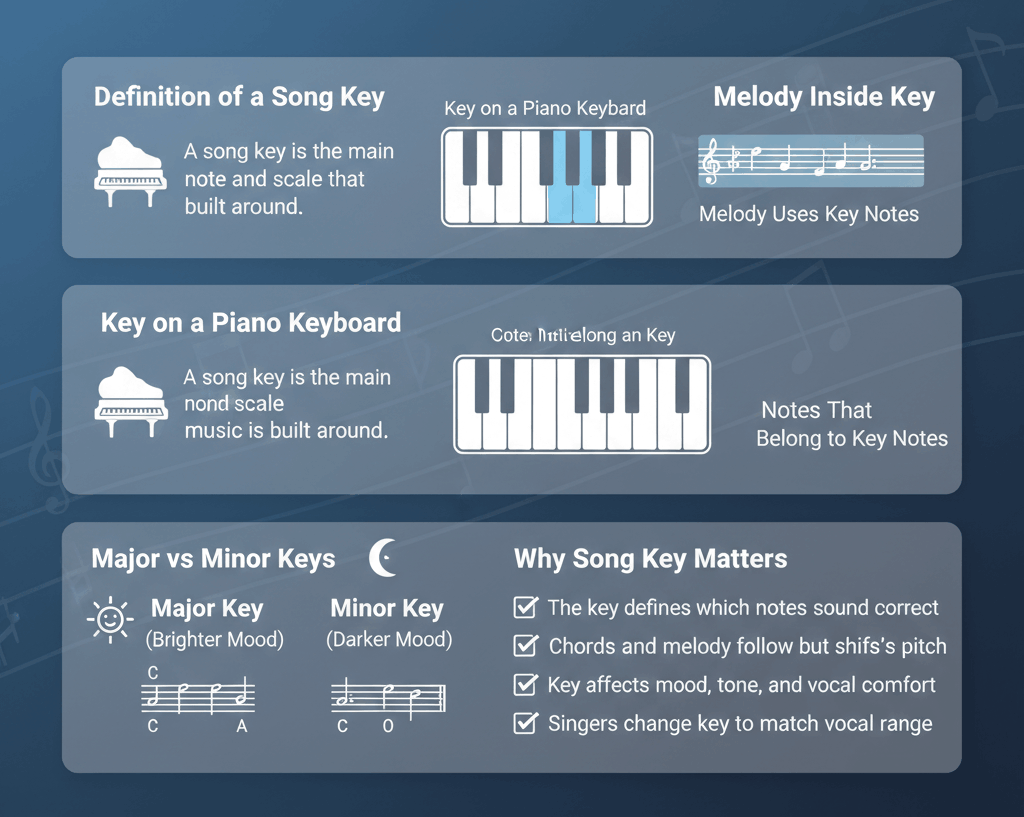
The key of a song is the group of notes and chords centered around a main note called the tonic.
The song key establishes the tonal center and determines how high or low the melody sits.
To experiment with sound, try this online tool.
How Song Keys Work (Simple, Accurate Explanation)
Every song is organized around a tonal center, known as the tonic.
- The tonic is the note that feels resolved or complete
- Melodies move away from it to create tension
- Chords and phrases return to it for resolution
The collection of notes built around this tonic forms a scale, and together they define the song key.
In simple terms:
The key tells the music where “home” is.
Song Key vs Pitch
Song key and pitch are related, but they are not the same.
| Song Key | Pitch |
|---|---|
| Overall tonal system | Individual note height |
| Determines melody range | Determines high or low sound |
| Built from multiple pitches | Single sound property |
| Affects vocal comfort | Affects single notes |
Changing pitch can result in a key change, but song key is the broader musical structure.
Learn more:
Major vs Minor Song Keys
Most songs are written in either major or minor keys.
| Key Type | How It Sounds | Common Use |
|---|---|---|
| Major | Bright, stable, uplifting | Pop, rock, upbeat music |
| Minor | Darker, emotional, tense | Ballads, cinematic music |
While keys influence mood, they also affect where melodies sit in your vocal range.
Why Song Key Matters for Singers
Songs are written for specific voices, not for all singers.
If a song’s key is:
- Too high → strain, tension, cracked notes
- Too low → breathiness, weak projection
This is not a talent problem.
It’s a key-selection problem.
Most vocal difficulties disappear when the song is moved into a key that fits your voice.
Helpful guides:
Why Changing the Key Fixes Most Singing Problems
Changing the song key:
- Moves the melody into your comfortable range
- Places most notes in your tessitura (where your voice sounds best)
- Reduces unnecessary tension
Professional singers change keys constantly—especially for live performances.
How to Find the Key of a Song
You can identify a song’s key by:
- Listening for the note or chord the song resolves to
- Checking the key signature in sheet music
- Using a digital key-detection tool
Once you know the key, you can decide if it suits your voice.
Can You Change the Key of a Song?
Yes—and it’s completely normal.
Changing key means shifting every note by the same number of semitones, preserving the song while moving it higher or lower.
Learn how:
Song Key vs Tempo
Song key does not control speed.
| Song Key | Tempo |
|---|---|
| Controls pitch range | Controls speed |
| Affects vocal comfort | Affects rhythm |
| Based on notes/scales | Measured in BPM |
Explanation:
Pitch vs tempo
Common Song Keys for Singing
Some keys are commonly used because they work well for many voices:
- C Major / A Minor – neutral, beginner-friendly
- G Major / E Minor – guitar-friendly
- F Major / D Minor – often vocal-friendly
There is no universal best key—only the best key for your voice.
Tools to Test and Change Song Keys
The fastest way to test keys is with tools that:
- Change key without changing tempo
- Preserve audio quality
- Allow instant comparison
Recommended:
Frequently Asked Questions
Is song key the same as pitch?
No. Pitch is individual notes; song key is a system of notes.
Can a song change keys?
Yes. This is called modulation.
Do professional singers change keys?
Yes—almost always.
What is the best key for singing?
The key that fits your vocal range and tessitura best.
- To quickly adjust any track, this online key changer makes shifting keys simple.
- If you need to move a song into a better range, this song transposer helps you change it smoothly.
- When choosing the right pitch, this vocal range guide helps match songs to your voice.
- To calculate precise changes, this semitone calculator shows how many steps to move.
- For practical editing, this key change tutorial walks through the process.
- If a melody feels too high, this helpful fix explains how to lower it.
- To visualize scales, this music key chart makes different keys easy to understand.