
Pitch in music is how high or low a sound is perceived. It is one of the most fundamental elements of music and the reason we can distinguish between low bass notes and high soprano notes.
Pitch determines notes, melodies, and keys, and it plays a major role in whether a song feels comfortable or difficult to sing. If you sing, play an instrument, or work with audio, understanding pitch is essential.
Pitch in music is how high or low a sound is, determined by its frequency. Higher frequencies create higher-pitched notes, while lower frequencies produce deeper sounds. Pitch defines melody, harmony, and vocal range in music.
You can see how to transpose a song online for free here.
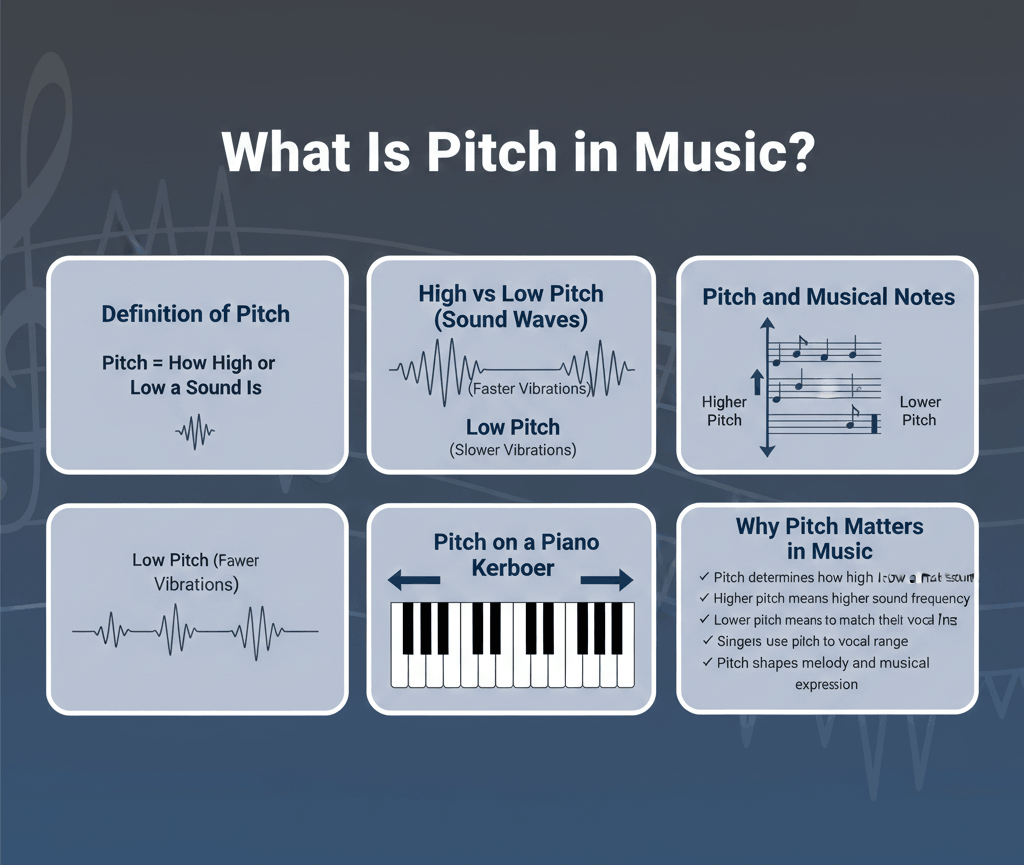
What Is Pitch in Music?
Pitch is the perceived highness or lowness of a sound.
In music, pitch is determined by the frequency of sound vibrations and is organized into notes, scales, and keys.
How Pitch Works ( Explanation)
Sound is created by vibrations in the air.
- Faster vibrations → higher pitch
- Slower vibrations → lower pitch
These vibrations are measured as frequency, usually in hertz (Hz).
Your ear interprets vibration speed as pitch.
For example:
- A low piano note vibrates slowly
- A high whistle vibrates very quickly
This physical difference is what creates different pitches.
High Pitch vs Low Pitch (Examples)
| Pitch Type | How It Sounds | Example |
|---|---|---|
| High pitch | Bright, sharp | Whistle, soprano note |
| Low pitch | Deep, heavy | Bass guitar, low piano |
Pitch is not volume.
A sound can be:
- High and quiet
- Low and loud
Pitch describes height, not loudness.
Pitch, Notes, and Octaves
In music, pitch is organized into notes (A, B, C, etc.).
What Is an Octave?
When a pitch doubles in frequency, it moves up one octave.
- The note name repeats
- The pitch sounds higher
This is why the same note can exist at multiple pitch levels while still sounding related.
What Determines Pitch in Music?
Pitch is determined by three main factors:
- Frequency (Hz) – how fast the sound vibrates
- Sound source – voice or instrument
- Musical system – how pitches are organized into notes and keys
Pitch in Singing
For singers, pitch control depends on:
- Vocal fold tension
- Breath support
- Resonance
If pitch sits outside a singer’s comfortable range, singing becomes strained or weak—regardless of skill level.
Pitch vs Tempo (Explained)
Pitch and tempo are completely different musical elements.
| Pitch | Tempo |
|---|---|
| High or low sound | Fast or slow speed |
| Measured in Hz / semitones | Measured in BPM |
| Affects singing comfort | Affects rhythm |
| Can change key | Cannot change key |
A song can be:
- High pitch and slow tempo
- Low pitch and fast tempo
Full explanation:
Pitch vs tempo
Pitch vs Key
- Pitch → individual note height
- Key → a system of pitches centered around a tonal “home”
Changing pitch can result in a key change, but pitch and key are not the same concept.
Learn more:
What is song key?
Why Pitch Matters in Singing
Pitch is one of the most important factors in vocal comfort.
If a song’s pitch is:
- Too high → strain, tension, fatigue
- Too low → breathiness, weak tone
This is not a talent issue.
It’s a key and pitch placement issue.
Helpful guides:
Can Pitch Be Changed Without Changing Tempo?
Yes.
Modern audio tools allow pitch to be changed independently of tempo.
This is essential for singers who need:
- A song in a different pitch
- The same speed and rhythm
Explanation:
Key change vs pitch change
Singer-focused tools:
Pitch and Semitones (How Pitch Changes Are Measured)
In Western music, pitch changes are measured in semitones.
- 1 semitone = smallest standard pitch step
- 12 semitones = one octave
Understanding semitones helps with:
- Changing song keys
- Adjusting pitch safely for singing
Learn more:
Frequently Asked Questions
What is pitch in music in simple terms?
Pitch is how high or low a sound is.
Is pitch the same as tempo?
No. Pitch is sound height; tempo is speed.
Is pitch the same as key?
No. Pitch is individual notes; key is a system of notes.
Why is pitch important for singers?
Because singing outside your comfortable pitch range causes strain or weak tone.
Can pitch be changed digitally?
Yes, using pitch shifters and key changers.