
Semitones are the smallest standard pitch units used in Western music.
A semitone is also called a half step and represents the shortest distance between two neighboring notes.
Semitones are the basic building blocks of pitch, scales, intervals, and key changes. If you sing, play an instrument, or adjust music digitally, understanding semitones is essential.
A semitone is the smallest pitch step in Western music, also called a half step. It’s the distance between two adjacent notes, like C to C♯ or E to F. Semitones build scales, keys, and determine how pitch rises or falls.
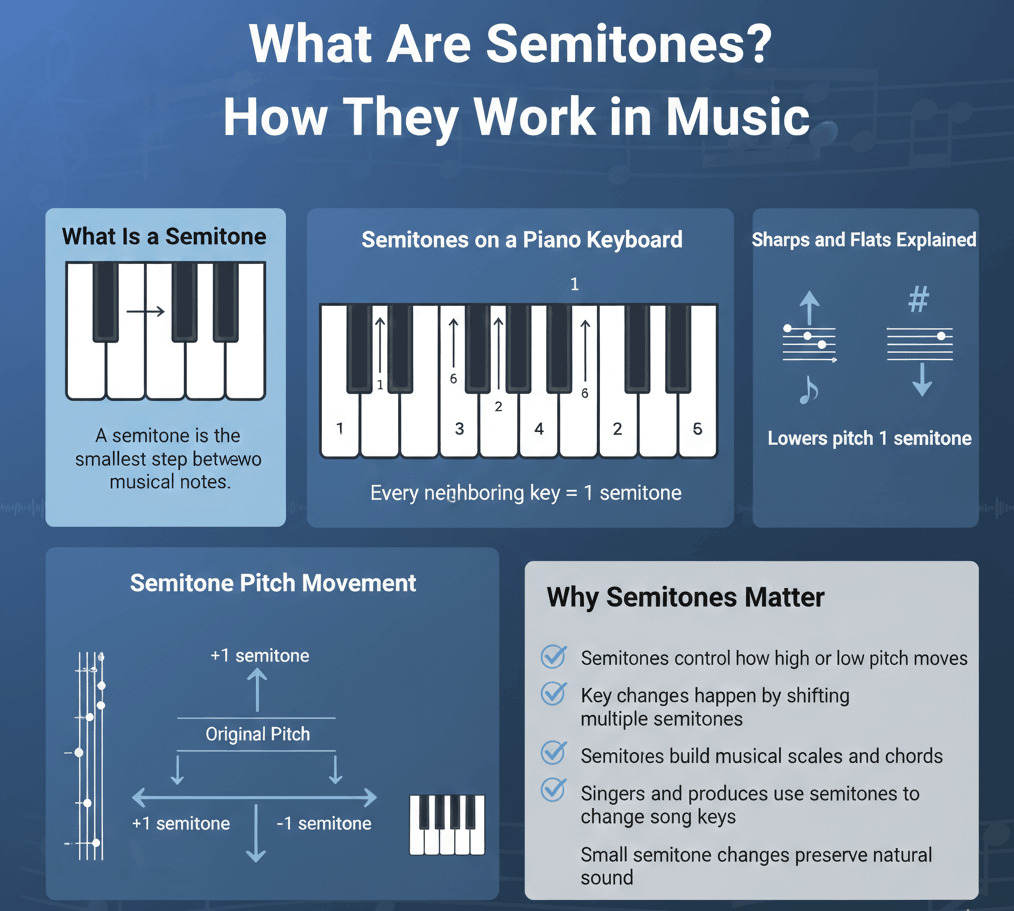
What Are Semitones?
A semitone is the smallest standard interval between two notes in Western music.
It is also known as a half step, and there are 12 semitones in one octave.
Semitone vs Tone (Half Step vs Whole Step)
Music uses two basic step sizes:
| Step Type | Size | Example |
|---|---|---|
| Semitone (half step) | 1 unit | C → C♯ |
| Tone (whole step) | 2 semitones | C → D |
So:
- 1 tone = 2 semitones
- 2 semitones = one whole step
This distinction is fundamental to how melodies and scales are built.
Semitones Between Musical Notes
On a piano, guitar, or chromatic scale, each adjacent note is one semitone apart.
Common semitone pairs include:
- C → C♯ / D♭
- D → D♯ / E♭
- F → F♯
- B → C
Important exceptions:
- E → F is one semitone
- B → C is one semitone
There are no notes between them.
How Many Semitones Are in an Octave?
There are 12 semitones in one octave.
An octave occurs when:
- A pitch doubles in frequency
- The note name repeats at a higher or lower level
This 12-semitone structure is the foundation of:
- Musical scales
- Keys and harmony
- Digital pitch shifting
Why Semitones Matter in Music
Semitones allow musicians to:
- Measure intervals accurately
- Build scales and chords
- Transpose music between keys
- Describe pitch changes precisely
Without semitones, it would be impossible to explain how far notes move or how keys relate to each other.
Why Semitones Matter for Singing
For singers, semitones are especially important because small pitch changes have a big effect.
Typical vocal adjustments:
- ±1 semitone → subtle improvement
- ±2 semitones → noticeable comfort
- ±3 semitones → major difference
If a song feels uncomfortable, adjusting it by a few semitones is often enough.
Helpful references:
Semitones, Pitch, and Key (How They Connect)
- Pitch → how high or low a sound is
- Semitone → the unit used to measure pitch change
- Key → a system of pitches organized around a tonal center
Changing a song’s key means shifting every note by the same number of semitones.
Foundational explanations:
Semitones vs Tempo (Common Confusion)
Semitones affect pitch, not speed.
| Semitones | Tempo |
|---|---|
| Change pitch | Change speed |
| Affect key | Affect rhythm |
| Measured in steps | Measured in BPM |
Explanation:
Pitch vs tempo
How Semitones Are Used to Change Keys
When music is transposed, every note is moved by the same number of semitones.
Example:
- C Major → D Major
- Change = +2 semitones
This is how singers and musicians change keys accurately.
Helpful tools:
Are Semitones the Same on All Instruments?
Yes. In Western music:
- Piano
- Guitar
- Voice
- Digital audio
All use the same 12-semitone octave system, even though the physical layouts differ.
Can Semitones Be Smaller?
In Western music, semitones are the smallest standard unit.
Some musical traditions use:
- Microtones (intervals smaller than a semitone)
However, most modern music uses the 12-semitone equal-temperament system.
Common Semitone Misconceptions
- Semitones are not volume changes
- Semitones are not tempo changes
- One semitone is not insignificant
For singers, one semitone can determine comfort or strain.
Frequently Asked Questions
Is a semitone the same as a half step?
Yes. They mean the same thing.
How many semitones are in a tone?
Two semitones.
Why do sharps and flats exist?
They indicate notes that are one semitone higher or lower.
Do professional singers think in semitones?
Yes, especially when choosing keys and transposing songs.
Quick pitch changes can be done at https://onlinepitchchanger.com/.