
If you can sing most of a song but struggle—or completely fall apart—when the chorus hits, the problem may not be your technique. In many cases, the song is simply too high for your voice.
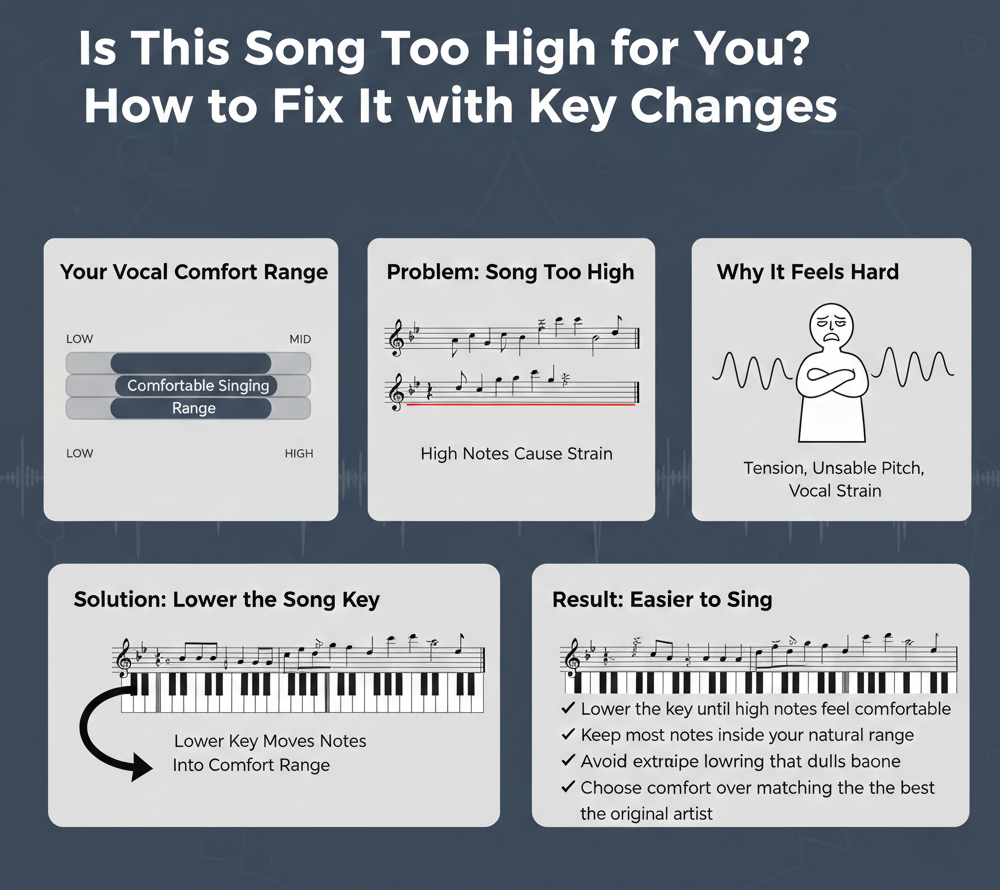
If a song feels too high, lower its key by 1–6 semitones so the highest notes fit your vocal range. Use transposition tools or pitch shifters to drop the key without changing tempo, making the song easier and strain-free to sing.
You don’t need to “push through it” or give up on the song. This guide shows you how to tell if a song is too high and how to fix it quickly and safely using key changes.
If a song feels too high, Online Pitch Changer tool lets you lower the key instantly.
How to Tell If a Song Is Too High for You
A song is likely too high if you notice these signs:
- The chorus feels much harder than the verse
- You can hit the notes once, but not repeatedly
- Your voice tightens, cracks, or loses tone
- Warm-ups don’t make the song easier
- You feel strain even at moderate volume
A song is too high if the chorus consistently causes strain, cracking, or fatigue—even after warming up.
This is not a failure of skill. It’s usually a key mismatch.
To keep the song’s timing intact, Online Pitch Changer pitch control adjusts key without changing speed.
Why Songs Feel Too High (Even If You Can Hit the Notes)
Many singers focus on their highest note, but the real issue is often tessitura—where most of the song sits.
If a melody:
- Repeatedly lives near your upper limit
- Forces you to stay tense for long sections
…it will feel exhausting, even if the notes are technically “in range.”
This is why the chorus almost always reveals the problem.
Why Changing the Key Works (And Practice Often Doesn’t)
Practice improves coordination and control—but it cannot change your vocal range.
If a song sits too high:
- More practice won’t move the notes
- More effort increases strain risk
Changing the key shifts the entire song to a more comfortable place in your range.
Helpful background:
What Is Song Key?
Key Change vs Pitch Change (Quick Clarity)
These terms are often confused.
- Key change = musical transposition
- Pitch change = the technical method used to move notes
Modern tools change pitch to achieve a key change—while keeping tempo the same.
Clear explanation:
Key Change vs Pitch Change
How Many Semitones Should You Lower the Song?
Most fixes require small adjustments, not drastic ones.
Featured-snippet answer
Most singers fix a song that’s too high by lowering it 1–3 semitones.
Practical guidance:
- −1 semitone → subtle relief
- −2 semitones → most common fix
- −3 semitones → major comfort improvement
- −4+ semitones → use carefully (tone may change)
For a deeper breakdown:
How Many Semitones to Change Key?
How to Test If a New Key Fixes the Problem
Use this simple method:
- Identify the hardest part (usually the chorus)
- Lower the song by 2 semitones
- Sing the chorus multiple times
- Notice whether:
- Strain disappears
- Tone improves
- Control increases
If it still feels tight, adjust by −1 semitone and test again.
For voice-specific guidance:
Best Key for Your Vocal Range
The Easiest Way to Lower a Song’s Key
The fastest and most reliable method is using an online tool that lets you change pitch without changing speed.
This allows you to:
- Test keys instantly
- Keep the song’s tempo intact
- Avoid software installation
Common Myths About Songs Being “Too High”
“I just need more practice.”
Practice helps—but it won’t move the notes.
“Lowering the key is cheating.”
Professionals change keys all the time.
“If I can hit the note once, it’s fine.”
Consistency matters more than a single attempt.
Frequently Asked Questions
Is it bad for my voice to sing a song that’s too high?
Yes. Repeated strain increases fatigue and injury risk.
Do professional singers change song keys?
Yes—especially for live performances and vocal health.
Will lowering the key ruin the song?
Small changes (1–3 semitones) usually preserve the song’s character.
Can I change the key on mobile?
Yes. Modern mobile tools work well for key testing and practice.
Related guide:
How to Change Pitch on Mobile
Final Takeaway
If a song feels too high, believe your voice.
The fix is usually simple:
- Lower the key by 1–3 semitones
- Keep the tempo the same
- Choose comfort over struggle
Changing the key isn’t giving up—it’s how singers sing better, longer, and healthier.