
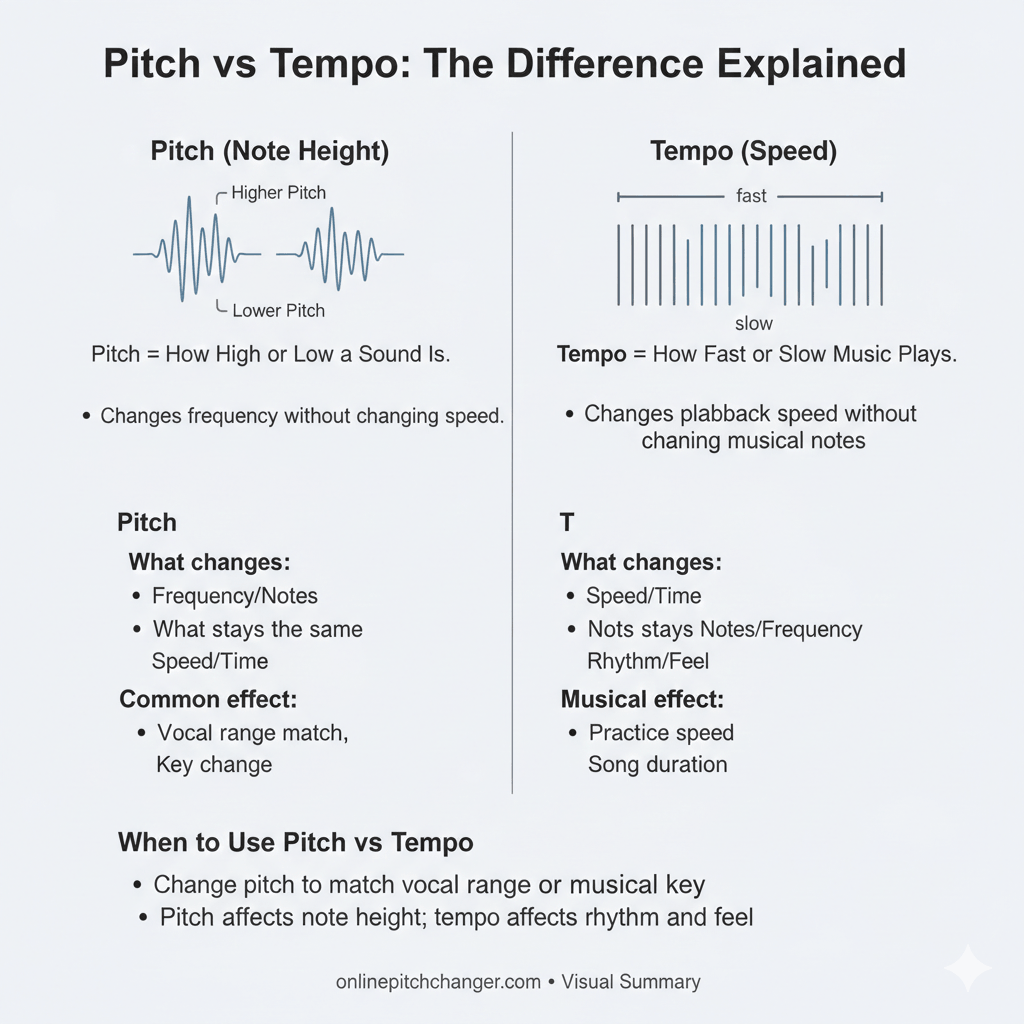
Pitch and tempo are not the same thing. Pitch describes how high or low a sound is, while tempo describes how fast or slow music plays.
They affect music in completely different ways—but they’re often confused, especially when changing audio for singing or practice.
Pitch changes how high or low music sounds, while tempo changes how fast it plays. Change pitch to fit your vocal range; change tempo to practice slower or faster without altering notes. Use pitch for vocal comfort, tempo for timing and learning.
This guide gives you a clear definition, a side-by-side comparison, and a simple rule for knowing whether to change pitch or tempo.
This tool helps you adjust audio pitch for better vocal range matching.
Quick Answer: Pitch vs Tempo
Pitch refers to how high or low a sound is. Tempo refers to how fast or slow the music plays.
Pitch is measured in frequency (Hz) or semitones, while tempo is measured in beats per minute (BPM). They are independent musical elements.
What Is Pitch in Music?
Pitch is the perceived height of a sound.
- High pitch → higher notes
- Low pitch → lower notes
In music, pitch is:
- Determined by frequency (Hz)
- Organized into notes and keys
- Adjusted using semitones
Pitch affects:
- Singing comfort
- Vocal strain
- Whether a song feels too high or too low
Learn the full concept:
What is pitch in music?
What Is Tempo in Music?
Tempo is the speed of the music.
- Fast tempo → energetic
- Slow tempo → relaxed
Tempo is measured in:
- BPM (beats per minute)
Tempo affects:
- Rhythm and groove
- Practice difficulty
- Overall feel
Tempo does not change the notes you sing.
- When comparing pitch shifts against tempo changes, Online Pitch Changer pitch control separates the two effects.
- For understanding how pitch changes impact vocals specifically, the Online Pitch Changer vocal tool makes differences easier to hear.
Pitch vs Tempo: Side-by-Side Comparison
| Feature | Pitch | Tempo |
|---|---|---|
| Controls | High or low sound | Fast or slow speed |
| Measured in | Hz / semitones | BPM |
| Changes key | Yes | No |
| Affects vocal strain | Yes | No |
| Changes rhythm | No | Yes |
This distinction is critical for singers and audio editing.
Why People Confuse Pitch and Tempo
1. Old Audio Tools Changed Both Together
Historically, speeding up tape:
- Raised pitch
- Slowing it down lowered pitch
This created the false belief that pitch and tempo are linked.
2. The Ear Associates Speed With Height
Faster sounds feel higher.
Slower sounds feel lower.
This is a perceptual illusion, not a musical rule.
Modern tools separate them completely.
Can Pitch and Tempo Be Changed Separately?
Yes. Modern audio processing allows you to:
- Change pitch without changing tempo
- Change tempo without changing pitch
This is essential for singers.
Explanation:
Key change vs pitch change
Pitch vs Tempo for Singers
When You Should Change Pitch
Change pitch if:
- The song is too high or too low
- You feel strain or breathiness
- Most notes sit outside your comfortable range
Helpful guides:
Pitch problems are vocal-range problems.
When You Should Change Tempo
Change tempo if:
- You’re practicing difficult passages
- You want to slow things down for learning
- You’re working on timing or phrasing
Tempo problems are practice problems, not vocal problems.
Pitch vs Key vs Tempo (Clarifying a Common Mix-Up)
- Pitch → individual note height
- Key → collection of pitches around a tonal center
- Tempo → speed of the music
Pitch changes can affect key.
Tempo changes never affect key.
Learn more:
What is song key?
Best Tools to Change Pitch or Tempo Correctly
Use tools that:
- Separate pitch and tempo
- Preserve audio quality
- Allow semitone-based control
Frequently Asked Questions
Does changing pitch make a song faster?
No. Pitch affects note height, not speed.
Does changing tempo change the key?
No. Tempo only affects speed.
Why did my song sound wrong after changing pitch?
Large pitch changes or poor algorithms can affect quality.
Is pitch the same as key?