
A music key chart is a structured reference that shows all musical keys, their key signatures, and how major and minor keys relate to each other. It’s used to understand song structure, transpose music, and choose the most comfortable key for singing or playing.
A music key chart lists all major and minor keys, showing their sharps or flats and key signatures. It helps musicians identify scales, chords, and transpose songs easily by visualizing how keys relate to each other.
This guide goes beyond a simple chart and teaches you how keys actually work, why they matter, and how to use a key chart in real musical situations.
To hear how different keys sound in practice, the Online Pitch Changer lets you test key changes instantly.
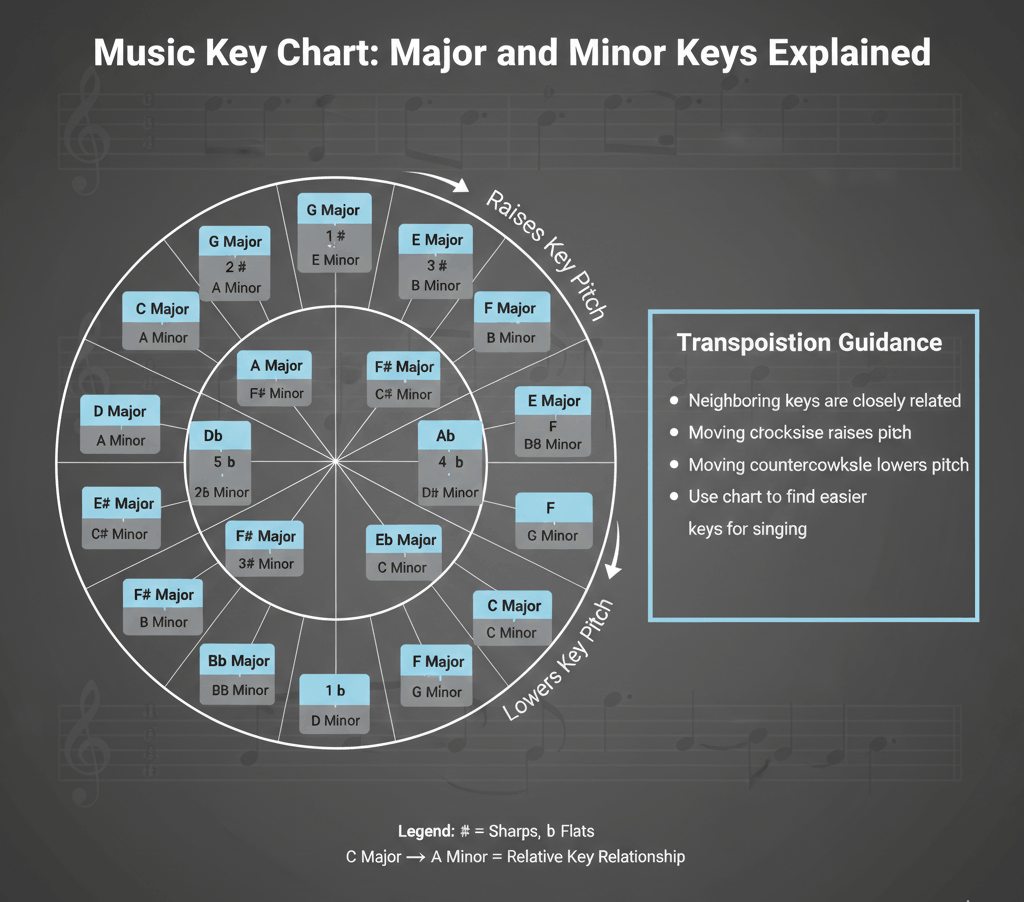
What Is a Music Key Chart?
A music key chart is a visual reference that lists musical keys (major and minor), showing how many sharps or flats each key has and how keys are related.
It helps you:
- Identify the key of a song
- Understand sharps and flats
- Transpose music correctly
- Choose better keys for singing
Core concept reference:
What is song key?
Major and Minor Keys (What the Chart Is Really Showing)
Major Keys
- Sound bright, stable, and resolved
- Common in pop, rock, EDM, and upbeat music
- Defined by a specific pattern of whole and half steps
Minor Keys
- Sound darker, emotional, or tense
- Common in ballads and cinematic music
- Share notes with their relative major keys
A music key chart shows these relationships, not just names.
For understanding how keys affect vocal range, the Online Pitch Changer vocal tool makes transposition easier to hear.
Complete Music Key Chart (Major & Minor)
| Major Key | Relative Minor | Sharps / Flats |
|---|---|---|
| C Major | A Minor | None |
| G Major | E Minor | 1 sharp |
| D Major | B Minor | 2 sharps |
| A Major | F♯ Minor | 3 sharps |
| E Major | C♯ Minor | 4 sharps |
| B Major | G♯ Minor | 5 sharps |
| F♯ Major | D♯ Minor | 6 sharps |
| F Major | D Minor | 1 flat |
| B♭ Major | G Minor | 2 flats |
| E♭ Major | C Minor | 3 flats |
| A♭ Major | F Minor | 4 flats |
| D♭ Major | B♭ Minor | 5 flats |
Each major key and its relative minor use the same notes, but sound different because the tonal center changes.
How to Read a Music Key Chart (Step-by-Step)
- Find the key name (e.g., G Major)
- Check the number of sharps or flats
- Identify the relative minor
- Look at nearby keys for easy transposition
Keys close together on the chart are musically similar, which is why changing keys by small amounts usually sounds natural.
Related concept:
What are semitones?
How Many Musical Keys Are There?
There are:
- 12 major keys
- 12 minor keys
Total: 24 commonly used keys
Some keys are enharmonic (same sound, different spelling), which is why charts may show more than 24 names.
When working with reference tracks, the Online Pitch Changer MP3 tool allows quick key comparisons.
Sharps vs Flats: Why Some Keys Look Different
Sharp Keys
- Use ♯ symbols
- Common in guitar-based music
- Often easier for sharp-friendly instruments
Flat Keys
- Use ♭ symbols
- Common in brass and jazz music
- Often preferred for vocal arrangements
A music key chart makes this visible at a glance.
Music Key Chart vs Circle of Fifths
| Music Key Chart | Circle of Fifths |
|---|---|
| Static reference | Relationship diagram |
| Easy lookup | Shows harmonic movement |
| Beginner-friendly | More theoretical |
Key charts are best for identification and transposition, while the circle of fifths explains why keys relate.
Using a Music Key Chart to Transpose Music
A key chart helps you transpose accurately, not by guessing.
Example
- Original key: C Major
- Raise by 2 semitones
- New key: D Major
This method is used by singers, producers, and arrangers.
Helpful explanation:
How many semitones to change key
Calculation help:
Semitone calculator
Using a Music Key Chart for Singing (Critical Use Case)
Original song keys are written for specific voices. If a song feels:
- Too high
- Too low
- Strained
- Weak
The key is often wrong for your vocal range.
A music key chart helps you find nearby keys that preserve the song but fit your voice.
Learn more:
Common Keys Used in Popular Music
- C Major / A Minor – neutral, beginner-friendly
- G Major / E Minor – guitar-friendly
- D Major / B Minor – bright, energetic
- F Major / D Minor – vocal-friendly
A music key chart helps explain why these keys are used so often.
How to Change a Song’s Key After Using the Chart
Once you identify the target key, use a tool that:
- Changes key without changing tempo
- Preserves audio quality
- Allows quick testing
Recommended:
Online key changer
Step-by-step guide:
How to change the key of a song
Frequently Asked Questions
What is the easiest key in music?
C Major is often easiest because it has no sharps or flats.
Do major and minor keys use the same notes?
Relative major and minor keys do, but they sound different because the tonal center changes.
Can a music key chart help with vocal strain?
Yes. It helps you choose keys that fit your voice more naturally.
Is changing key the same as changing pitch?
No. A key change is musical; pitch change alone can distort context.
Explanation:
Key change vs pitch change