
If a song feels just slightly too high or too low, the solution is often simple: change the key by a few semitones. The challenge is knowing how many semitones to change—without guessing, overcorrecting, or ruining the feel of the song.
You typically change a song’s key by 1–8 semitones depending on vocal range needs. Small adjustments (1–3 semitones) fine-tune comfort, while larger shifts (4–8 semitones) adapt songs for different voice types or genders.
To test different semitone shifts quickly, use a quick pitch changer.
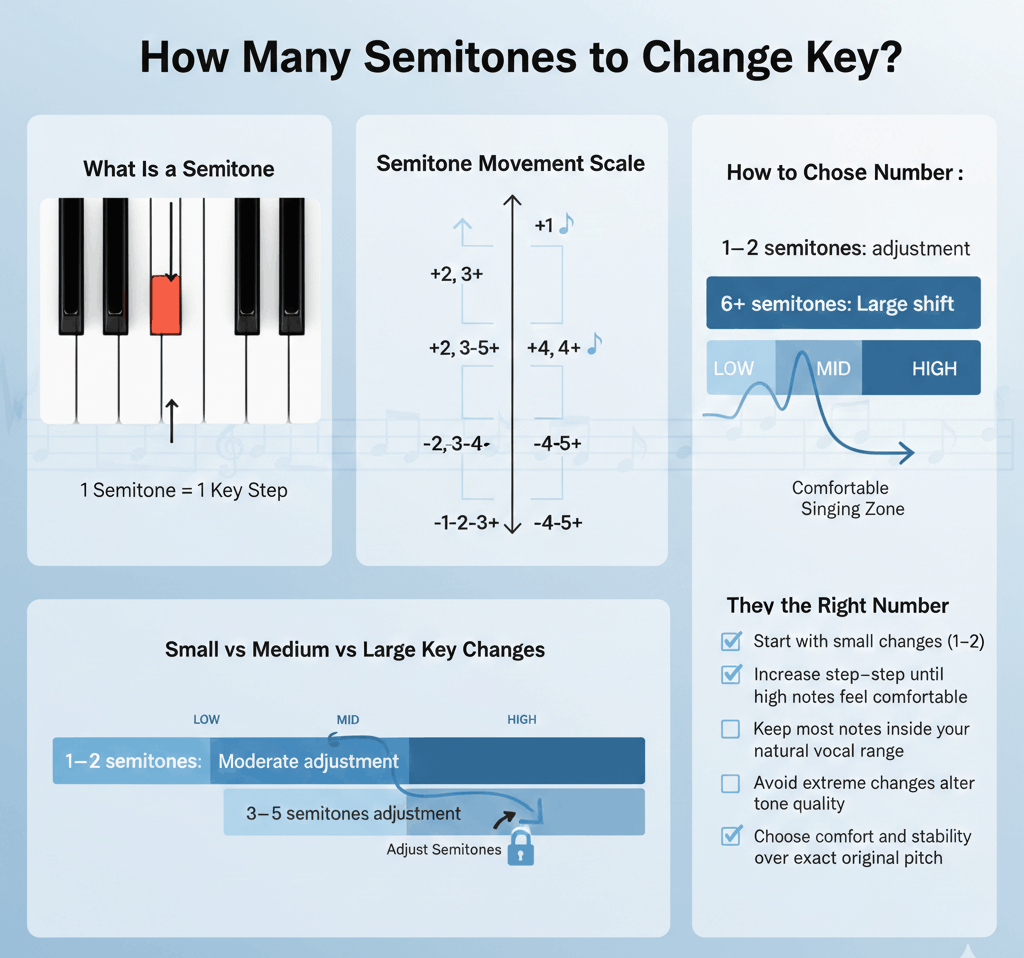
How Many Semitones Should You Change?
Most singers change a song by 1–3 semitones to find a comfortable key. Small adjustments usually solve pitch and strain issues without changing the character of the song.
Why this range works:
- One semitone is clearly noticeable
- Two to three semitones often remove strain entirely
- Small changes preserve the song’s natural sound
What Is a Semitone? (Simple Explanation)
A semitone (also called a half step) is the smallest standard distance between two notes in Western music.
Examples:
- C → C♯ = 1 semitone
- E → F = 1 semitone
There are 12 semitones in an octave. Changing a song by semitones simply moves everything up or down by that amount.
If you want a deeper breakdown:
What Are Semitones?
If you need to compare key changes without affecting timing, Online Pitch Changer’s pitch control keeps playback consistent.
Why Small Semitone Changes Make a Big Difference
Most songs don’t fail because they’re wildly out of range. They fail because:
- The chorus sits just above your comfort zone
- High notes repeat too often
- The melody hovers near a difficult register transition
Lowering or raising the song by just 1–2 semitones can:
- Reduce vocal strain
- Stabilize pitch
- Improve tone immediately
This is especially common when a song is too high for your voice.
Related guide:
Song Too High? How to Fix It
Typical Semitone Ranges (Real-World Guidance)
These are starting points, not rules.
- ±1 semitone → very small comfort adjustment
- ±2–3 semitones → most common and effective
- ±4–6 semitones → adapting across vocal types (e.g., female to male)
Larger changes are possible, but they often alter the character of the song more noticeably.
How to Choose the Right Number of Semitones (Step-by-Step)
Step 1: Focus on the hardest section
This is usually the chorus, not the verse.
Step 2: Start with −2 semitones
This is the most reliable first test for songs that feel too high.
Step 3: Sing the chorus multiple times
Ask:
- Does it feel easier?
- Is tone more stable?
- Less tension?
Step 4: Adjust by ±1 semitone if needed
Stop when the song feels comfortable and repeatable, not just barely reachable.
For a voice-specific approach:
Best Key for Your Vocal Range
Key Change vs Pitch Change (Why It Matters)
When people talk about “changing semitones,” they often mix up key change and pitch change.
- Key change = musical transposition (what singers want)
- Pitch change = frequency adjustment (the technical method)
Modern tools may use pitch shifting to achieve a key change, but the goal is always a musical key that fits your voice.
Clear explanation here:
Key Change vs Pitch Change
Change Semitones Without Changing Speed
To evaluate a key properly, the tempo must stay the same. Otherwise, the song feels unnatural and gives misleading feedback.
Use a method that lets you change pitch without changing speed, so you’re hearing the song as it would actually be sung.
For quick, precise testing:
Semitone Calculator
Common Mistakes to Avoid
Changing too much at once
→ Makes it hard to judge what actually helped
Judging after one run-through
→ Always test the chorus multiple times
Focusing only on the highest note
→ Comfort across the whole song matters more
- When working with visual lessons, a video key shifter lets you demonstrate pitch steps clearly.
- To experiment with semitone changes from online songs, try Online Pitch Changer for YouTube audio.
- For precise semitone testing on files, a simple MP3 key changer allows quick comparisons.
- During vocal practice, a karaoke pitch shifter helps find the most comfortable key.
Frequently Asked Questions
Is one semitone really enough?
Often, yes. One semitone can be the difference between strain and stability.
How many semitones is too many?
More than 6–7 semitones usually changes the song’s character significantly.
Is lowering better than raising?
Lowering is more common, but the correct direction depends on where the song sits in your range.
Do professional singers change keys this way?
Yes. Professionals routinely adjust songs by exact semitone amounts.
Final Takeaway
Most singers don’t need a new song—they need a better key.
If a song feels almost right:
- Start with −2 semitones
- Adjust by ±1
- Choose comfort over theory
Small, precise semitone changes are the fastest way to sing better—without strain.
- If you need a quick reference, this simple overview explains how the steps between notes work.
- When you’re ready to try it out, this online tool lets you shift a track in just a few clicks.
- To better understand tonal movement, this clear comparison breaks down what actually changes.
- If your song feels strained, this helpful tip shows how to bring it down smoothly.
- For a hands-on approach, this step-by-step guide walks you through the process.
- When working on a phone, this mobile option keeps things simple.
- To adjust full tracks, this practical solution gives you flexible control.