
Our onlinepitchchanger lets you raise or lower the pitch of a song in seconds—but many users want to know what actually happens behind the scenes. Does it just speed the song up or slow it down? Does it damage audio quality? And how does it keep everything in sync?
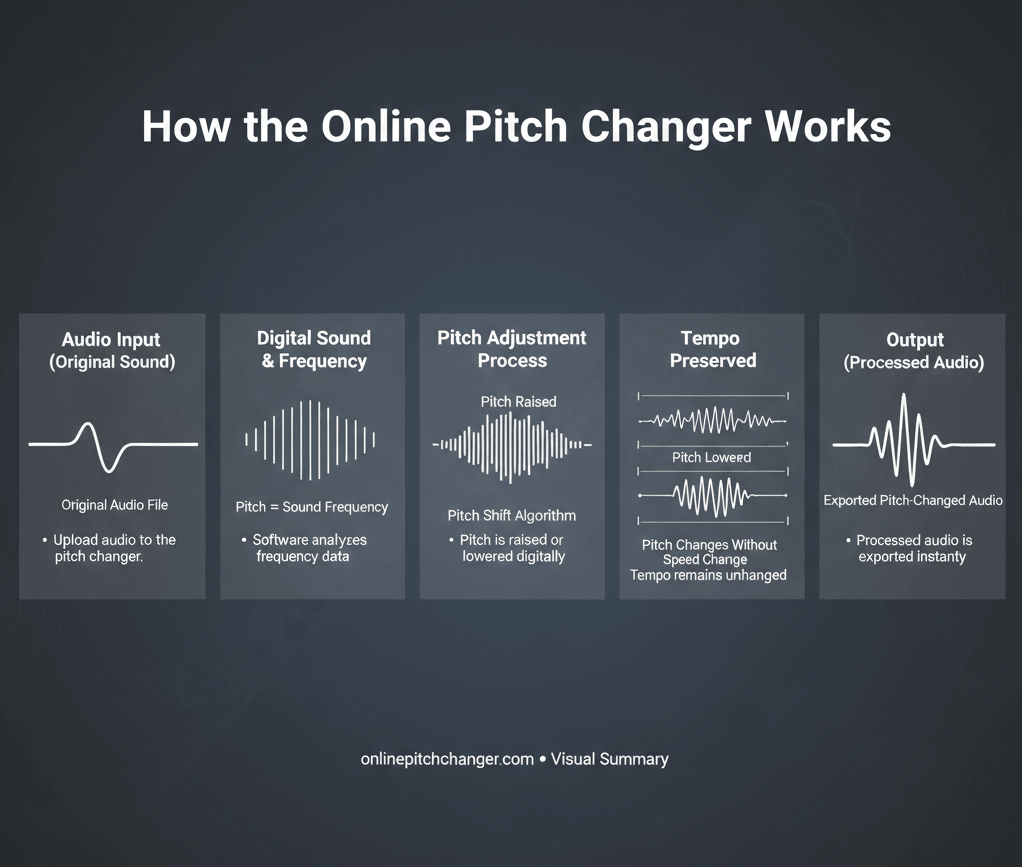
An online pitch changer works by digitally shifting the frequency of audio up or down, raising or lowering pitch without re-recording. It uses signal processing algorithms to modify tones while preserving timing, rhythm, and overall sound quality.
Use this tool if you’re looking for how to raise or lower audio pitch for free.
What Pitch Means in Digital Audio
Pitch describes how high or low a sound is, and it is determined by frequency.
- Higher frequency → higher pitch
- Lower frequency → lower pitch
When you change pitch, you are modifying the frequencies that make up the sound—not the timing.
Pitch is the perceived highness or lowness of a sound, determined by its frequency.
Pitch vs Tempo: The Most Common Confusion
Many people assume that changing pitch automatically changes speed. That used to be true with older, analog methods—but not with modern digital tools.
- Pitch = how high or low the sound is
- Tempo = how fast the audio plays
Modern online pitch changers treat pitch and tempo as separate parameters, which allows one to change without affecting the other.
Clear explanation:
Pitch vs Tempo: What’s the Difference?
How Pitch Is Changed Digitally (High-Level View)
Online pitch changers use digital signal processing (DSP) to alter audio safely and precisely.
At a high level, the tool:
- Analyzes the audio waveform
- Identifies pitch-related frequency components
- Shifts those frequencies up or down
- Reconstructs the sound at the new pitch
For musical accuracy, pitch is adjusted in semitones, the standard steps between musical notes.
- For voice-specific processing, the vocal tuning feature preserves natural tone while shifting pitch.
- Video files are handled through a built-in video pitch processor that adjusts audio without re-encoding visuals.
How the Online Pitch Changer Keeps the Speed the Same
To change pitch without changing speed, the tool combines pitch shifting with time-stretching.
In simple terms:
- Pitch information and timing information are separated
- Pitch is adjusted up or down
- Original timing is preserved
This is why a song can sound higher or lower while staying perfectly in time.
Step-by-Step: What Happens When You Use the Tool
Here’s what typically happens when you use an online pitch changer:
- You upload an audio file (MP3, WAV, etc.)
- The tool analyzes the waveform
- You select a pitch change (for example, −2 semitones)
- The audio is processed using pitch-shifting + time-stretching
- You download the adjusted file
Although this feels instant to the user, the processing ensures the song remains musically accurate and in sync.
Key Change vs Pitch Change (Why the Terms Overlap)
Technically, pitch change and key change are different ideas:
- Pitch change adjusts frequencies
- Key change is a musical transposition
Online pitch changers usually use pitch shifting to achieve a key change, which is why the terms are often used interchangeably.
Clear comparison:
Key Change vs Pitch Change
For singers and creators, the important part is the result: a song that fits the voice and still sounds natural.
Why Pitch Changes Sometimes Sound Unnatural
Pitch changes can sound artificial when:
- The adjustment is very large (usually 5–7+ semitones)
- Vocal formants are pushed outside natural ranges
- Low-quality algorithms are used
Smaller changes—especially 1–3 semitones—are usually very natural and ideal for singing practice, karaoke, and covers.
Is Using an Online Pitch Changer Safe?
Yes, when used properly.
Modern online pitch changers:
- Do not permanently alter your original file
- Preserve tempo and structure
- Are safe for practice, performance prep, and content creation
The key factor is moderation: smaller pitch adjustments preserve audio quality best.
- Streamed content is processed using Online Pitch Changer’s YouTube tool for real-time pitch changes.
- Uploaded audio files are converted via a dedicated MP3 pitch engine for accurate results.
- Practice tracks rely on a karaoke pitch system to shift keys while keeping backing music intact.
Frequently Asked Questions
Does changing pitch affect tempo?
Not with modern pitch-shifting tools. Tempo is preserved intentionally.
How many semitones can I change safely?
Most users stay within ±1–3 semitones for best quality.
Does an online pitch changer use AI?
Some tools use AI-assisted processing, others rely on advanced DSP. For small changes, the results are similar.
Can I use an online pitch changer on mobile?
Yes. Most online pitch changers work directly in a browser.
Final Takeaway
An online pitch changer works by:
- Digitally adjusting pitch (frequency)
- Preserving tempo using time-stretching
- Applying changes in musically accurate semitone steps
When used correctly, it is a safe, precise, and reliable tool—especially for singers who need fast key adjustments without installing software.
- To see the tool in action, this quick start lets you try it right away.
- If you want more details, this simple breakdown explains each step of the process.
- When you need to adjust audio files, this useful option handles most common formats.
- For vocal-specific tweaks, this dedicated tool offers more focused control.
- If you’re working with karaoke tracks, this handy feature makes fine-tuning easier.
- To better understand what’s changing, this clear explanation covers the basics.
- When tempo also matters, this practical solution lets you adjust both together.