
Many popular songs are written in female vocal keys, which often feel too high for male singers. The result is strain, unstable pitch, or choruses that feel just out of reach. The solution is not to force your voice—it’s to change the song to a male-friendly key.
To change a female song to a male key, lower the key by 3–8 semitones depending on your vocal range. Use transposition tools or pitch shifters to drop the key so high notes become comfortable without distorting the melody.
To instantly lower a song into a male-friendly range, try this simple pitch tool.
This guide explains what a female to male key change is, how many semitones to lower a song, and how to do it instantly while keeping the song natural and in time.
What Is a Female to Male Key Change?
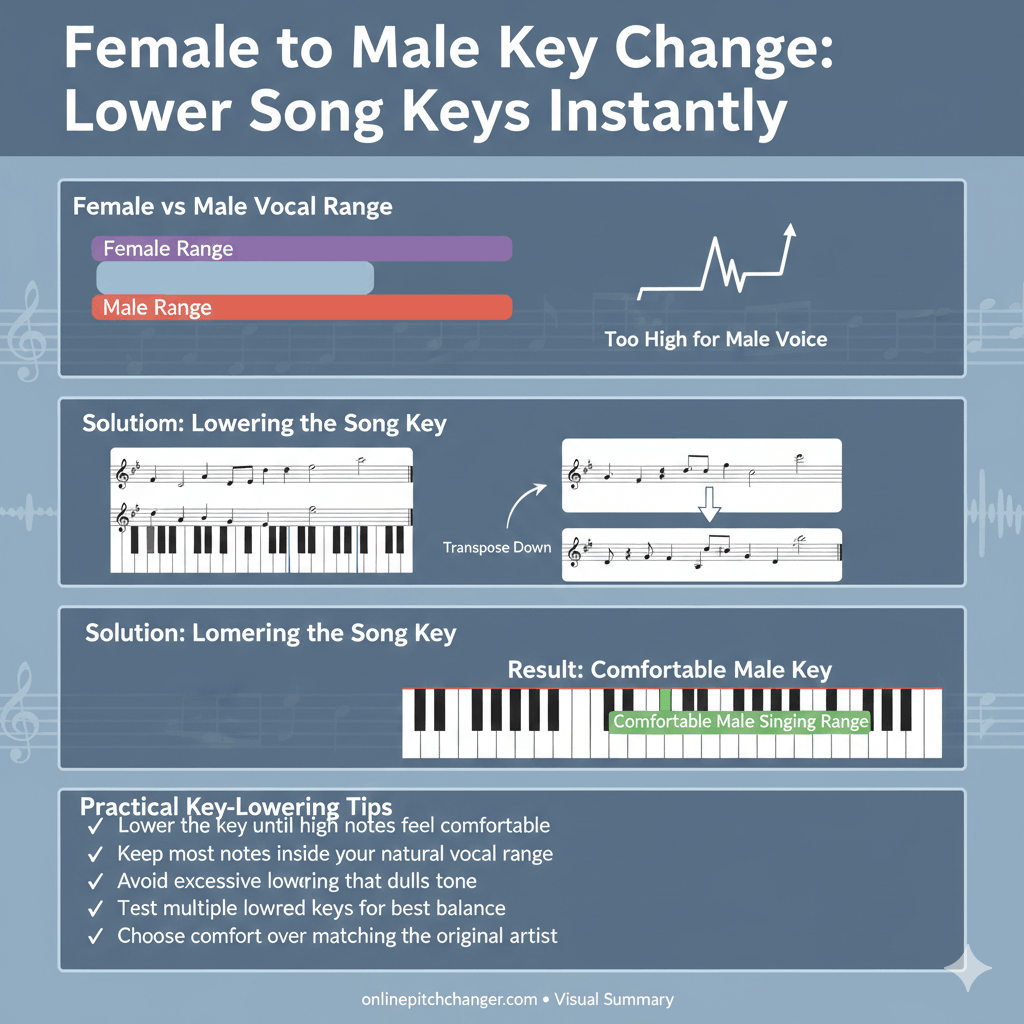
A female to male key change means lowering the key of a song originally written for female vocals so it fits a male vocal range more comfortably.
A female to male key change is the process of transposing a song down in pitch so that music written for female vocals can be sung comfortably by a male voice.
This adjustment preserves the song’s melody, harmony, and tempo—it simply moves everything lower.
Why Female Songs Feel Too High for Male Singers
Female-key songs are typically written to suit soprano or mezzo-soprano tessituras, where melodies sit higher for long stretches—especially in the chorus.
For male singers, this often causes:
- Strain on repeated high notes
- Pitch instability
- Fatigue after short practice sessions
If a song consistently feels uncomfortable, it’s likely the song is too high, not that your technique is failing.
Related guide:
Song Too High? How to Fix It
How Many Semitones Should a Man Lower a Female Song?
Most female-to-male key changes fall within a predictable range.
Typical starting points (not rules)
| Male Voice Type | Common Adjustment |
|---|---|
| Tenor | −2 to −4 semitones |
| Baritone | −3 to −6 semitones |
| Bass | −5 to −7 semitones |
Most male singers lower female-key songs by 3–5 semitones, then fine-tune from there.
The exact number depends on:
- Your tessitura (comfortable range)
- Where the chorus sits
- How long high notes are sustained
For precision:
How Many Semitones to Change Key?
Key Change vs Pitch Change (Important Distinction)
When lowering songs, many singers confuse key change with pitch change.
- Key change = musical transposition (best for singing)
- Pitch change = raw frequency adjustment
Modern tools often use pitch shifting to achieve a key change, but the goal for singers is always a musical key change, not just lowering sound.
Clear explanation here:
Key Change vs Pitch Change
How to Lower a Song Instantly (Without Changing Speed)
To test male keys properly, the song must:
- Stay in time
- Keep its natural feel
- Avoid sounding slow or fast
This requires a method that lets you change pitch without changing speed.
This allows you to:
- Try multiple male keys quickly
- Find the most comfortable option
- Practice or perform confidently
- For voice-focused adjustments, the vocal pitch editor makes transitions sound more natural.
- When working with performance clips, a video pitch adjuster lets you shift keys without re-editing audio.
Step-by-Step: Converting a Female Song to a Male Key
- Identify the problem section (usually the chorus)
- Lower the song by −3 semitones
- Sing through the chorus
- Adjust by ±1 semitone if needed
- Choose the key that feels stable, not just reachable
This “test-first” approach works better than guessing based on charts alone.
For a structured method tailored to your voice:
👉 Best Key for Your Vocal Range
Common Mistakes When Lowering Songs
Lowering too much at once
→ Can make verses feel weak or muddy
Ignoring tessitura
→ A song can still feel wrong even if the highest note is reachable
Changing tempo accidentally
→ Makes the song feel unnatural and harder to evaluate
Frequently Asked Questions
Do all male singers need the same key?
No. Male voices vary widely. Always test.
Will lowering a song ruin audio quality?
Small, controlled key changes preserve quality well.
Can I lower karaoke or backing tracks?
Yes—this is one of the most common uses.
Is it better to use a capo instead?
Capos help instruments, not prerecorded tracks.
Final Takeaway
A female to male key change is one of the fastest ways to sing more comfortably and confidently.
Instead of forcing high notes:
- Lower the key
- Preserve the song’s feel
- Match the music to your voice
Small adjustments—often just 3–5 semitones—can completely transform how a song feels to sing.
- To get a simple definition, this clear explanation walks through what the shift means.
- For understanding how keys work, this helpful overview breaks down the basics.
- When you need to calculate the drop, this useful guide shows how many steps to move.
- If a track still feels high, this practical tip explains how to lower it.
- To apply the change online, this easy tool lets you adjust the key in seconds.
- For vocal-focused edits, this dedicated option keeps the voice natural.
- To match the new key to your range, this clear resource helps you find the best fit.