
Pitch problems are one of the most common challenges singers face—at every level. You may feel confident with a song, yet still notice moments where notes sound sharp, flat, or unstable, especially in certain sections.
The key insight is this: most pitch problems are predictable, explainable, and fixable. They usually come from coordination issues, vocal fatigue, or songs that simply don’t fit your voice.
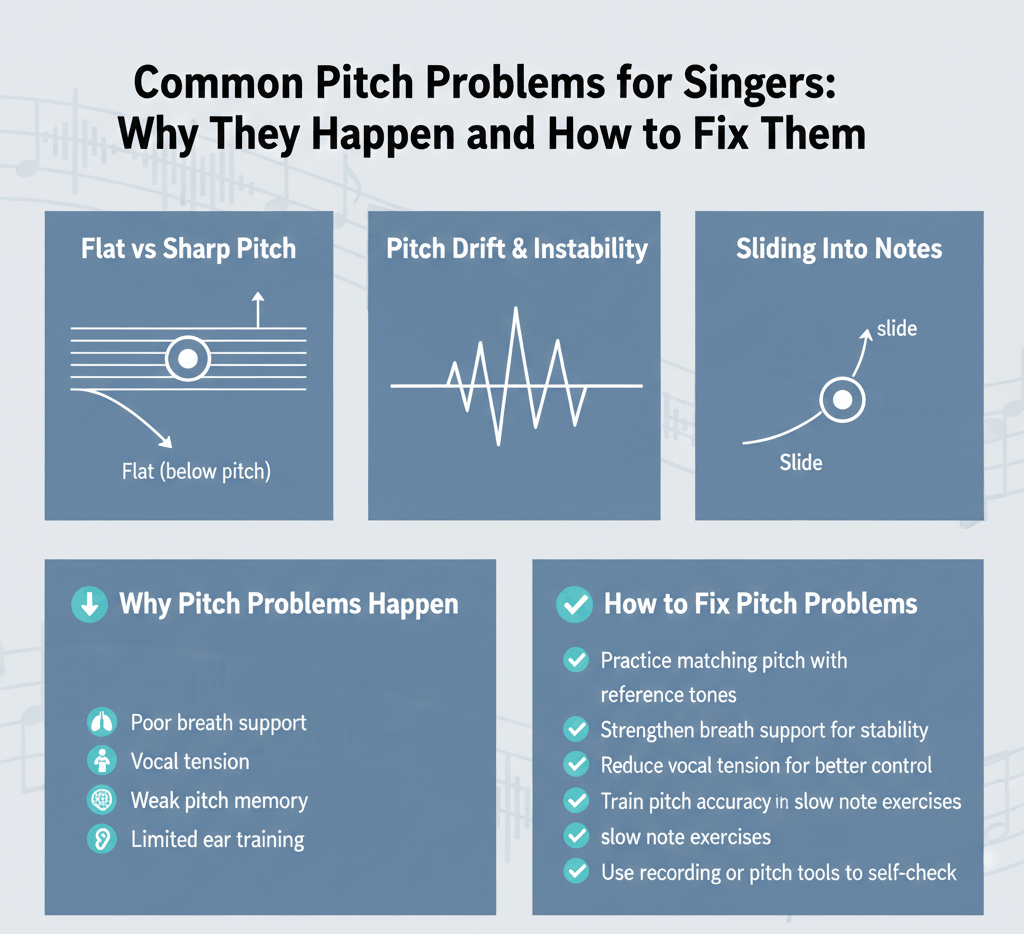
Common pitch problems in singers happen due to poor breath support, weak pitch memory, tension, or limited ear training. Fix them by strengthening breath control, practicing scales with a tuner, relaxing the voice, and training your ear to recognize accurate pitch.
This free tool works as a pitch changer for songs directly in your browser.
What Does It Mean to Sing Off Pitch?
Singing off pitch means your voice does not match the intended musical note.
- Singing flat: the pitch is lower than the target note
- Singing sharp: the pitch is higher than the target note
Singing off pitch occurs when a singer consistently sings notes slightly higher (sharp) or lower (flat) than the intended pitch, often due to breath, tension, coordination, or song-key issues.
Occasional pitch slips are normal. Repeated patterns are what matter.
When pitch issues are tied to timing or rushing, Online Pitch Changer’s pitch and tempo tool helps isolate whether speed is affecting intonation.
The Most Common Pitch Problems (and Their Real Causes)
1. Singing Flat at the End of Phrases
What it sounds like:
Notes start in tune but drop lower near the end of lines.
Why it happens:
- Running out of breath
- Loss of airflow consistency
- Vocal fatigue
As airflow weakens, pitch often falls. This is one of the most common pitch issues in singers.
2. Singing Sharp When Singing Louder
What it sounds like:
Notes rise sharp when volume or intensity increases.
Why it happens:
- Excessive breath pressure
- Throat or jaw tension
- Over-pushing chest voice
This frequently appears in choruses or emotional moments.
3. Pitch Drift on Sustained Notes
What it sounds like:
The pitch slowly wanders sharp or flat while holding a note.
Why it happens:
- Inconsistent airflow
- Tension changes mid-note
- Weak pitch awareness
Pitch drift is not an “ear problem” alone—it’s usually a coordination issue.
4. Pitch Problems on High Notes
High notes are a major trigger for pitch instability.
Common reasons:
- The song sits too high for your voice
- Register transitions are unbalanced
- Anticipation or fear causing tension
If high notes are consistently unstable, the issue may be that the song is too high for your vocal range, not that you lack technique.
Helpful reference:
Song Too High? How to Fix It
5. Pitch Problems on Low Notes
Low notes can be just as problematic.
Symptoms:
- Flat or breathy tone
- Difficulty matching pitch
- Weak resonance
This often occurs when a song sits below your comfortable tessitura.
Related guide:
Song Too Low? What to Do
6. Pitch Issues During Register Transitions
Many singers experience pitch slips when moving between chest, mix, and head voice.
Common signs:
- Cracks or sudden pitch jumps
- Brief sharpness or flatness
- Loss of control mid-phrase
These transitions require precise coordination and are a frequent source of pitch problems.
7. Pitch Problems That Only Appear When Recording
It’s very common to sound more “pitchy” on recordings.
Why this happens:
- Increased self-awareness
- Tension from headphones
- Hearing pitch more accurately than during live singing
This doesn’t mean your pitch got worse—it means you’re hearing it clearly.
How to Diagnose Your Pitch Problem
Use this simple process:
- Record a short verse or chorus
- Listen for patterns, not isolated mistakes
- Always flat at phrase ends?
- Sharp when louder?
- Unstable only on high notes?
- Match the pattern to the sections above
Once you identify the pattern, the solution becomes far more targeted.
For singers struggling with flat or sharp notes, the Online Pitch Changer vocal tool makes it easier to hear how small pitch adjustments affect vocal accuracy.
When Pitch Problems Are Really a Key Problem
Sometimes pitch issues persist because the song key does not fit your voice.
Signs the key is wrong:
- Repeated strain in the same sections
- Pitch problems only in the chorus
- Fatigue after short practice sessions
In these cases, no amount of drilling will fully fix the issue without adjusting the song.
Learn how to choose a better key:
Best Key for Your Vocal Range
Most singers improve pitch accuracy dramatically by adjusting a song just 1–3 semitones.
👉 Precision reference:
How Many Semitones to Change Key?
Practice Tip: Fix Pitch Without Changing the Feel of the Song
When testing new keys, the tempo must remain the same. Otherwise, the song feels different and gives misleading feedback.
Use a method that allows you to change pitch without changing speed, so you can evaluate comfort and control realistically.
Frequently Asked Questions
Why do I sing flat even when I try hard?
Most often due to breath loss or fatigue—not lack of ability.
Why do I go sharp when I belt?
Excessive air pressure or tension often pushes pitch sharp.
Can pitch problems be trained?
Yes. Pitch accuracy improves with awareness, coordination, and proper song keys.
Should I change the key if I keep going off pitch?
Yes. Adjusting the key is often the fastest and healthiest fix.
For singers who struggle to stay in tune during rehearsals, a karaoke pitch changer from Online Pitch Changer can make difficult songs more manageable.
Final Takeaway
Common pitch problems are not a talent issue.
They are signals—pointing to breath management, coordination, register balance, or song choice.
When you:
- Identify the pitch pattern
- Address the root cause
- Choose a key that fits your voice
Pitch accuracy improves faster, more consistently, and with far less strain.
- To understand what singers are dealing with, this clear explanation breaks down how pitch actually works.
- When notes feel uncomfortable, this helpful tip shows how to handle songs that sit too high.
- If everything sounds too low instead, this practical guide explains how to bring it back up.
- To match songs to your voice, this useful resource helps find the right key.
- For making quick fixes online, this easy tool lets you adjust vocal tracks.
- When you’re unsure how far to shift, this handy calculator gives you the exact change.
- To avoid confusion between adjustments, this simple comparison explains the difference.